

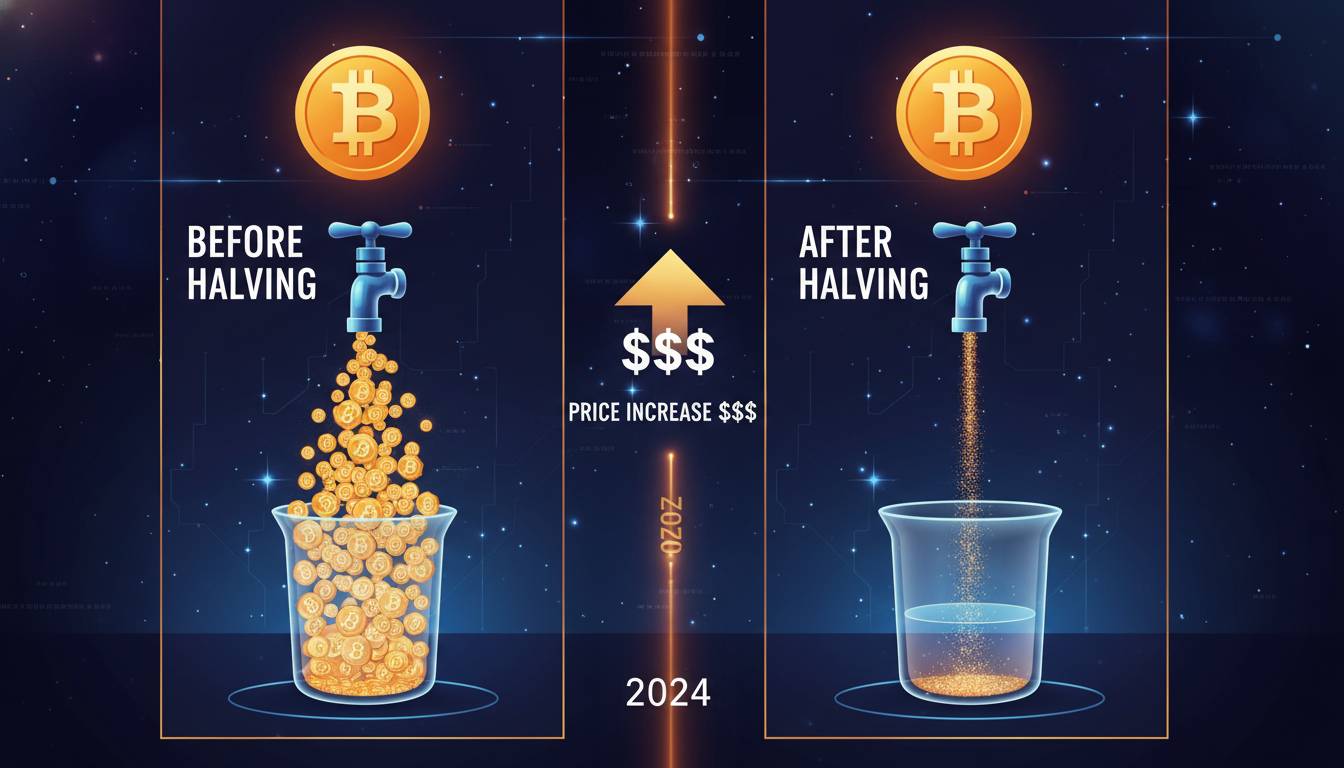
The Bitcoin halving scheduled for 2024 is one of the most talked-about events in crypto. As the leading digital currency approaches its fourth halving, investors and analysts are looking at historical patterns, current market conditions, and expert forecasts to guess what might happen next.
Understanding Bitcoin Halving
Bitcoin halving happens roughly every four years, after every 210,000 blocks are mined. Satoshi Nakamoto built this mechanism into Bitcoin’s code to control inflation and keep the total supply capped at 21 million coins.
When a halving happens, miners get 50% less Bitcoin for each block they add to the blockchain. This reduces the rate at which new Bitcoin enters circulation.
As of early 2024, more than 19 million Bitcoin have been mined. The last coins won’t be produced until around 2140. The 2024 halving will cut the block reward from 6.25 Bitcoin to 3.125 Bitcoin per block.
This matters because miners’ revenue drops in half. If Bitcoin’s price doesn’t rise to make up the difference, smaller or less efficient miners might shut down. Many people see this supply shock as a reason for prices to go up—but past performance doesn’t guarantee future results.
Historical Bitcoin Halving Performance
Looking at what happened after previous halvings gives some context, though each cycle is different.
The first halving happened on November 28, 2012, cutting the reward from 50 to 25 Bitcoin. Bitcoin was trading around $12. Twelve months later, it had climbed to over $1,100—a gain of more than 9,000%.
The second halving was on July 9, 2016, reducing the reward from 25 to 12.5 Bitcoin. Bitcoin was at roughly $650. Over the next 18 months, it surged to nearly $20,000 in December 2017—a roughly 3,000% increase.
The most recent halving occurred on May 11, 2020, dropping the reward from 12.5 to 6.25 Bitcoin. Bitcoin was trading around $9,000. It then climbed to over $64,000 in April 2021—about a 600% gain.
These numbers are eye-catching, but the market has changed a lot since then. Institutional players are now involved, the regulatory landscape has shifted, and the overall market is much larger. All of this could mean different outcomes this time.
The 2024 Bitcoin Halving: Key Dates and Market Context
The 2024 halving is expected in April or May, though exact timing depends on how fast blocks are being mined. In early 2024, Bitcoin was trading between $40,000 and $50,000—nowhere near its all-time high of nearly $69,000 from November 2021.
This lower starting point matters. Previous bull runs launched from different price levels, and the market was much smaller.
What’s different now? For one, institutional adoption has accelerated. Major financial institutions now offer Bitcoin through various investment products. The approval of Bitcoin ETFs in early 2024 made it easier for big money to get exposure.
Regulatory scrutiny has also increased. Governments worldwide are developing rules for crypto. The SEC has taken enforcement actions against several crypto firms, while the EU implemented MiCA regulations. These rules could push prices up or hold them back—it’s hard to say.
Mining has also become more corporate. Large operations and publicly traded companies now dominate the industry. The halving will squeeze less efficient miners, likely triggering some consolidation.
Bitcoin Halving 2024 Price Prediction: Expert Forecasts
Analysts have all kinds of predictions. Here’s where different people land:
Bull case: Some think Bitcoin could hit $100,000 or even $150,000 in the year or two after the halving. They point to the historical pattern, more institutional money getting in, and potentially favorable economic conditions like monetary easing.
Base case: More moderate forecasts put prices in the $75,000 to $100,000 range. These acknowledge growth potential but also account for headwinds.
Bear case: Others warn of disappointment—maybe Bitcoin drops to $30,000-$40,000 or lower. They highlight that previous halvings happened in very different economic environments. If interest rates stay high, or if regulators crack down, or if the broader market pulls back, Bitcoin could underperform.
The honest answer is that nobody knows for sure.
Factors Influencing Post-Halving Price Movements
Several things will determine what actually happens with Bitcoin’s price after the halving.
Mining economics is fundamental. Halving the block reward cuts miner revenue in half. If Bitcoin’s price doesn’t rise enough to compensate, less efficient miners will drop out. This could lower the network’s hash rate and affect security. If prices do rise, mining might stay profitable despite the reduced output.
Broader market conditions matter a lot. Bitcoin tends to move with other risk assets. If the economy heads into recession, or if central banks keep monetary policy tight, Bitcoin’s gains could be limited. On the flip side, economic recovery or monetary easing could boost risk assets, including Bitcoin.
Regulation is a big unknown. Clear, supportive rules could bring more institutional money in. Hostile rules could slow things down. Various governments are still figuring out their approach.
Institutional adoption continues to evolve. More corporate treasury purchases, more financial products, and more integration with traditional finance could create demand that pushes prices higher.
Expert Opinions on the 2024 Halving
Analysts have different takes:
Some emphasize the structural case for higher prices. With new supply cut in half, there’s a fundamental supply-demand imbalance that could push prices up—if demand stays steady or grows. This pattern has held in the past, though there’s no guarantee it will again.
Others are more skeptical. They note that Bitcoin is now much bigger, making percentage gains like those from 2012 or 2016 harder to achieve. The market has also gotten more sophisticated, with algorithmic trading and institutional players—potentially changing how price moves unfold.
Technical analysts look at charts and indicators. They watch support and resistance levels, trading volume, derivatives open interest, and on-chain metrics. These tools can help identify likely trading ranges, though nothing is certain.
Timeline Expectations for Price Movements
History suggests the biggest gains don’t happen right away. The major price increases typically came 12 to 18 months after each halving.
In the immediate aftermath, expect some volatility. The market will adjust to reduced miner rewards. There might be a short-term dip—a “dead cat bounce” or temporary decline—before any sustainable rally takes hold.
The 6 to 12 months after the halving is when things should become clearer. As the reduced supply works through the system and as economic conditions become more obvious, Bitcoin’s direction should emerge. Anyone investing should be prepared for volatility—it’s just part of how crypto works.
Conclusion
The 2024 Bitcoin halving is a meaningful event. History suggests prices often go up after halvings, but that’s not a promise. The market is bigger, more regulated, and more institutional than ever before.
Predictions range all over the map—from new highs to significant declines. What actually happens will depend on mining economics, market sentiment, regulation, and the broader economy.
For anyone considering Bitcoin, the halving is a reminder of what makes it different: a fixed supply and programmed reductions. Whether that translates into higher prices this time around is still uncertain, but the event will definitely shape market dynamics for months to come.
Frequently Asked Questions
When is the Bitcoin halving 2024 expected to occur?
The 2024 halving is expected in April or May, though the exact date depends on block production speeds. It triggers automatically after 210,000 blocks since the last halving, so timing varies slightly.
What price predictions do analysts have for Bitcoin after the 2024 halving?
Predictions vary widely. Bull cases go as high as $150,000, base cases target $75,000-$100,000, and bear cases warn of drops to $30,000 or lower. The spread reflects real uncertainty about what drives crypto prices.
Does Bitcoin halving always result in price increases?
Historically, yes—each of the three previous halvings was followed by major gains over the next 12-18 months. But past results don’t guarantee future performance. The market is fundamentally different now.
How much will the Bitcoin block reward decrease in 2024?
The reward drops from 6.25 to 3.125 Bitcoin per block—a 50% reduction that cuts the rate of new supply creation in half.
What factors could prevent Bitcoin from rising after the 2024 halving?
Several things could hold prices back: bad regulatory news, economic problems like recession or high rates, weak demand, or simply the fact that Bitcoin is now a much larger market making big percentage gains harder.
How long after the halving does Bitcoin typically reach its cycle high?
Looking at history: the 2020 halving peaked around 12 months later, and the 2016 halving peaked about 18 months later. So 12-18 months seems to be the typical window.