
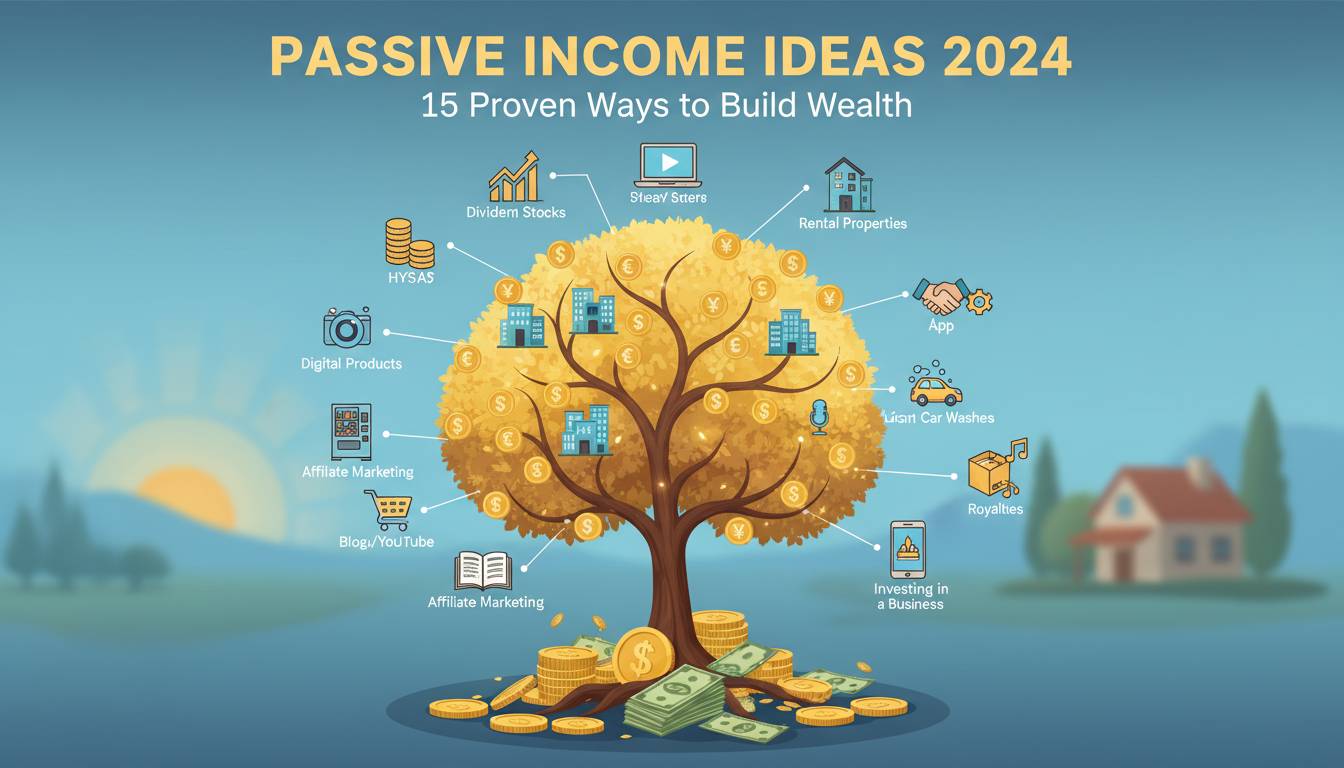
The idea of making money without constantly working for it has become increasingly appealing in 2024. With economic uncertainty, inflation, and remote work now mainstream, more people are looking for ways to earn beyond their regular paychecks. The good news? You don’t need a fortune to get started—some options below need almost nothing upfront.
This guide covers 15 passive income strategies that actually work in today’s market. Some require significant money to start; others just need time and effort upfront. Pick what fits your situation.
What Passive Income Means in 2024
Passive income is money you earn from something you set up once and then don’t have to actively work on daily. It’s not “free money”—there’s always some upfront work involved. But unlike a regular job, the income keeps coming after you’ve done the initial setup.
The IRS treats passive income differently from regular earnings for tax purposes, so it’s worth understanding those rules before diving in.
About 67% of Americans have thought about or actively pursue some kind of passive income, according to recent surveys. That’s a lot of people looking for alternatives to the traditional work-until-you-retire model.
High-Yield Savings and Money Market Accounts
This is the simplest option on this list. High-yield savings accounts at online banks currently offer around 5% APY—way better than the 0.5% you’d get at a typical big bank.
You set up the account, deposit money, and that’s it. Your principal is FDIC-insured up to $250,000 per depositor per bank. The main “work” involved is occasionally checking rates and moving money if a better offer comes up.
Money market accounts work similarly, often with limited check-writing privileges. These are great for emergency funds or money you might need soon—not for long-term wealth building, but a solid foundation for any passive income plan.
Dividend Investing Through Index Funds
Index funds are a popular way to build passive income, especially for folks who don’t want to pick individual stocks. The S&P 500 dividend yield sits around 1.5% right now, but many dividend-focused funds pay more.
The beauty here is instant diversification—you own pieces of hundreds of companies at once. Dividend growth funds specifically look for companies that consistently increase their payouts, so your income can grow over time. Warren Buffett famously recommends index funds for most individual investors, and it’s easy to see why: low fees, broad diversification, and solid long-term returns.
Most dividend investors use DRIP (dividend reinvestment plans) to automatically buy more shares when dividends pay out. This compounds your returns without any extra effort.
Real Estate Investment Trusts
REITs let you invest in real estate without becoming a landlord. The IRS requires them to pay out at least 90% of taxable income as dividends, so you’re looking at regular income distributions.
In 2024, REIT opportunities span residential, commercial, industrial, and niche sectors like data centers and healthcare facilities. Some areas—particularly e-commerce infrastructure and healthcare real estate—continue performing well even with economic uncertainty.
You can buy REITs through any standard brokerage, often with minimum investments under $100. They’re liquid (unlike actual property), professionally managed, and transparent about performance. If you want real estate exposure without dealing with tenants or repairs, REITs are worth considering.
Peer-to-Peer Lending
Peer-to-peer platforms like Prosper and LendingClub connect individual lenders directly with borrowers. This cuts out the bank, often resulting in better rates for borrowers and better returns for lenders—sometimes 5% to 8% annually.
You choose your risk level by picking which borrowers to fund based on credit scores and loan purposes. The catch: defaults happen. Historical default rates run 3-10% depending on economic conditions and your pickiness about who you lend to.
The smart play is spreading your money across lots of loans to minimize the impact of any single default. Most platforms offer automated tools to do this with minimal ongoing management.
Creating Digital Products
This is one of the most scalable options available—you create something once and sell it infinitely. E-books, online courses, templates, printables, photography, software—there’s a market for nearly everything.
Your costs are minimal: mostly platform fees and whatever time you spend creating. Once the product exists, selling more copies costs essentially nothing.
The downside? Competition is fierce, and getting noticed takes work. Many creators see first sales within weeks, but building meaningful passive income usually requires multiple products and ongoing marketing. The upside is the asymmetric risk—you can try with minimal investment and potentially see big returns.
Stock Photography and Video
If you have a camera or even a good smartphone, you can license photos and videos to agencies like Shutterstock, Adobe Stock, and Getty Images. Every download earns you a royalty.
The stock content market keeps growing as businesses need visual assets for websites, social media, and ads. Video content is particularly in demand right now.
Here’s the reality: you need volume to make real money. Top contributors often have libraries exceeding 1,000 images. But once you build that library, uploads keep generating income indefinitely with zero additional work. Learn SEO for your descriptions and understand seasonal trends to maximize earnings.
Affiliate Marketing
Affiliate marketing means promoting products and earning a commission when people buy through your link. The US market exceeds $12 billion annually, with opportunities in virtually every category.
The key is building authority in a niche and creating content that attracts an audience. Product reviews, comparisons, and tutorials work well. Amazon’s affiliate program is beginner-friendly, while networks like ShareASale and CJ Affiliate connect you with bigger brands.
Expect to put in 12-24 months of consistent content creation before seeing meaningful income. But properly optimized content can keep generating traffic and commissions for years—a true passive setup once established.
Dropshipping
Dropshipping lets you sell products without holding inventory. The supplier stores and ships items directly to customers. You handle marketing and customer acquisition; they handle the rest.
Shopify and similar platforms have made this much easier to set up. The challenge is finding reliable suppliers—fulfillment problems destroy customer satisfaction and your reputation.
Profit margins typically run 15-30%, though popular categories are competitive. Finding underserved niches and building a brand helps protect against price wars. It’s not completely passive (marketing and customer service still require attention), but well-established operations need far less daily work than traditional retail.
YouTube Channel
YouTube ad revenue can be substantial for creators who build large audiences. Top creators earn millions, but the path there requires significant effort upfront.
You need 1,000 subscribers and 4,000 watch hours to monetize through the Partner Program. Beyond ads, successful channels earn from sponsorships, merchandise, and memberships—often more than ads alone.
The honest truth: most creators spend months or years before reaching monetization. But once videos are live, they keep generating views and income indefinitely. Success depends on consistent uploads, search optimization, and creating content people actually want to watch.
Renting Property
Rental property is one of the oldest passive income strategies, offering tangible assets, regular cash flow, and potential appreciation.
Airbnb and VRBO have expanded possibilities beyond traditional leases, letting owners capture premium rates during high-demand periods. This requires more active management but often yields better returns.
Property management companies handle everything—tenant screening, maintenance, rent collection—for 8-12% of collected rent. This gets you closer to true passive income while keeping ownership benefits.
Mobile Applications
Successful apps can generate years of revenue through sales, subscriptions, or advertising. The global app economy exceeds $120 billion in consumer spending annually.
The challenge is standing out. Millions of apps compete for attention, and most fail. Successful apps solve specific problems or offer unique value. Discoverability depends on reviews, ratings, and search optimization.
Maintenance needs vary. Simple utilities might need minimal updates; complex apps require ongoing work. Development costs can be significant unless you can build yourself.
Self-Publishing Books
Amazon Kindle Direct Publishing has opened book authorship to anyone. You retain higher royalties than traditional publishing and reach global audiences in both e-book and print-on-demand formats.
Successful self-publishers treat it as a business—releasing series, building newsletters, and investing in professional editing and covers. Series writing tends to perform best by building loyal readers and increasing discoverability.
E-book royalties run 35-70% of sale prices depending on pricing and format. Building an audience matters enormously—most self-published authors with meaningful income have multiple books and active promotion.
Domain Name Investing
Domain investing involves buying web addresses and holding them for resale or lease. Premium domains—short, memorable, or keyword-rich—can sell for millions. More commonly, investors build portfolios generating smaller annual revenues.
This is a long game. Holding periods often measure years before profitable sales. Capital requirements are lower than real estate, and you can build portfolios incrementally.
GoDaddy Auctions and Namecheap facilitate buying and selling. Understanding brand naming conventions and industry trends helps identify domains with potential.
Investing in Small Businesses
Platforms like Main Street and SeedInvest connect investors with businesses seeking growth capital. You can invest as an accredited investor or through regulation crowdfunding (with limits on annual amounts).
These platforms do due diligence on businesses, reducing your research burden. Returns depend heavily on business success—there’s real risk of losing money. But successful investments can yield multiples of initial capital, significantly exceeding public market returns.
Private investments are illiquid, so only invest money you won’t need for years.
Frequently Asked Questions
What’s the easiest passive income to start in 2024?
A high-yield savings account. Just set it up with an online bank. No expertise, no ongoing work, FDIC-insured returns. Done.
How much money do I need?
It varies wildly. Digital products and affiliate marketing can start with almost nothing. Real estate needs significant capital. Many strategies work with under $100—savings accounts, peer-to-peer lending, content creation platforms.
Can passive income replace my job?
Possible, but it usually takes years and often significant upfront money. Build gradually while keeping your regular income, then transition when passive earnings approach your salary.
Is it truly passive?
Almost all passive income requires some ongoing attention—maintenance, occasional content creation, periodic rebalancing. Completely hands-off income is rare.
How long until I see meaningful income?
Usually 12-36 months depending on strategy. Financial investments often generate income faster but need more money. Content and digital products take longer but can become highly passive once established.
What about taxes?
Treatment varies significantly. Dividends and capital gains often get favorable rates; rental income and interest are taxed as ordinary income. Each type has specific rules. A tax professional can help optimize your situation.
Conclusion
The opportunities for passive income in 2024 are genuinely more accessible than ever. Whether you want to put $50 into a high-yield savings account or invest years building digital products, there’s a path that fits your resources and goals.
The real insight: success requires patience and realistic expectations. These aren’t get-rich-quick schemes. Most take 1-3 years of consistent effort before generating meaningful returns. The strategies in this guide have worked for many people, but results vary based on your situation, execution, and luck.
Start somewhere. Diversify. Stay consistent. That’s how actual wealth gets built.