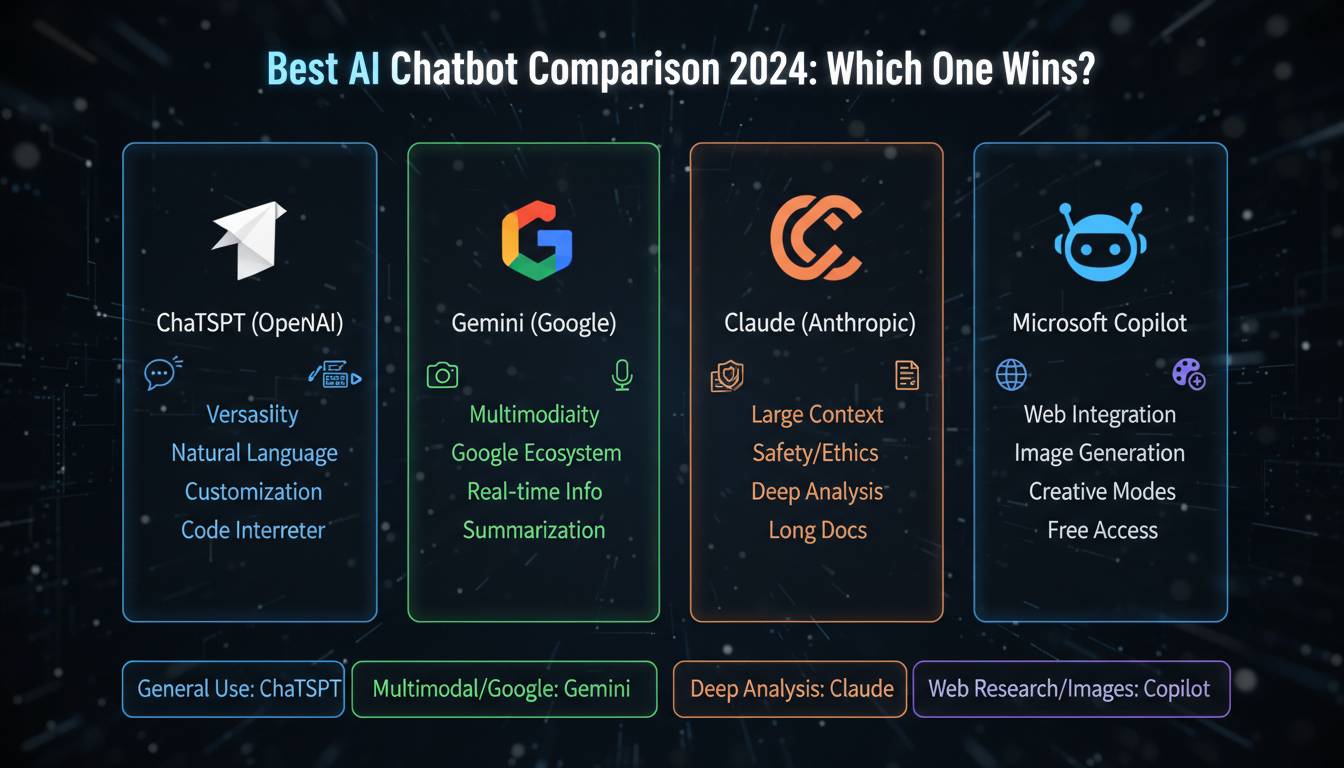
The AI chatbot landscape shifted dramatically in 2024. Competition heated up among major tech companies and a growing field of startups. OpenAI still leads with ChatGPT, but Google rebuilt Gemini from the ground up, Anthropic pushed Claude toward mainstream relevance, and Microsoft found its angle with enterprise integration. If you’re shopping for an AI chatbot, the options are genuinely better than they were a year ago—but also more confusing.
This guide breaks down what matters: capability, pricing, what each tool actually does well, and which one fits your workflow. No fluff, no sponsored placements, just practical analysis.
Understanding the Current AI Chatbot Landscape
Since ChatGPT exploded onto the scene in late 2022, the market has matured fast. We’re past the hype cycle and into the phase where companies compete on actual differentiation—specialized features, pricing tiers, and specific use cases rather than just claiming to be “the smartest.”
Industry analysts project the conversational AI market will surpass $18 billion by 2026. That’s real money driving real investment across the space.
The field has settled into recognizable tiers. ChatGPT leads in adoption and general capability. Claude emphasizes safety, lengthy documents, and thoughtful responses. Gemini integrates with Google’s productivity suite. Microsoft Copilot plays to enterprise customers already using 365. Meanwhile, Perplexity carved out a niche in research, and open-source options like Llama 3 and Mistral give developers alternatives to the corporate players.
What matters most is understanding which chatbot handles your specific needs—creative writing, coding, research, business tasks—better than the others. That depends on their underlying architecture, training priorities, and optimization decisions.
Quick Comparison Table
| Chatbot | Developer | Best For | Pricing | Context Window |
|---|---|---|---|---|
| ChatGPT 4o | OpenAI | General use, versatility | Free / $20/month | 128K tokens |
| Claude 3.5 | Anthropic | Long documents, analysis | Free / $20/month | 200K tokens |
| Gemini Ultra | Multimodal, research | Free / $20/month | 1M tokens | |
| Copilot | Microsoft | Productivity, enterprise | Free / $10/month | 128K tokens |
| Llama 3 | Meta | Open-source, developers | Free | 8K tokens |
| Mistral | Mistral AI | Coding, efficiency | Free | 32K tokens |
| Perplexity | Perplexity AI | Research, citations | Free / $20/month | 90K tokens |
| Grok | xAI | Witty responses, X integration | $16/month | 131K tokens |
ChatGPT 4o: The Industry Leader
OpenAI’s ChatGPT remains the most popular AI chatbot worldwide, with over 180 million users as of mid-2024. GPT-4o (“omni”), released in May 2024, processes text, audio, and visual inputs within a single model—a meaningful technical leap.
The strength here is versatility. ChatGPT handles creative writing, coding, data analysis, and philosophical discussion about equally well. The free tier gives you solid capability. The $20/month Plus subscription adds priority access during busy periods, voice features, and early access to new releases. The 128,000-token context window lets you drop in lengthy documents and discuss them in one conversation.
The ecosystem matters too—DALL-E for image generation, Code Interpreter for running analysis code, and the broader OpenAI roadmap all factor into the platform’s appeal. The tradeoff is that ChatGPT sometimes plays it too safe, refusing reasonable requests to avoid policy violations. And the knowledge cutoff means it doesn’t know about events after its training date.
Claude 3.5 Sonnet: The Analysis Champion
Anthropic built Claude into a serious competitor, especially for analysis, writing, and processing long documents. The 3.5 Sonnet model, released June 2024, improved performance while maintaining Anthropic’s focus on helpful, harmless, honest responses.
The 200,000-token context window stands out. That’s significantly larger than competitors, making Claude ideal for reading legal contracts, research papers, or entire books in a single session. It handles nuanced reasoning well and writes more naturally than some alternatives—not as stiff, if that makes sense.
The free tier works fine for casual use. The $20/month Pro plan adds priority processing and five times more usage. Anthropic also launched Claude Team for businesses, with admin controls and usage analytics. The Constitutional AI approach produces responses that feel more thoughtful, less prone to knee-jerk refusals.
Gemini Advanced: Google’s Multimodal Powerhouse
Google built Gemini from the ground up as a multimodal model—reasoning across text, images, audio, and video in one system. Previously called Bard, the rebranded Gemini gained serious capability with Ultra 1.0, now competing directly with GPT-4 in most benchmarks.
Gemini Advanced, bundled with Google One AI Premium at $20/month, offers a million-token context window. That’s the largest of any mainstream chatbot, letting you feed it massive documents or multiple files at once. Integration with Google Workspace (Docs, Sheets, Gmail) makes it seamless if you’re already living in Google’s ecosystem.
The research angle is strong—Gemini pulls current information and cites sources, unlike chatbots stuck with older knowledge cutoffs. Image generation is included, though results vary. The real advantage is access to Google’s search infrastructure and real-time information no other chatbot matches.
Microsoft Copilot: Enterprise Integration Leader
Microsoft found Copilot’s niche by embedding it deeply into Microsoft 365. If your company runs Word, Excel, PowerPoint, Outlook, and Teams, Copilot lives right inside those apps—summarizing meetings, drafting emails, building spreadsheets, creating presentations from existing documents.
The $10/month price undercuts competitors. Enterprise customers get compliance certifications, data privacy guarantees (Microsoft won’t use your data for training), and admin controls for organization-wide deployment. It’s the obvious choice if you’re already invested in Microsoft 365.
The tradeoff: general capability lags slightly behind ChatGPT and Claude in some benchmarks. And the tight Microsoft integration can feel restrictive if you prefer working across different platforms.
Open-Source Alternatives: Llama 3 and Mistral AI
Open-source AI chatbots gained real momentum in 2024. Meta’s Llama 3 and Mistral AI offer free alternatives you can run locally—which means better data privacy and customization than proprietary services.
Llama 3, released April 2024, approaches GPT-4 level performance while staying free. It codes well and handles reasoning tasks impressively, though the default 8,000-token context window limits how much you can feed it at once. Developers can run it locally or access it through various platforms.
Mistral AI, the French startup that attracted major investment, uses a mixture-of-experts architecture that delivers strong performance with less computational overhead. It’s efficient and accessible.
Both require more technical setup than clicking a website, but the flexibility pays off for developers and privacy-focused users.
Specialized Chatbots: Perplexity and Grok
Beyond general-purpose chatbots, specialized tools emerged for specific needs.
Perplexity AI targets researchers. It cites sources for every claim and pulls real-time information—functioning as an AI-powered search engine. If you’re doing academic work, journalism, or fact-checking, this matters. You see where the information comes from.
Grok, from xAI (Elon Musk’s company), takes a different approach—designed to be funnier and less filtered than competitors. At $16/month through X Premium+, it appeals to users wanting a casual AI or current information through X integration.
Jasper AI still serves marketing teams, offering templates optimized for copy, blog posts, and social media. It’s pricier (starting around $49/month) but justified if your team lives in marketing workflows.
How to Choose the Right Chatbot
Your choice depends on what you need, what ecosystem you’re already in, and what you want to spend.
What matters most to you? For general versatility, ChatGPT 4o is the safe default. For lengthy documents, Claude’s context window genuinely helps. For research, Gemini or Perplexity provide current information and citations.
What’s your ecosystem? Microsoft 365 users get real value from Copilot integration. Google Workspace users fit naturally into Gemini. If privacy or customization matters, look at Llama 3 or Mistral.
Budget: Most premium tiers landed at $20/month. Free versions from ChatGPT, Claude, and Gemini work well for casual use. Enterprise pricing varies by deployment size and security needs.
Performance: For everyday tasks, the differences between top models are small. Specific advantages emerge in specific areas—Claude for analysis, Gemini for multimodal, Copilot for productivity workflows.
Frequently Asked Questions
Which AI chatbot is best for coding in 2024?
ChatGPT 4o and Claude 3.5 Sonnet lead in coding. Both generate code, debug issues, and explain programs across many languages. Llama 3 is impressive for a free option if you’re comfortable with the technical setup.
Are there reliable free AI chatbots available?
Yes. ChatGPT’s free tier uses GPT-3.5 with reasonable limits. Claude’s free version has usage caps. Gemini works free with a Google account. Each has tradeoffs—speed, usage limits, or features—but all are genuinely useful.
Which chatbot has the longest context window?
Gemini Advanced wins at one million tokens. Claude comes second at 200,000. That’s the main reason to pick Gemini if you regularly analyze huge documents.
Can AI chatbots be used for business purposes?
All major chatbots offer business tiers with security, compliance, and admin features. Copilot targets enterprise specifically. ChatGPT Team and Claude Team work for businesses. Just check privacy policies, especially for sensitive work.
How do AI chatbots handle privacy and data security?
Providers improved significantly. Microsoft says it won’t use customer data for training. Anthropic emphasizes safety through its Constitutional AI approach. Review specific policies, and consider open-source options if data handling is a concern.
Will AI chatbots replace traditional search engines?
Not completely. Perplexity and Gemini offer search-like AI responses, but traditional search still works better for navigation, shopping, and certain queries. The integration of AI into search results seems more likely than total replacement.
Conclusion
The chatbot landscape in 2024 offers genuinely good options at every price point. ChatGPT 4o leads through breadth and ecosystem. Claude 3.5 excels at analysis and long documents. Gemini makes sense for Google users. Copilot delivers enterprise value through Microsoft integration.
Free options from multiple providers democratized access. Open-source alternatives like Llama 3 and Mistral give developers flexibility and privacy. The “best” chatbot depends entirely on what you need—coding, documents, research, productivity integration—rather than any universal ranking.
One thing to remember: this space moves fast. Providers ship quarterly updates that shift the rankings. Test several options through free tiers before paying. Your actual use pattern matters more than marketing promises.