
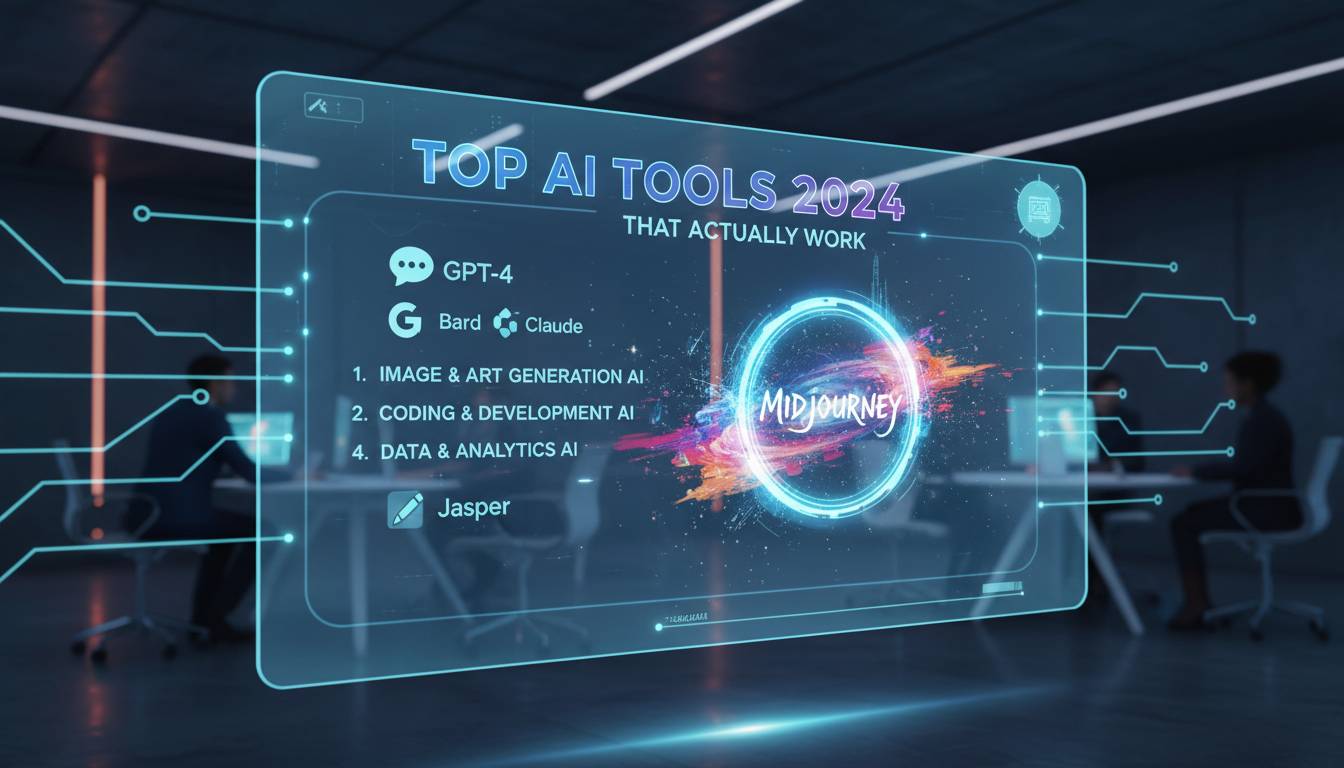
The AI landscape shifted dramatically in 2024. Tools became more accessible, more capable, and more woven into everyday work than ever before. Generative AI assistants now draft content in seconds. Image and video creation platforms churn out professional-quality visuals. Competition among providers heated up, which meant better products and cheaper prices for everyone. This guide looks at the most useful AI tools available now, breaking down what they do, how much they cost, and when they actually make sense to use.
The State of AI Tools in 2024
The AI tools market hit a turning point this year. More than 75 percent of enterprises now use some form of AI at work, up from roughly 50 percent in early 2023. Multiple large language models from different providers created a competitive environment. Consumers benefited through better features, lower prices, and more options.
OpenAI, Google, Microsoft, and Anthropic all released major updates to their platforms throughout 2024. Reasoning capabilities improved. Factuality got better. Context windows expanded. These changes made AI assistants genuinely more useful for complex tasks. Specialized tools also emerged for specific use cases, letting users find targeted solutions instead of relying on general-purpose assistants.
Many providers now offer free tiers or significantly reduced pricing for individuals. This opened AI up to freelancers, small business owners, and creative professionals who couldn’t justify enterprise pricing before. The result is an ecosystem where AI tools in 2024 serve a wide range of users with different needs and budgets.
Best AI Writing and Content Creation Tools
AI writing tools have matured significantly. Several platforms now lead the space, moving beyond simple text generation into comprehensive content assistance.
ChatGPT remains the most widely recognized AI chatbot. Recent versions offer strong reasoning and broad knowledge coverage. It handles casual questions and complex problem-solving. OpenAI keeps refining the model, fixing accuracy issues and expanding integration options.
Claude, from Anthropic, attracts users who value thoughtful, nuanced responses. Its Constitutional AI approach to safety appeals to people wanting reliable help for professional and creative work. The extended context window handles longer documents well, making it useful for research and analysis.
Jasper focuses on marketing copy, blog posts, and social media content. Brand voice customization keeps generated content consistent, which matters for marketing teams trying to maintain a unified tone.
Notion AI embeds artificial intelligence directly into the Notion productivity platform. Users can generate meeting summaries, brainstorm ideas, and polish documents without switching apps. Teams already using Notion for project management find this seamless integration especially convenient.
When choosing a writing tool, think about your specific use case, required accuracy, and how it fits with your existing tools. Many people use multiple tools for different tasks, playing to each platform’s strengths.
AI Image Generation Tools
Image generation advanced rapidly in 2024. Tools now produce increasingly realistic and stylistically diverse visuals. Designers, marketers, and content creators use these platforms to create high-quality assets without needing extensive graphic design skills.
Midjourney dominates conversations about AI image generation. Known for its distinctive artistic style and visually striking compositions. The community-driven development model led to fast improvements. Recent versions produce images that rival professional photography in many contexts.
DALL-E 3, OpenAI’s image model, got much better at understanding nuanced prompts and generating coherent, detailed images. Integration with ChatGPT for prompt refinement helps users who struggle to describe their visual ideas in technical terms.
Adobe Firefly brought AI generation into familiar creative tools like Photoshop and Illustrator. Professionals already using Adobe’s suite can access AI capabilities without learning entirely new workflows. Generated content comes with commercial usage rights, which matters for business use.
Canva AI brought image generation to a broader audience through its design platform. Users create visuals in the same interface they use for other design tasks. This accessibility opened AI image creation to people without technical backgrounds.
Legal and ethical questions around AI-generated images continue evolving. Copyright, disclosure requirements, and appropriate use cases remain subjects of ongoing discussion. Users should stay current on developments in these areas.
AI Video and Audio Production Tools
Video and audio AI tools became some of the most transformative technologies of 2024. Creators now produce professional-quality content with far less time and resources. These tools handle various production aspects, from scripting and voiceover to editing and post-production.
Runway established itself as a comprehensive video editing platform with powerful AI features. Generative fill, style transfer, and automated editing capabilities serve applications ranging from independent filmmaking to corporate video production. The platform continuously releases new features, keeping it at the forefront.
Synthesia specializes in AI-powered video creation using virtual presenters. Users generate videos with AI avatars speaking their scripts. This works well for corporate training videos, product demonstrations, and multilingual content where traditional video production would cost too much.
Descript changed podcast and video editing by letting creators edit media through text transcripts. AI-powered features include automatic transcription, filler word removal, and voice cloning for overdubbing. These features dramatically speed up post-production.
ElevenLabs gained recognition for voice cloning and synthesis technology. The platform creates natural-sounding voiceovers in multiple languages from text input. Applications span content creation, accessibility, and entertainment.
Expect continued growth and capability expansion in this category. Video and audio tools will likely become even more accessible to non-professional creators.
AI Productivity and Business Tools
Integrating artificial intelligence into productivity and business applications transformed how organizations work. These tools automate routine tasks and provide insights for decision-making, addressing needs across business functions from customer service to data analysis.
Microsoft Copilot integrated deeply into the Microsoft 365 ecosystem, providing AI assistance within Word, Excel, PowerPoint, and Outlook. Tight integration with existing workflows accelerated enterprise adoption. Features are designed specifically for business contexts.
Google Gemini (formerly Bard) offers AI capabilities across Google’s productivity suite, including Gmail, Docs, and Sheets. The ability to access real-time information and integrate with Google’s ecosystem makes it valuable for users invested in Google’s tools.
Grammarly evolved beyond grammar checking into a comprehensive writing assistant. Tone adjustment, clarity improvements, and generation capabilities now ship with the platform. Widespread adoption in professional settings established it as a standard tool for business communication.
Zapier AI enables automation workflows incorporating AI capabilities. Users build custom AI-powered processes without coding. This approach lets businesses create tailored solutions for their specific operational needs.
The productivity category sees significant investment from major tech companies and startups. New entrants regularly offer innovative approaches to AI-assisted work. Maximize value by identifying specific pain points in your workflows and selecting tools that address them directly.
How to Choose the Right AI Tools for Your Needs
Picking the right AI tools requires thinking beyond feature lists. Understanding your specific use cases, technical requirements, and budget constraints helps narrow down the options.
Start by identifying the main tasks you want the AI tool to handle. Different tools excel at different functions. A tool optimized for creative writing might not work well for data analysis. A coding assistant may lack the nuanced language capabilities needed for marketing copy. Many users get better results combining multiple specialized tools rather than using one general-purpose solution.
Consider the learning curve and integration requirements. Some platforms offer intuitive interfaces requiring minimal training. Others need significant time investment to use effectively. Also evaluate how well the tool integrates with your existing technology stack. Poor integration creates friction that undermines the productivity benefits of AI assistance.
Pricing varies widely across AI tools, from free tiers for exploration to enterprise plans costing hundreds monthly. Carefully evaluate features at each price level. Ask whether paid features justify the cost for your specific needs. Many platforms offer strong value at lower price points, so explore options thoroughly before committing to expensive subscriptions.
Frequently Asked Questions
What is the best AI tool in 2024?
The best AI tool depends entirely on your specific needs. For general conversation and reasoning, ChatGPT and Claude perform well. Midjourney and DALL-E 3 lead image generation. Microsoft Copilot and Google Gemini excel at productivity integration. Start by identifying your primary use case.
Are free AI tools worth using in 2024?
Free tiers from major AI providers have become remarkably capable and work well for many applications. ChatGPT’s free version, Claude’s free tier, and Google’s Gemini Advanced all offer substantial functionality without payment. Paid versions typically provide access to more advanced models and features, but free options handle basic needs adequately.
Which AI tools are most popular among professionals?
ChatGPT leads in overall adoption. Microsoft Copilot saw rapid uptake in enterprise environments due to Microsoft 365 integration. Midjourney remains popular among creative professionals. Notion AI gained traction with teams already using the productivity platform. Popularity often correlates with specific industry use cases.
What can AI tools help with in 2024?
AI tools now assist with content creation and editing, image and video generation, data analysis and research, coding and technical projects, customer service automation, language translation, summarization, and brainstorming. Capabilities continue expanding as models improve.
How much do professional AI tools cost monthly?
Pricing varies widely. Many platforms offer plans from free to around $20-30 monthly for individual users. Enterprise solutions cost more depending on features and user counts. Many tools offer annual billing discounts. Competition continues driving prices down while improving features.
Will AI tools replace human workers?
AI tools augment human capabilities rather than replace workers. They automate routine tasks and speed up workflows, but human oversight, creativity, and judgment remain essential for most professional applications. The most effective approach combines AI assistance with human expertise.
Conclusion
The AI tools available in 2024 represent a significant step forward in accessible, capable technology. Writing assistants help craft compelling content. Image generation tools bring visual ideas to life. Options exist for diverse needs and skill levels.
Successfully leveraging these tools means understanding your specific requirements and selecting solutions that fit your workflow. Don’t adopt technology for its own sake. Treat AI as a powerful assistant that amplifies your capabilities rather than a replacement for human creativity and judgment.
Continued competition among providers will drive further improvements in capability, accessibility, and value through the rest of the year. Staying informed about developments helps you identify opportunities to incorporate new capabilities into your work. The AI tools landscape in 2024 offers unprecedented opportunities for those willing to explore and experiment.