
Artificial intelligence has moved from sci-fi territory to something businesses actually use every day. Companies everywhere are dumping AI into their operations to cut costs, serve customers better, and stay ahead of competitors. Whether you’re running a five-person startup or managing a multinational, AI tools are no longer optional—they’re becoming table stakes.
The range of AI-powered stuff available now is honestly overwhelming. We’ve got tools that can crunch massive datasets, write marketing copy, predict what customers will do next, and help with decisions that used to require senior leadership. Picking the right ones for your specific business goals is becoming a skill set in itself.
This guide breaks down what actually works, based on how businesses are using these tools right now.
Understanding the AI Tools Landscape for Modern Enterprises
The AI tools market is exploding. Analysts say the global AI software market will hit $150 billion by 2025, with business apps growing fastest. That’s not just hype—companies are actually seeing returns, whether it’s cutting expenses or making money from new products.
Here’s how most business AI tools shake out:
Natural language processing (NLP) lets machines understand and generate human language. This powers chatbots, content generators, and anything involving text analysis.
Machine learning looks at historical data to spot patterns and make predictions. Think demand forecasting or catching fraud before it happens.
Computer vision helps computers make sense of images and video. Factories use it for quality control. Hospitals use it to analyze medical scans.
The good news: you don’t need a data center in your basement to use this stuff anymore. Cloud services from the big tech companies offer serious AI capabilities without huge upfront costs. Subscription pricing means even small businesses can afford tools that were once enterprise-only. Open-source options exist if your team has the skills to build custom solutions.
Leading AI Tools for Customer Service and Support
Customer service is where AI delivers the quickest wins. Chatbots handle the easy stuff—password resets, order status, basic questions—so your human agents can focus on problems that actually need a person.
Salesforce Einstein is the heavy hitter if you’re already in the Salesforce ecosystem. It plugs predictive analytics right into your sales and service workflows, telling you which leads are worth chasing and what to do next with each customer. The catch: you need Salesforce already, plus time to train the system.
Zendesk’s AI does solid chatbot work with its Answer Bot, which hunts through your help docs to answer questions automatically. When it gets stumped, it hands off to a real person smoothly. Expect to pay around $49 per user monthly to start, more for the full enterprise package.
Freshworks Freshdesk keeps things simple with its Freddy AI assistant. It routes tickets intelligently, suggests responses, and even picks up on customer sentiment. The pricing is friendlier for smaller teams—about $15 per agent monthly for basics.
AI Solutions for Marketing and Content Creation
Marketing teams are eating this up. AI writing tools pump out blog posts, social media updates, email sequences, and ad copy at speeds no human team can match. Still needs humans for strategy and brand voice, but the drafting phase gets way faster.
Jasper AI (formerly Jarvis) is probably the best-known option. It has templates for just about every marketing format and can learn your brand voice. Plans start at $49 monthly. Enterprise gets you team collaboration and API access for custom setups.
Copy.ai is better for short-form stuff—headlines, product descriptions, quick social posts. Has a free tier so you can test drive it before paying. Paid plans run $49 to $500 monthly depending on what you need.
HubSpot’s AI lives inside their marketing automation platform, which is convenient if you’re already using HubSpot for CRM. You get content suggestions, email optimization, and SEO tips without adding new tools to your stack.
Operational Efficiency and Automation Tools
AI is also fixing the messy stuff happening inside companies. Workflow automation now handles decision-making that used to need humans—not just following rules, but actually thinking through situations.
UiPath dominates the robotic process automation space. Their AI Center lets you build custom machine learning models for specific business needs. Pre-built models handle document processing, conversation analysis, and visual recognition. It’s enterprise-level stuff, so costs vary widely based on what you’re building.
Microsoft Copilot sneaks AI into the Microsoft 365 apps your team already uses. It summarizes Teams meetings, writes emails, builds PowerPoints, and digs into Excel data. If your company lives in Microsoft’s world, the $30 per user monthly price tag is a no-brainer.
Zapier connects thousands of apps with automated workflows, and its newer AI features actually suggest automations based on how you work. It’s getting smarter at figuring out what you want without you having to be a technical wizard. Pricing goes from free to $600 monthly for serious automation teams.
AI for Data Analytics and Business Intelligence
Every company is drowning in data. AI tools help you actually do something with it instead of just staring at spreadsheets.
Tableau (owned by Salesforce) added AI features like Explain Data, which automatically tells you why your charts look the way they do. The Salesforce connection helps if you’re already analyzing customer data. Pricing is per-user, annually.
Microsoft Power BI hooks into Azure and brings AI analysis to business users who don’t code. You can ask questions in plain English and get answers from your data. The free tier is surprisingly capable, which is why it’s so popular with smaller companies.
Google Looker plays nice with the Google Cloud world, especially BigQuery for serious data crunching. Looker Studio creates dashboards automatically from your data sources.
Strategic Implementation Considerations
Here’s where most AI projects tank: they pick a cool tool without thinking through whether their company is actually ready.
Data is usually the bottleneck. Machine learning models need clean, labeled data to work right. If your data is scattered across systems, inconsistent, or just thin, you’ll spend months fixing that before AI can help. This is why a lot of successful AI projects start with “let’s clean up our data” rather than “let’s buy AI.”
Integration is harder than it looks. The best AI tools integrate with what you already have, but some setups are messier than others. Check what connections are possible before you commit. The last thing you want is another standalone tool nobody uses.
Security matters more every day. AI tools often process sensitive customer data, which means you need to think about compliance. CCPA applies to a lot of companies now, plus industry-specific rules. Check vendor security practices, where data lives, and what certifications they have.
The Future of AI in Business Operations
The pace of improvement is crazy. Language models are doing things that seemed impossible last year, and that’s not slowing down.
The big shift coming: autonomous AI agents. These won’t just answer questions—they’ll actively pursue goals, make decisions, and handle multi-step processes with little supervision. We’re seeing early versions in customer service and coding, and it’ll spread fast.
Ethics and regulations are also getting real. Companies need to think about transparency, bias, and responsible AI use. Getting ahead of this isn’t just about avoiding fines—it’s about building trust with customers who are paying attention.
Conclusion
AI tools for business have hit the point where they actually deliver value, not just promises. The trick is picking what fits your situation—your goals, your budget, your team’s skills—rather than chasing the flashiest option.
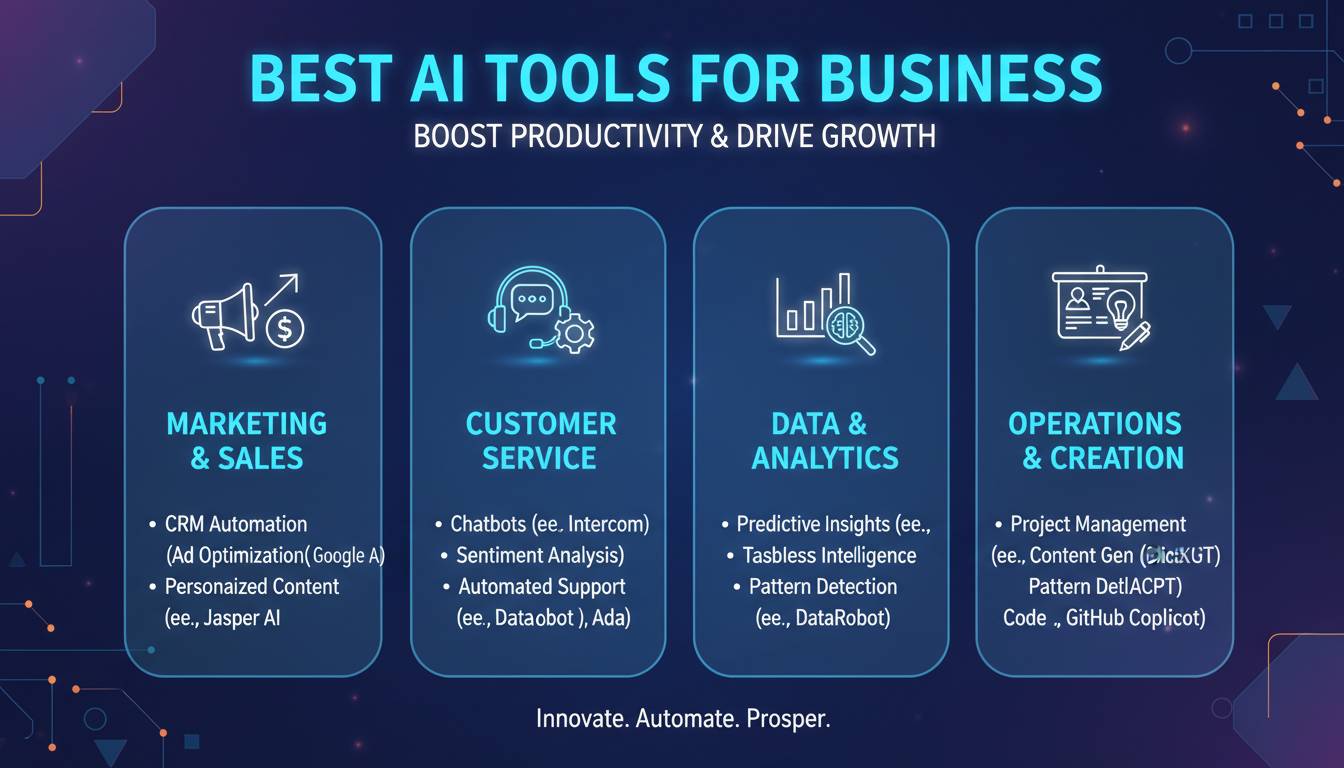
Customer service, marketing, operations, and analytics each have solid choices that work for different company sizes and budgets. Start with whatever pain point hurts most, try something small, prove it works, then expand.
The landscape will keep shifting as capabilities improve. Companies that figure out how to implement AI well now will have a huge advantage as the tech gets even better. This isn’t a one-time project—it’s an ongoing capability to build.
Frequently Asked Questions
What are the most essential AI tools for small businesses?
Start with what hurts most. Customer service chatbots, email automation, and basic analytics usually give the best bang for buck. HubSpot, Zapier, and ChatGPT all have free or cheap tiers that let you test things out without risking much.
How much do AI business tools typically cost?
All over the map. Basic AI features in existing business software might run $15-30 monthly per user. Full enterprise AI platforms can hit $100K+ annually. Most vendors scale pricing as you grow, so you can start small.
How long does AI tool implementation take?
Simple chatbots? Days. Enterprise-wide AI transformation? Months. Cloud tools with easy integrations often show value within weeks. Custom machine learning that needs data wrangling and model training? Figure 3-6 months minimum.
Do AI tools require technical expertise to use?
The trend is toward easier, but it depends. Basic features are built for regular users. Advanced stuff usually needs someone who knows what they’re doing. Most vendors offer training and support to help close the gap.
Can AI tools integrate with existing business software?
Usually yes. The big ecosystems—Salesforce, Microsoft, Google, Zapier—have tons of built-in connections. Just verify your specific setup during evaluation so you don’t buy something that won’t actually work with your systems.
What is the ROI timeline for AI business tools?
Depends on what you’re doing. Some companies see efficiency gains in a few months. Bigger transformations that change business models take years. Set milestones along the way so you can see progress and adjust course.