
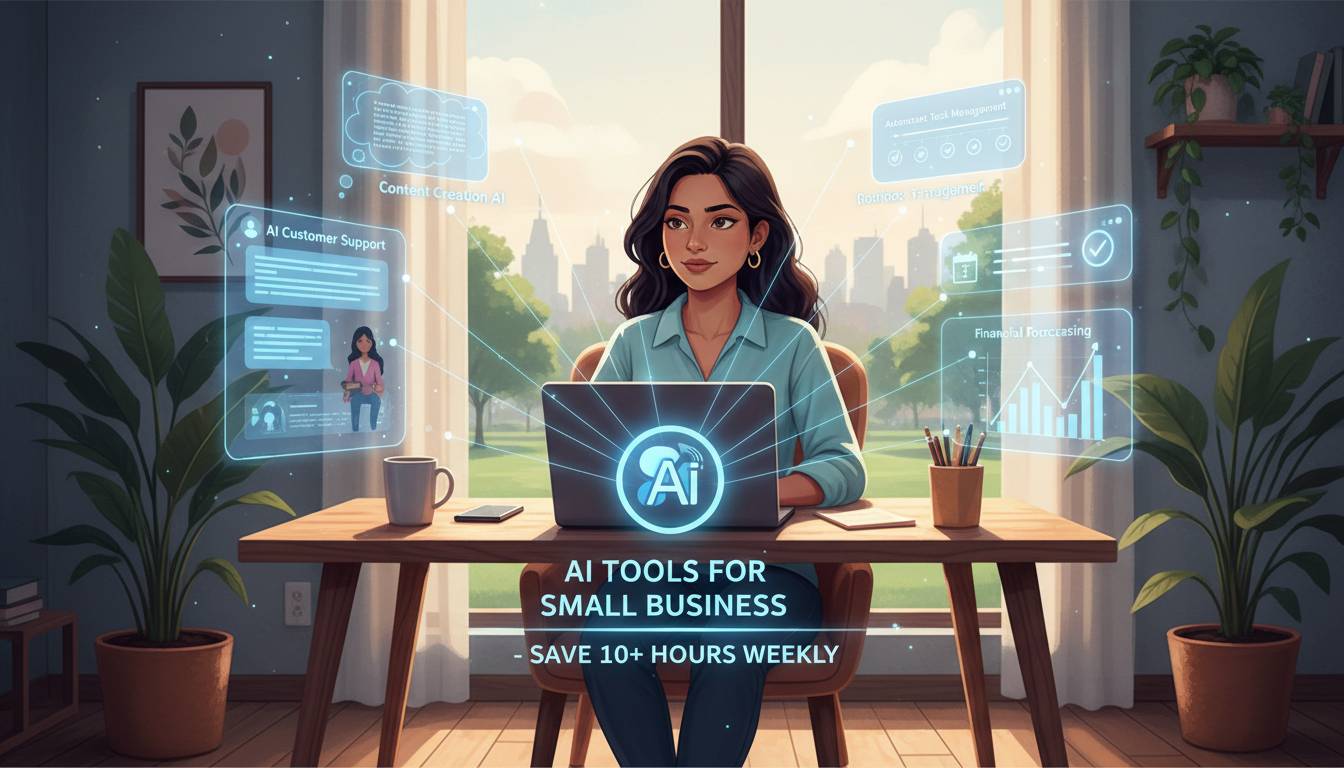
Artificial intelligence isn’t just for tech giants anymore. Small businesses across every industry now use AI to automate admin tasks, generate marketing content, and make sense of customer data. These tools let small companies compete with larger enterprises while keeping costs down. This guide looks at the best AI tools for small businesses in 2025, breaking down what they do, how much they cost, and how they can save you more than ten hours per week.
Why Small Businesses Need AI
About 35% of small businesses now use at least one AI-powered tool, up from 13% in 2022, according to a Small Business Administration survey. The interfaces have gotten simpler, and cloud-based solutions don’t require technical expertise to set up.
Small business owners deal with tight budgets, small teams, and the constant juggle of wearing multiple hats. AI handles tasks that would otherwise need dedicated staff or long hours of manual work. Customer service chatbots answer questions 24/7 without overtime. Marketing AI can crank out social posts, email campaigns, and ad copy in minutes instead of hours.
The competitive landscape has shifted too. Customers expect fast responses, personalized experiences, and smooth digital interactions. Businesses that can’t deliver fall behind competitors who use AI to provide better customer experiences.
Best AI Tools for Small Business in 2025
Here’s a rundown of the most useful AI tools available right now for small business owners.
1. ChatGPT (OpenAI)
ChatGPT has become the go-to AI tool for millions of small businesses. You can use it to draft customer emails, generate marketing copy, answer FAQs, and brainstorm business ideas. The free version is surprisingly capable, while the Plus plan at $20/month gives you faster responses and access to GPT-4.
Best for: Content creation, customer communication, and general business assistance.
2. Claude (Anthropic)
Claude handles analytical tasks and long-form writing well. Many small business owners prefer it for proposals, business plans, and detailed reports. The free tier covers substantial usage, and the Pro plan at $20/month gives you more capacity.
Best for: Complex documents, data analysis, and thoughtful business writing.
3. Jasper AI
Jasper specializes in marketing content. It has templates for blog posts, social media captions, product descriptions, and advertising copy. Plans start at $39/month, making it solid for businesses with regular content needs.
Best for: Marketing teams and businesses needing high-volume content.
4. Grammarly Business
Grammarly Business does more than check grammar—it adjusts tone, improves clarity, and detects plagiarism. At $15/user/month, it keeps all your customer communications professional.
Best for: Error-free written communications across teams.
5. HubSpot AI Tools
HubSpot has woven AI throughout its CRM platform, offering AI content assistants, meeting schedulers, and predictive analytics. Pricing depends on which HubSpot plan you choose, with AI features included in most tiers.
Best for: Businesses already using or planning to use HubSpot for CRM and marketing automation.
6. QuickBooks AI
QuickBooks uses AI to automatically categorize expenses, forecast finances, and process invoices. You don’t need accounting expertise to keep accurate books. Pricing starts at $35/month for the Self-Employed plan.
Best for: Automated bookkeeping and financial management.
7. Zapier AI
Zapier connects different apps and automates workflows without coding. The AI additions suggest automations based on what you want to accomplish—just describe it. Plans start at $19.99/month.
Best for: Connecting software tools and creating automated workflows.
8. Canva AI
Canva’s AI includes Magic Design, which creates complete layouts from text prompts, and Magic Write, which helps with content inside designs. You can generate custom visuals without hiring a designer. Pro plans start at $13/month.
Best for: Creating marketing materials without design skills.
9. Otter.ai
Otter provides AI transcription for meetings, interviews, and customer calls. The business plan at $10/user/month includes automated summaries and action item extraction—no more scrambling to take notes.
Best for: Capturing and summarizing calls, meetings, and interviews.
10. Midjourney
Midjourney generates high-quality images from text descriptions. You can create custom visuals for marketing, social media, and websites without using stock photos. Basic plans cost $10/month.
Best for: Custom visual content without design resources.
How to Pick the Right AI Tool
Choosing AI tools isn’t just about comparing feature lists. You need to think about your most time-consuming tasks, what software you already use, your budget, and what your team can handle.
Start by identifying your biggest pain points. If customer service is killing you with response times, look at chatbots and email automation. If content creation is the bottleneck, focus on generative AI platforms. If financial tracking is a mess, AI-powered accounting will help more than a fancy new chatbot.
Integration matters. The best AI tool won’t help much if it can’t talk to your existing software. Check that any solution you’re considering plays nice with your CRM, accounting system, email marketing tools, and e-commerce platform. Zapier can bridge gaps when native integrations don’t exist.
Think about the learning curve too. Some tools are intuitive and need minimal training; others require more technical know-how. If your team doesn’t have time to learn something complex, pick a platform with good tutorials, responsive support, and an active user community.
Understanding Costs and ROI
Small business owners frequently worry about the actual cost of AI. Free tiers exist, but most tools require paid subscriptions for business use. Understanding the real return helps you justify spending and avoid buying things you don’t need.
Most AI tools cost between $10 and $100 per month, often priced per user. If you stack up multiple tools, the total adds up. Prioritize tools that address your biggest inefficiencies first. A single well-chosen tool can save enough time to pay for itself in the first month.
The benefits go beyond just time savings. Faster responses improve conversion rates. Consistent content quality strengthens your brand. Better data analysis leads to smarter decisions. These compounding benefits often outweigh the direct time savings.
Implementation Tips
Success with AI takes more than just signing up. Here’s how to get the most out of your AI tools:
Start with one tool that solves your most urgent problem. Don’t try to implement five things at once—you’ll get overwhelmed and won’t use any of them properly. Master one tool first, then add more. This way your team builds real proficiency and sees real results, which makes adding more tools easier.
Set clear rules for how your team uses AI. Figure out which tasks are appropriate for AI help, how to review what AI generates, and what level of human oversight is needed. Without guidelines, you’ll get inconsistent results and miss the point of using AI to augment human thinking.
Track metrics before and after implementing AI. Record how long specific tasks take, customer response rates, content output, or whatever KPIs matter to you. Concrete data proves AI’s value and shows where you can improve.
Where AI Is Heading for Small Business
The AI landscape keeps changing. Here’s what to watch:
Natural language processing keeps getting better. Future tools will understand context better, hold longer conversations, and produce more accurate outputs with less prompting. That means even more tasks will become suitable for AI automation.
Industry-specific AI solutions are popping up in healthcare, construction, and other sectors. These tools understand specialized terminology, regulatory requirements, and workflows that generic AI platforms can’t handle. Worth checking if your industry has something tailored to your needs.
AI-powered analytics are becoming accessible to smaller businesses. Predictive analytics, customer behavior modeling, and market trend analysis are no longer just for enterprises with data science teams.
Common Questions
What’s the best free AI tool for small business?
ChatGPT and Claude both have solid free tiers. ChatGPT handles content creation and general business tasks well. Claude is stronger on analytical work and detailed documents. Try both to see which fits your needs better.
How much should a small business spend on AI monthly?
Most small businesses do well spending between $50 and $200/month, depending on team size and needs. Start with free versions, then upgrade as you figure out what actually helps. Prioritize tools that tackle your most time-consuming tasks for the best return.
Can AI tools replace human employees?
AI works best as a productivity enhancer, not a replacement. It handles repetitive tasks and generates first drafts that need human review. The best setup combines AI efficiency with human creativity, judgment, and relationship skills that machines can’t match.
How do I get my team to adopt AI tools?
Successful adoption requires explaining why you’re using AI, training people properly, and showing real benefits. Start with team members who are excited about trying new things—they’ll help convince the skeptics. Share wins early and often to build momentum.
Are AI tools secure for business data?
Reputable AI providers use encryption, access controls, and compliance certifications. Still, check privacy policies before sharing sensitive data. Don’t input confidential customer information unless the privacy policy allows it and you’re following relevant regulations.
How often should I update my AI strategy?
Review your AI tools quarterly. Check if they still meet your needs and whether newer tools offer better options. AI advances quickly, so staying informed helps you keep your edge.
Conclusion
AI tools have moved from experimental novelty to practical necessity for small businesses that want to work efficiently and stay competitive. The tools in this guide represent the most accessible and useful options for 2025—any of them can save you significant time while improving what you produce.
Start with clear goals, pick tools that match your actual needs, and implement them thoughtfully. You can use AI to work smarter, not harder. Saving ten or more hours per week isn’t wishful thinking—businesses already using these tools are doing it.