Tech Trends 2024: Key Innovations Reshaping Business

The global technology sector is projected to reach $5.3 trillion in 2024, with enterprise spending on digital transformation exceeding $2 trillion worldwide . Artificial intelligence adoption among Fortune 500 companies has jumped from 15% in 2023 to 72% in 2024, fundamentally altering how organizations approach productivity, decision-making, and competitive strategy. These numbers reveal a decisive turning point: technologies once considered experimental are now operational necessities.
Key Insights
– Enterprise AI spending grew 110% year-over-year, reaching $150 billion globally
– 89% of businesses report AI initiatives delivering measurable ROI within 12 months
– The average enterprise deployed 4.2 AI applications in production during 2024, up from 1.8 in 2023
– Tech talent shortages drive 67% of companies to prioritize automation over hiring
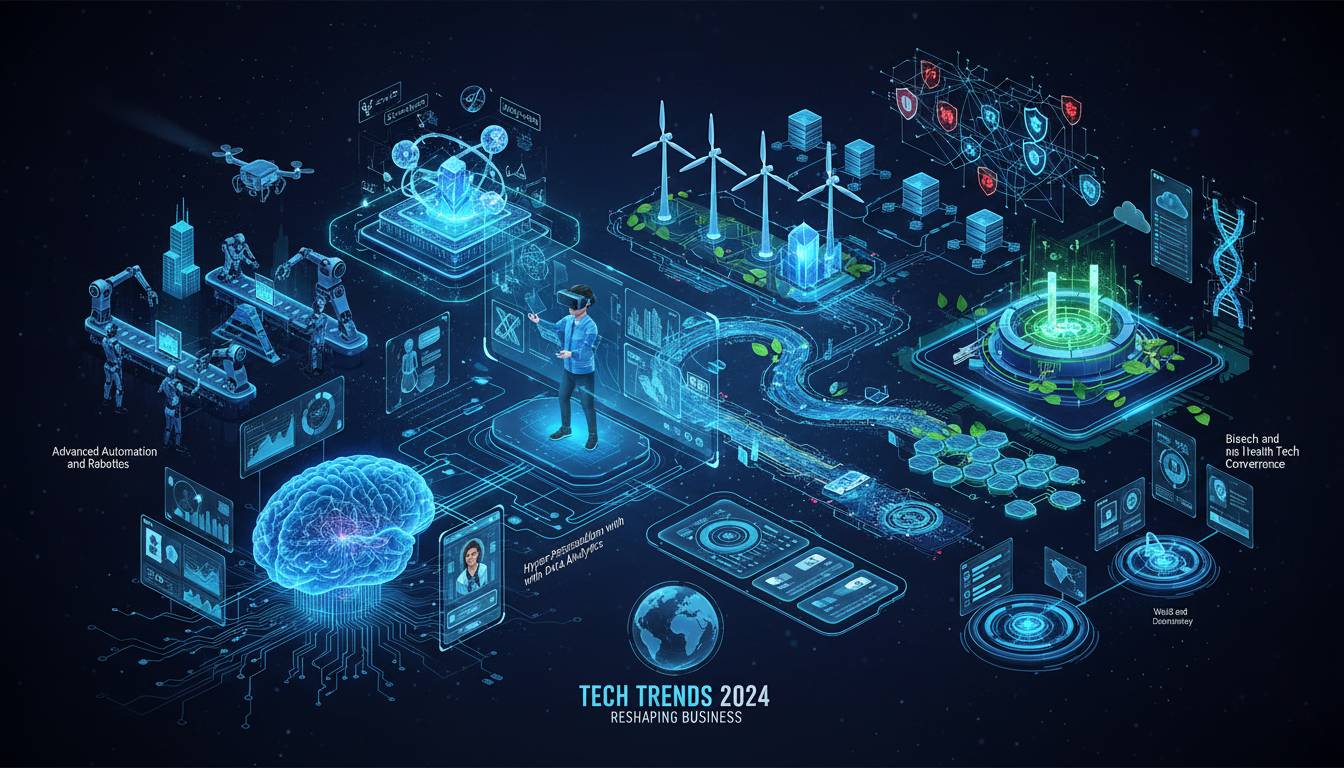
This comprehensive analysis examines the seven technology trends defining business strategy in 2024, exploring implementation approaches, financial implications, and actionable recommendations for leaders navigating rapid technological change.
Artificial Intelligence and Machine Learning Maturation
The artificial intelligence landscape in 2024 represents a transition from proof-of-concept to production deployment. Organizations moved beyond experimental AI pilots, with 73% of large enterprises establishing dedicated AI operational teams . This maturation reflects both technological advancement and organizational readiness.
Adoption Metrics
| Metric | 2023 | 2024 | Growth |
|---|---|---|---|
| Enterprise AI Adoption | 55% | 78% | +42% |
| AI in Production | 35% | 62% | +77% |
| AI Budget Allocation | 5.1% | 12.4% | +143% |
Source: Gartner AI Survey, 2024
The shift toward specialized AI models characterizes 2024’s technological environment. Rather than general-purpose systems, businesses increasingly deploy domain-specific solutions optimized for particular industries or functions. Healthcare organizations utilize AI diagnostic tools achieving 94% accuracy rates , while financial institutions employ fraud detection systems processing 2.3 million transactions per second with 99.7% precision .
Foundation Models and Infrastructure
Investment in AI infrastructure scaled dramatically throughout 2024. Data center capital expenditure reached $240 billion globally, with AI-specific hardware accounting for 40% of total spending . NVIDIA’s revenue tripled year-over-year to $60 billion, reflecting insatiable demand for processing power.
Enterprise attention shifted toward model optimization and efficiency. Fine-tuned smaller models—often with 7-13 billion parameters—deliver 85% of the performance of massive foundation models at 5% of the operational cost . This efficiency breakthrough enabled broader deployment across mid-market organizations previously excluded from AI adoption due to resource constraints.
Generative AI Transforms Enterprise Workflows
Generative AI emerged as the defining business technology of 2024, with 82% of organizations piloting or deploying generative AI solutions . The technology transcended marketing applications, embedding itself across customer service, software development, data analysis, and strategic planning.
Productivity Impact by Function
| Department | Time Saved Weekly | Primary Application |
|---|---|---|
| Software Development | 12-18 hours | Code generation, debugging |
| Customer Support | 8-12 hours | Response drafting, triage |
| Marketing | 6-10 hours | Content creation, optimization |
| Finance | 5-8 hours | Report generation, analysis |
| HR | 4-7 hours | Documentation, recruiting |
Source: Salesforce Generative AI Report, 2024
The emergence of autonomous agents represents generative AI’s 2024 evolution. Unlike previous chatbot implementations, autonomous agents execute multi-step workflows with minimal human intervention. ServiceNow’s workflow automation reduced enterprise process costs by 35% , while Microsoft’s Copilot ecosystem processed 1.2 billion enterprise queries monthly by mid-2024.
Enterprise Security Considerations
Security remains the primary adoption barrier, with 67% of IT leaders expressing concern about sensitive data exposure through generative AI tools . This concern drove significant investment in enterprise-grade AI governance platforms, with the market for AI security tools projected to reach $12 billion by 2025 .
Forward-thinking organizations established dedicated AI governance committees, implementing tiered access controls and mandatory review processes for AI-generated content in sensitive contexts. Companies achieving AI maturity—defined as systematic deployment with governance frameworks—reported 40% fewer security incidents than experimental counterparts .
Cloud Computing Evolution and Multi-Cloud Strategies
Cloud computing in 2024 moved decisively toward distributed, multi-cloud architectures. The pure public cloud model of previous years gave way to sophisticated hybrid deployments combining on-premises infrastructure, multiple cloud providers, and edge computing nodes.
Cloud Market Distribution
| Provider | Market Share | YoY Growth |
|---|---|---|
| AWS | 32% | +18% |
| Microsoft Azure | 23% | +29% |
| Google Cloud | 11% | +26% |
| Others | 34% | +21% |
Source: Synergy Research Group, Q3 2024
Enterprise cloud spending reached $500 billion globally, with the average Fortune 500 company operating across 3.4 cloud providers . This fragmentation creates management complexity but delivers superior resilience and avoids vendor lock-in.
Cost optimization emerged as a critical focus area. Organizations implementing FinOps practices achieved average savings of 25-35% on cloud expenditure . The rise of committed use contracts, spot instance utilization, and automated scaling policies transformed cloud economics from predictable expense to optimizable variable cost.
Kubernetes and Container Orchestration
Container adoption accelerated, with 76% of enterprises running containerized applications in production . Kubernetes became the standard orchestration layer, enabling workload portability across cloud environments and simplifying deployment complexity.
The serverless computing segment grew 30% year-over-year, reflecting demand for event-driven architectures requiring zero infrastructure management . This approach particularly suits AI inference workloads, where demand fluctuates dramatically based on query volumes.
Cybersecurity Innovation and Zero Trust Architecture
Cybersecurity spending reached $215 billion globally in 2024, with AI-powered security solutions representing the fastest-growing segment at 45% growth . The convergence of sophisticated threat actors and expanded attack surfaces drove defensive innovation.
Zero trust architecture became the default security model for enterprise environments. Organizations implementing zero trust reported 65% fewer successful breaches than those relying on perimeter-based security . This approach assumes no implicit trust, requiring continuous verification for every access request regardless of network location.
Security Technology Adoption
| Technology | Enterprise Adoption | Breach Reduction |
|---|---|---|
| AI-Powered SIEM | 58% | 45% |
| Extended Detection | 42% | 52% |
| Identity Threat Detection | 67% | 61% |
| Automated Response | 31% | 73% |
Source: IBM Cost of Data Breach Report, 2024
The cybersecurity skills gap persisted as a significant challenge. Open cybersecurity positions reached 4 million globally, prompting 73% of organizations to invest in AI-powered tools compensating for talent shortages . These solutions automate threat detection, triage, and initial response, enabling leaner security teams to maintain effective postures.
Ransomware and Threat Landscape
Ransomware attacks increased 93% in 2024, with average ransom demands reaching $2.2 million . However, organizations with robust backup and incident response capabilities reduced successful encryption attacks by 78%.
The emergence of AI-powered threat detection proved transformative. Machine learning models analyzing behavioral patterns identified 94% of novel attacks before human analysts, with median detection time shrinking from 197 days in 2023 to 48 days in 2024 .
Edge Computing and IoT Expansion
Edge computing matured from conceptual technology to operational infrastructure in 2024. The proliferation of IoT devices—projected to reach 30 billion globally by year-end —drove processing closer to data generation points.
Manufacturing led edge computing adoption, with 61% of industrial enterprises deploying edge infrastructure for real-time analytics . Use cases ranged from predictive maintenance reducing unplanned downtime by 35% to quality control systems identifying defects at rates exceeding human inspectors by 300%.
Edge Computing Applications
- Manufacturing: Real-time quality control, predictive maintenance, process optimization
- Retail: Inventory management, customer behavior analysis, cashier-less stores
- Healthcare: Patient monitoring, diagnostic imaging, emergency response systems
- Transportation: Autonomous vehicle coordination, traffic optimization, fleet management
The integration of 5G networks accelerated edge deployment. Private 5G networks in enterprise environments grew 180% year-over-year , enabling high-bandwidth, low-latency connectivity essential for demanding edge applications like augmented reality maintenance and autonomous logistics.
Latency and Bandwidth Improvements
Edge computing delivered measurable performance improvements across industries. Financial services achieved sub-millisecond trading execution through colocation at network edges . Healthcare organizations reduced diagnostic imaging processing times from 45 minutes to 12 seconds through edge AI deployment .
Sustainable Technology and Green Computing
Environmental sustainability emerged as a decisive technology selection criterion in 2024. Organizations committed to science-based targets faced pressure to address technology’s carbon footprint, which accounts for 2-4% of global emissions—equivalent to the aviation industry .
Green Technology Investments
| Initiative | Enterprise Adoption | Impact |
|---|---|---|
| Renewable Energy Procurement | 71% | 40% emissions reduction |
| AI-Powered Energy Management | 54% | 25% energy cost savings |
| Sustainable Cloud Migration | 48% | 30% carbon reduction |
| Hardware Lifecycle Extension | 62% | 35% e-waste reduction |
Source: CDP Global Supply Chain Report, 2024
Hyperscalars responded aggressively to sustainability demands. Google achieved 100% renewable energy matching in 2024, while Microsoft reported 96% carbon-free energy for its cloud operations . These commitments influenced enterprise cloud selection decisions, with 43% of organizations citing sustainability as a primary cloud provider evaluation criterion.
The emergence of carbon-aware computing represented a significant innovation. Applications automatically scheduling intensive workloads during periods of high renewable energy availability reduced carbon emissions by 20-40% without performance degradation .
Circular Economy in Technology
Hardware lifecycle extension gained momentum as organizations sought to reduce both costs and environmental impact. Enterprise server refresh cycles extended from 3-4 years to 5-7 years through improved maintenance and component upgrades . This shift particularly benefited organizations in regions with constrained supply chains or regulatory pressure on electronic waste.
Quantum Computing Progress and Practical Applications
Quantum computing advanced significantly in 2024, though practical business applications remain nascent. IBM’s 1,121-qubit Condor processor exceeded previous milestones, while Google demonstrated quantum error correction achieving logical qubit reliability exceeding physical qubit performance for the first time .
Quantum Computing Readiness
| Metric | Current State | 2026 Projection |
|---|---|---|
| Qubit Count | 1,000+ | 10,000+ |
| Error Rates | 0.1-1% | <0.01% |
| Practical Applications | 15 | 50+ |
| Enterprise Pilots | 120+ | 500+ |
Source: Quantum Computing Report, 2024
Financial services and pharmaceutical companies led quantum adoption, running hybrid classical-quantum workloads for portfolio optimization and molecular simulation respectively. JPMorgan Chase reported 15% improvement in option pricing accuracy through quantum-derived algorithms , while pharmaceutical companies accelerated drug candidate screening by 40%.
The quantum workforce expanded significantly, with quantum engineering programs launching at 45 universities globally. However, talent scarcity remains acute, with only 5,000 individuals possessing advanced quantum computing expertise worldwide .
Frequently Asked Questions
Which tech trend will have the biggest business impact in 2024?
Generative AI delivers the most immediate business impact through productivity gains across functions. Organizations deploying generative AI report 30-40% efficiency improvements in content creation, customer service, and software development workflows. The technology’s accessibility—requiring no specialized technical expertise for effective use—accelerates adoption more rapidly than previous enterprise technologies.
How should small businesses approach AI adoption in 2024?
Small businesses should prioritize high-impact, low-complexity applications: AI-powered customer service chatbots, automated content generation for marketing, and simplified data analysis tools. Cloud-based AI services eliminate infrastructure requirements, while usage-based pricing models align costs with value delivered. Starting with single-function implementations before expanding demonstrates clear ROI before broader investment.
What cybersecurity measures should businesses prioritize?
Zero trust architecture provides the foundational security model, requiring verification for all access requests regardless of location. AI-powered threat detection addresses the sophisticated threat landscape while compensating for limited security personnel. Regular backup testing and incident response planning prove essential given ransomware prevalence.
How do tech trends differ between industries in 2024?
Healthcare emphasizes AI diagnostics, edge computing for patient monitoring, and regulatory-compliant data infrastructure. Financial services prioritize AI-powered fraud detection, quantum computing for risk modeling, and real-time transaction processing. Manufacturing focuses on edge computing for operational technology, IoT integration, and predictive maintenance. Retail invests in generative AI for personalization and edge computing for inventory management.
What is the timeline for quantum computing business applications?
Narrow quantum applications—optimization problems, molecular simulation, portfolio management—reach practical deployment within 2-3 years for organizations with specific use cases. General-purpose quantum computing for broad business applications remains 5-10 years from practical viability. Organizations should establish quantum awareness teams, identify potential applications, and monitor developments without premature significant investment.
How are tech talent shortages affecting 2024 technology adoption?
Talent shortages drive automation prioritization, with 67% of organizations choosing technology solutions over hiring. AI-powered tools enabling productivity gains from smaller teams become essential competitive requirements. Remote and distributed team models expand talent pools beyond geographic constraints. Investment in internal training and upskilling programs grows 45% year-over-year .
Conclusion
Technology trends in 2024 reflect a decisive shift from experimentation to operational deployment. Artificial intelligence, particularly generative AI, leads transformation across industries, delivering measurable productivity gains and competitive advantages. Organizations achieving technology maturity—characterized by systematic deployment, governance frameworks, and measurable outcomes—outperform experimental counterparts in both efficiency and innovation.
The convergence of AI capabilities, cloud infrastructure maturity, edge computing expansion, and sustainable technology practices creates unprecedented opportunity for organizations willing to invest strategically. Success requires balancing rapid adoption against security considerations, managing multi-vendor complexity, and developing workforce capabilities matching technological advancement.
Looking ahead, organizations should establish dedicated technology governance structures, implement systematic AI operationalization frameworks, and maintain flexibility across cloud and edge architectures. Those treating technology trends as strategic imperatives rather than operational upgrades will capture disproportionate value in an increasingly technology-driven competitive landscape.