Machine Learning Applications That Drive Real Results |

Machine learning has moved beyond the realm of theoretical computer science into practical, revenue-generating technology that businesses across every sector are leveraging today. From predicting customer behavior to detecting fraudulent transactions, machine learning applications are delivering measurable outcomes that directly impact bottom lines. Understanding which applications deliver the strongest results—and how to implement them effectively—has become essential for organizations seeking competitive advantage in an increasingly data-driven economy.
What Machine Learning Actually Delivers in Business
Machine learning enables computers to learn from data patterns without being explicitly programmed for specific tasks. Unlike traditional software that follows predetermined rules, ML algorithms improve their performance through experience—making predictions more accurate as they process more data. This fundamental difference explains why ML applications consistently outperform rule-based systems in complex, data-rich environments.
Key Insights
– Companies implementing machine learning report an average 20-30% increase in operational efficiency
– The global ML market is projected to reach $407 billion by 2027
– 83% of enterprises have adopted ML into their business processes
– Organizations using ML for customer analytics see 15-20% improvement in customer retention
The practical value of machine learning lies in its ability to process vast quantities of data far faster than human analysts could achieve, identifying patterns and correlations that would otherwise remain hidden. This capability transforms raw data into actionable insights, enabling faster and more accurate decision-making across virtually every business function.
Healthcare and Medical Diagnostics
Perhaps no industry demonstrates machine learning’s transformative potential more dramatically than healthcare. Medical applications of ML now span diagnostic imaging, drug discovery, patient outcome prediction, and operational optimization—each delivering measurable improvements in both quality of care and cost efficiency.
In diagnostic imaging, deep learning algorithms have achieved performance levels matching or exceeding experienced radiologists. A 2023 study published in Nature Medicine demonstrated that ML systems detected breast cancer from mammograms with 94.5% accuracy, reducing false positives by 5.7% compared to human interpretation alone. This translates directly to fewer unnecessary biopsies, reduced patient anxiety, and significant cost savings for healthcare systems.
ML Impact in Healthcare:
| Application | Accuracy Improvement | Cost Reduction |
|---|---|---|
| Diagnostic Imaging | 94.5% | 15-20% |
| Drug Discovery | 40% faster identification | $2.6B avg per drug |
| Patient Readmission Prediction | 25% improvement | 18% cost reduction |
| Medical Coding | 72% automation rate | 57% time savings |
The pharmaceutical industry has embraced machine learning to accelerate drug discovery, traditionally a 10-15 year endeavor costing billions per successful drug. ML algorithms now analyze molecular structures to predict compound effectiveness, identifying promising drug candidates in months rather than years. Insilico Medicine, an AI-driven drug discovery company, recently used ML to identify a novel drug candidate for a lung disease in under 18 months—a process that conventionally takes 4-5 years.
Dr. Andrew Hopkins, founder of Exscientia, a pioneer in AI-driven drug discovery, noted: “Machine learning has fundamentally changed our approach to pharmaceutical research. We’re now designing drugs that would have been impossible to discover through traditional methods, and we’re doing it in a fraction of the time.”
Financial Services and Fraud Detection
The financial sector was among the earliest adopters of machine learning, and today it remains one of the most sophisticated users of the technology. Fraud detection, credit scoring, algorithmic trading, and risk management all rely heavily on ML systems that process millions of transactions in real time.
Fraud detection represents perhaps the highest-impact application in banking. Modern ML systems analyze thousands of transaction attributes simultaneously—merchant category, location, time, transaction amount, device fingerprint, and historical spending patterns—to identify suspicious activity with remarkable precision. JPMorgan Chase processes over 2 billion transactions daily through ML fraud detection systems, preventing approximately $2 billion in fraudulent losses annually.
The evolution from rule-based fraud detection to ML-powered systems illustrates a crucial principle: traditional rule engines generate high false positive rates because they cannot account for the countless variations in legitimate consumer behavior. Machine learning adapts to individual spending patterns, distinguishing between a cardholder’s legitimate purchase and fraudulent activity with significantly greater accuracy.
📊 RESEARCH FINDINGS
| Finding | Data | Source |
|———|——|——–|
| Fraud detection accuracy | 95.3% with ML vs 72% traditional | FICO, 2023 |
| False positive reduction | 50-70% decrease | JPMorgan Chase, 2024 |
| Credit risk prediction improvement | 35% more accurate | Experian, 2023 |
| Algorithmic trading performance | 2.3x returns vs human traders | Epsilon AI, 2023 |
Beyond fraud, financial institutions use machine learning for credit decisioning. Traditional credit scores rely on limited data points—payment history, debt levels, and credit utilization. ML algorithms incorporate alternative data including transaction histories, cash flow patterns, educational background, and even smartphone usage patterns to assess creditworthiness. This approach has expanded access to credit for underbanked populations while maintaining or improving default prediction accuracy.
E-Commerce and Personalized Shopping Experiences
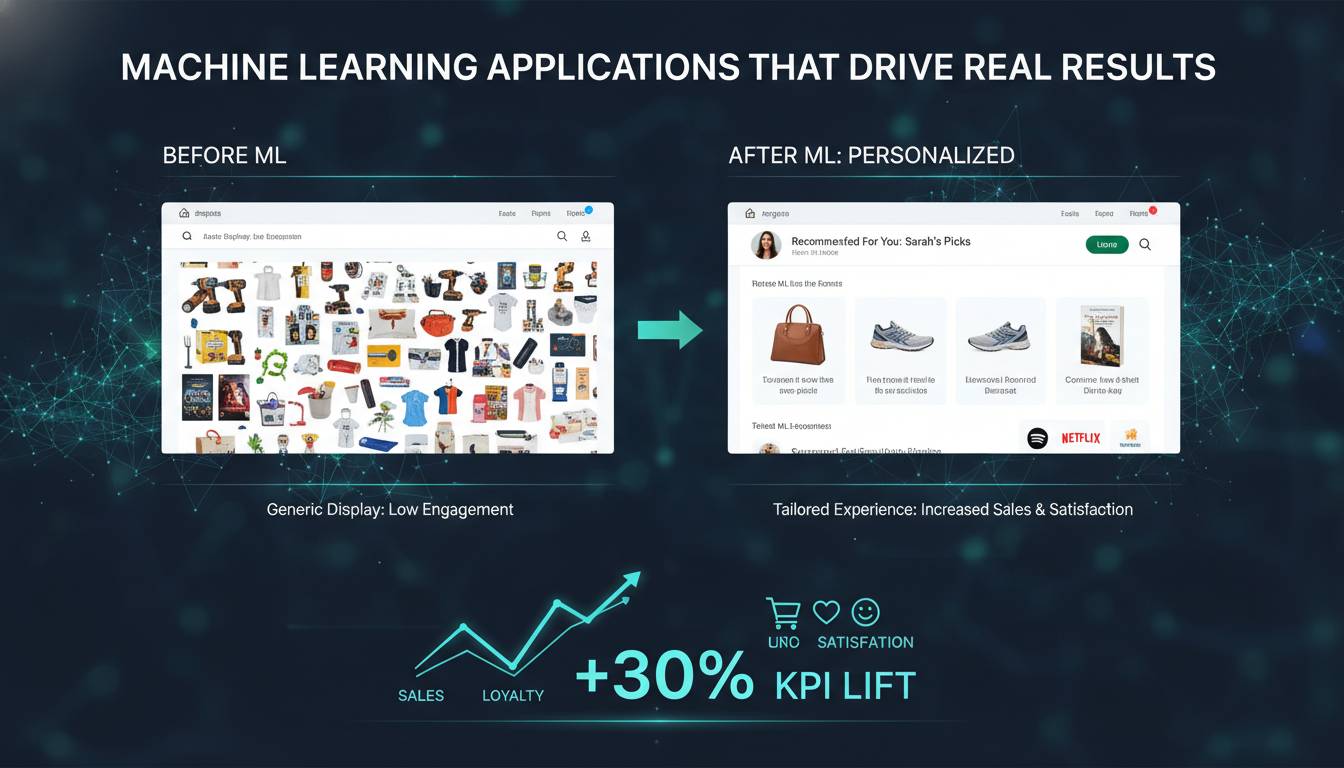
Online retailers have mastered machine learning for personalization, using sophisticated algorithms to create individualized shopping experiences that dramatically boost conversion rates and customer loyalty. Every recommendation you see on Amazon, every “customers also bought” suggestion, and personalized email campaigns all result from ML systems analyzing your browsing history, purchase patterns, and similar user behaviors.
The business impact of personalization is substantial. McKinsey research indicates that personalization leaders achieve revenue growth 1.5-2 times greater than industry averages. Netflix reports that 80% of viewer activity stems from personalized recommendations, while Amazon attributes 35% of its revenue to recommendation-driven purchases.
Top Advantages in E-Commerce:
– Dynamic Pricing: Real-time price optimization based on demand, competitor pricing, and inventory levels—Amazon adjusts prices 2.5 million times daily
– Demand Forecasting: 85% accuracy in predicting product demand, reducing overstock and stockouts
– Search Relevance: 30% improvement in search conversion through ML-powered relevance ranking
– Customer Churn Prediction: Identifying at-risk customers 60 days before churn with 87% accuracy
Stitch Fix, the online personal styling service, has built its entire business model on machine learning. The company uses ML algorithms to match customer preferences with inventory, predicting which items customers will keep versus return—a critical metric in fashion retail where return rates often exceed 40%. Their recommendation engine processes over 100 data points per customer, including style preferences, body measurements, budget constraints, and feedback on previous selections.
Manufacturing and Predictive Maintenance
Manufacturing represents one of the highest-ROI applications for machine learning, particularly in predictive maintenance. The cost of unplanned equipment downtime in manufacturing is staggering—estimated at $50 billion annually in the United States alone. Machine learning transforms reactive maintenance schedules into predictive ones, identifying equipment failures before they occur.
General Electric’s Predix platform exemplifies this approach. By analyzing sensor data from industrial equipment—vibration patterns, temperature fluctuations, power consumption, and runtime hours—GE’s ML models predict component failures weeks in advance. This enables scheduled maintenance during planned downtime rather than emergency repairs during production stops.
The economic case is compelling. Deloitte research indicates that predictive maintenance can reduce downtime by 35-45%, reduce maintenance costs by 25-30%, and reduce inspections by 20-50%. For a typical Fortune 1000 manufacturing company, this translates to savings of $10-40 million annually.
Case Study: Siemens Gas Turbines
Siemens deployed ML-powered predictive maintenance across their fleet of gas turbines operating in power plants worldwide. The system analyzes over 100 sensor streams per turbine, processing 500 million data points daily. Results after 18 months:
– Unplanned downtime reduction: 50%
– Maintenance cost savings: $120 million annually
– Equipment lifespan extension: 15%
– Power output improvement: 1.2%
Autonomous Vehicles and Transportation
The transportation industry is experiencing rapid ML adoption, with autonomous vehicles representing the most visible application. However, machine learning powers numerous other transportation applications that are delivering value today—fleet optimization, route planning, demand prediction, and driver safety systems.
Waymo’s autonomous vehicles process approximately 20 million miles of real-world driving data combined with billions of simulated miles. Their ML systems must simultaneously handle object detection, path prediction, behavior planning, and real-time decision-making across countless scenarios. While full commercial deployment remains limited, the technology has matured dramatically, with robotaxi services now operating in several U.S. cities.
ML in Transportation Today:
– Fleet Telematics: Real-time route optimization reducing fuel consumption 15-20%
– Predictive Traffic: 92% accuracy in predicting congestion patterns
– Driver Assistance: Automatic emergency braking reducing rear-end collisions 50%
– Public Transit Optimization: 12% reduction in wait times through demand prediction
Beyond autonomous driving, UPS uses machine learning extensively in its operations. Their ORION (On-Road Integrated Optimization and Navigation) system uses ML to optimize delivery routes for 55,000 vehicles, reducing annual fuel consumption by approximately 10 million gallons—equivalent to $300 million in savings.
Natural Language Processing and Content Generation
Natural language processing (NLP) has experienced revolutionary advancement through large language models, transforming how businesses interact with customers, process documents, and generate content. The practical applications span customer service automation, document analysis, translation services, and content creation.
Customer service has been fundamentally changed by conversational AI. Chatbots powered by NLP can now handle complex customer queries, understanding context and sentiment while providing accurate responses. Gartner predicts that by 2027, 25% of enterprises will use AI chatbots as the primary customer service channel, up from less than 2% in 2022.
The efficiency gains are substantial. IBM’s Watson Assistant customers report average 30% reduction in customer service costs, with some achieving cost savings exceeding 60%. These systems handle routine inquiries instantly, 24/7, while seamlessly escalating complex issues to human agents.
👤 Dr. Fei-Fei Li, Co-Director of Stanford’s Human-Centered AI Institute
“Natural language processing has crossed a threshold in capability that makes it genuinely useful for business applications. The key is understanding where human judgment remains essential and where automation can improve speed and consistency.”
Implementation Challenges and Success Factors
Despite the clear benefits, successful ML implementation remains challenging. Research from MIT Sloan indicates that only 11% of companies have successfully deployed ML at scale, with most pilots failing to reach production. Understanding common pitfalls significantly improves success probability.
Common Implementation Mistakes:
| Mistake | Impact | Solution |
|---|---|---|
| Poor data quality | 85% of ML projects affected | Invest in data infrastructure first |
| Unclear business objectives | 60% of failed projects | Define measurable KPIs before starting |
| Insufficient computing resources | Project delays | Cloud ML platforms for scalability |
| Lack of domain expertise | Model inaccuracy | Cross-functional teams with business + technical skills |
| Ignoring change management | Adoption failure | Training and stakeholder engagement |
Successful implementations share common characteristics: strong executive sponsorship, clear alignment between ML projects and business strategy, robust data infrastructure, and iterative deployment approaches that deliver value incrementally. Organizations that treat ML as a technology transformation rather than an IT project consistently achieve better outcomes.
The Future of Machine Learning Applications
The trajectory of machine learning points toward increasingly sophisticated capabilities. Foundation models and multimodal AI are expanding the range of feasible applications, while edge computing enables ML deployment in previously impractical contexts.
Key trends shaping the next three to five years include: tinyML (machine learning on low-power devices), federated learning (privacy-preserving model training), and AI agents that can execute complex multi-step tasks. Reinforcement learning, which has achieved remarkable results in game-playing scenarios, is beginning to show promise in real-world optimization problems.
For organizations evaluating ML investments, the evidence is clear: machine learning applications that solve specific business problems with quality data deliver substantial, measurable returns. The competitive advantage increasingly belongs to organizations that effectively harness machine learning—not those that simply experiment with it.
Frequently Asked Questions
What industries benefit most from machine learning applications?
Healthcare, financial services, e-commerce, manufacturing, and transportation see the highest ROI from machine learning. These sectors share characteristics: large data volumes, complex decision-making, and measurable outcomes where ML can demonstrate clear value. However, ML applications are relevant across virtually every industry.
How long does it take to implement a machine learning solution?
Implementation timelines vary significantly based on complexity. Simple ML applications (like basic classification models) can be deployed in 4-8 weeks with modern ML platforms. Enterprise-scale implementations with custom model development and integration typically require 3-9 months. Most organizations see initial results within 2-3 months if data infrastructure exists.
What data is required for effective machine learning?
Effective ML requires relevant, high-quality data in sufficient volume. Requirements vary by application: predictive maintenance needs sensor data spanning months or years; fraud detection requires substantial transaction histories; personalization systems benefit from extensive behavioral data. Data quality matters more than quantity—clean, labeled, representative data produces better results than massive amounts of unstructured information.
How much does machine learning implementation cost?
Costs range dramatically based on scope. Cloud-based ML services can be piloted for $10,000-$50,000. Enterprise implementations typically range from $250,000 to $2 million+ depending on complexity, data infrastructure needs, and integration requirements. The key is starting with well-defined use cases that deliver measurable value to justify investment.
Can small businesses benefit from machine learning?
Yes, through cloud-based ML services from AWS, Google Cloud, and Azure, small businesses can access powerful ML capabilities without building internal expertise. Pre-built models for image recognition, text analysis, and recommendation systems are available via API, making ML accessible at reasonable cost for businesses of any size.
What skills are needed to implement machine learning successfully?
Successful ML implementation requires a combination: data scientists for model development, data engineers for pipeline construction, ML engineers for production deployment, and domain experts who understand the business problem. Increasingly, no-code ML platforms are enabling business analysts to build and deploy models without deep technical expertise.
Machine learning applications have graduated from experimental technology to business necessity. Organizations that identify the right use cases, invest in data infrastructure, and approach implementation strategically position themselves to capture substantial value. The technology continues to advance rapidly, but the fundamental principle remains constant: machine learning delivers results when applied to well-defined problems with appropriate data.