
Digital Transformation Strategy That Drives Real Results | Expert Framework

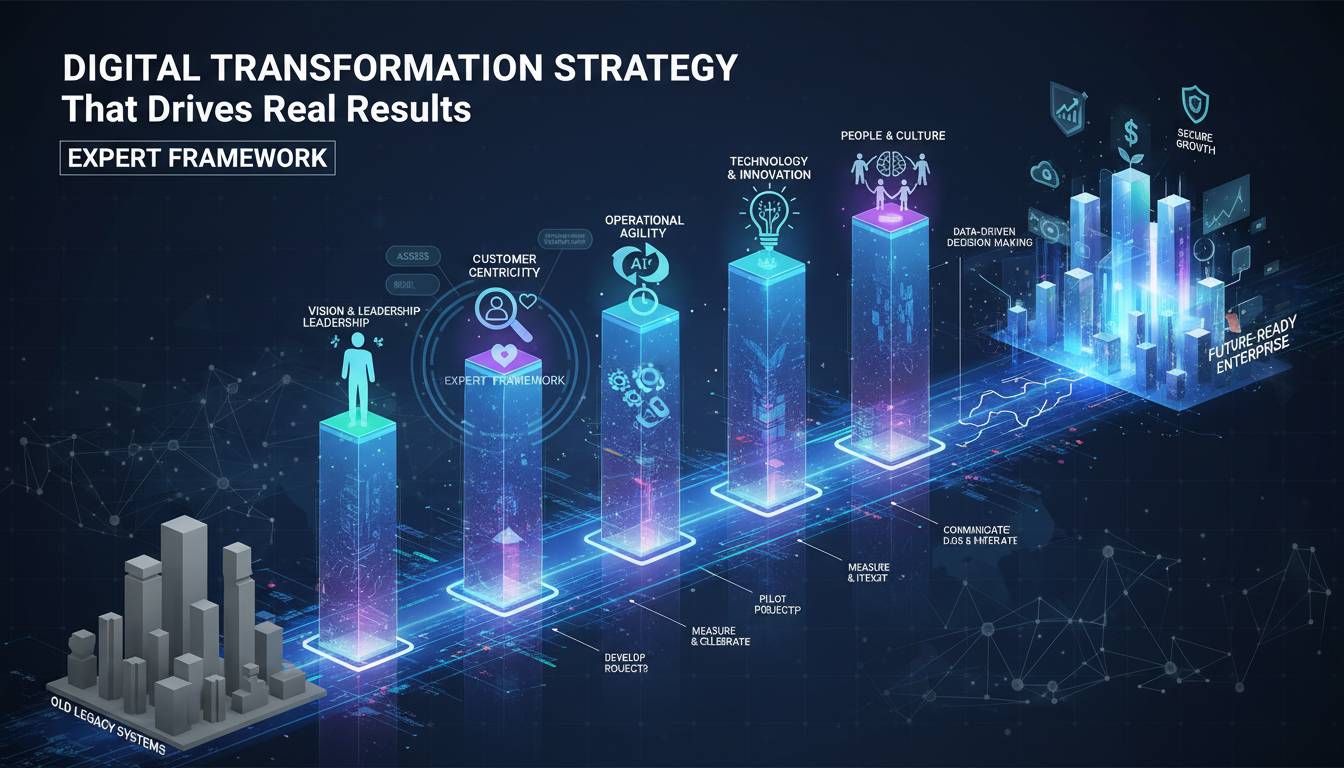
Digital transformation has evolved from a competitive advantage to a business imperative. Organizations that fail to adapt their operations, customer experiences, and internal processes for the digital age risk irrelevance within a decade. Yet despite billions spent annually on transformation initiatives, most fail to deliver measurable results. This discrepancy between investment and outcome stems from a fundamental misunderstanding of what digital transformation truly requires.
A digital transformation strategy is not simply adopting new technology—it’s a comprehensive reimagining of how your organization creates value, delivers experiences, and operates in an increasingly digital economy. The organizations achieving real results approach transformation as a continuous journey rather than a one-time project, aligning technology initiatives with clear business outcomes and cultural change.
This framework provides a structured approach to building and executing a digital transformation strategy that drives measurable business value.
Understanding the Digital Transformation Landscape
The global digital transformation market reached $567 billion in 2023 and continues growing at approximately 17% annually, according to IDC. Yet McKinsey research indicates that roughly 70% of digital transformation initiatives fail to meet their objectives, and only 20% of companies report successful transformation at scale. This paradox—massive investment paired with persistent failure—reveals a critical gap between ambition and execution.
What Digital Transformation Actually Means
True digital transformation encompasses three interconnected dimensions:
Operational transformation involves redesigning core business processes using digital technologies to improve efficiency, reduce costs, and increase agility. This includes automation of repetitive tasks, implementation of data-driven decision systems, and redesign of workflows across departments.
Customer experience transformation reimagines how your organization interacts with customers through digital channels. This extends beyond building a mobile app or modernizing your website—it requires fundamentally rethinking customer journeys, personalizing interactions at scale, and creating seamless omnichannel experiences.
Business model transformation represents the deepest level of change, where organizations develop entirely new revenue streams, value propositions, or competitive positions enabled by digital capabilities. Examples include companies transitioning from product sales to subscription services, or traditional retailers building marketplace platforms.
Most organizations focus heavily on operational transformation while neglecting the customer and business model dimensions. The most successful transformations address all three in coordination.
The Strategic Framework for Successful Transformation
Effective digital transformation requires a structured framework that connects technology investments to business outcomes. Gartner’s framework emphasizes three core elements: leadership and governance, technology capabilities, and organizational culture. However, organizations need a more actionable approach.
Phase 1: Assessment and Strategic Clarity
Before implementing any technology, organizations must develop clear strategic clarity about what digital transformation should accomplish. This requires answering fundamental questions about competitive positioning, customer needs, and operational capabilities.
Begin by conducting a comprehensive digital maturity assessment across all business units. This assessment should evaluate current technology infrastructure, data capabilities, skill gaps, and process efficiency. Bain & Company’s research shows that companies with accurate baseline assessments are 2.5 times more likely to achieve transformation success.
Simultaneously, define your transformation ambition at three levels:
- Operational excellence targets: Specific cost reduction, efficiency gains, or speed improvements
- Customer experience goals: Measurable improvements in satisfaction, retention, or acquisition
- Strategic positioning: New capabilities or market positions you intend to build
The most critical success factor in this phase is executive alignment. Transformation initiatives fail when leadership lacks shared understanding of priorities, timeline, and resource commitments. Spend adequate time building this alignment before proceeding.
Phase 2: Building the Foundation
With strategic clarity established, organizations must build foundational capabilities before pursuing advanced initiatives. This includes:
Data infrastructure: Modern data architecture enables the analytics and intelligence that power digital transformation. This involves consolidating data sources, implementing cloud-based data warehouses, and establishing data governance frameworks. Organizations with strong data foundations generate 30% more value from their transformation investments, according to MIT Sloan research.
Technology platform: Evaluate your core technology stack for flexibility and integration capabilities. Legacy systems often require modernization or wrapping with API layers to participate in broader digital ecosystems. Prioritize platform decisions that enable future flexibility rather than locking into single-vendor solutions.
Talent and skills: Identify critical skill gaps across technical capabilities, digital literacy, and change management. Successful transformations invest significantly in upskilling existing employees while strategically hiring for capabilities that cannot be developed internally. Deloitte research indicates that organizations with dedicated transformation talent pools achieve outcomes 40% faster.
Governance structures: Establish decision-making frameworks that balance speed with accountability. This includes defining investment approval processes, establishing cross-functional steering committees, and creating clear ownership for transformation initiatives.
Phase 3: Execution and Scaling
Execution separates successful transformations from aspirational strategies. The most effective approach follows three principles:
Start with quick wins: Identify two to three high-visibility, lower-risk initiatives that demonstrate value quickly. These victories build organizational confidence and generate momentum for more complex changes. Early wins should align with your strategic priorities while delivering measurable results within 90 to 180 days.
Build iteratively: Rather than attempting large-scale implementations, pursue incremental development with continuous feedback loops. This approach reduces risk, enables course correction, and generates learning that improves subsequent initiatives. Adopt agile methodologies not just for software development but for transformation programs broadly.
Scale systematically: Replicate successful pilots across the organization with appropriate adaptations for different business units or regions. Scaling requires careful change management, communication, and support infrastructure. Many organizations achieve pilot success but struggle to scale—address this challenge explicitly in your planning.
Common Transformation Challenges and How to Overcome Them
Understanding common pitfalls enables proactive mitigation. Based on analysis of transformation failures across industries, several patterns emerge consistently.
Challenge 1: Technology-First Thinking
Perhaps the most prevalent mistake is prioritizing technology adoption over business outcome definition. Organizations invest in cloud migration, AI platforms, or automation tools without clear connection to specific business results. Technology becomes an end rather than a means.
Solution: Reverse the traditional approach. Begin every initiative by defining the desired business outcome, then work backward to identify required capabilities and technologies. Require business case documentation for all significant investments, including explicit connection to strategic objectives.
Challenge 2: Underestimating Cultural Change
Digital transformation fundamentally requires behavioral change across the organization. New technologies fail when employees lack motivation, skills, or authority to adopt new ways of working. Boston Consulting Group research indicates that cultural and organizational factors account for more transformation failures than technology issues.
Solution: Invest as heavily in change management as in technology implementation. This includes transparent communication about transformation rationale and impact, training programs that build required skills, incentive structures that reward adoption, and leadership behaviors that model new ways of working.
Challenge 3: Insufficient Governance and Accountability
Transformation initiatives often span multiple departments with conflicting priorities. Without strong governance, projects drift, resources become fragmented, and accountability becomes unclear.
Solution: Establish clear governance structures with executive sponsorship, cross-functional steering committees, and designated program management offices for major initiatives. Define decision rights explicitly—who approves investments, resolves conflicts, and holds teams accountable for results.
Challenge 4: Continuing Business as Usual
Organizations frequently attempt transformation while maintaining full operational responsibilities. Existing priorities compete with transformation demands, resulting in insufficient attention and resources for change.
Solution: Create dedicated transformation resources—whether separate teams, dedicated budgets, or protected time allocations—that operate with some insulation from ongoing business pressures. This does not mean complete separation, but rather explicit recognition that transformation requires focused investment beyond normal operations.
Measuring Transformation Success
What gets measured gets managed. Effective transformation requires comprehensive metrics that track both implementation progress and business outcomes.
Leading Indicators
These metrics predict future results and enable proactive management:
- Initiative completion rates: Percentage of planned initiatives delivered on time and budget
- Adoption metrics: User adoption rates for new tools and processes
- Capability development: Skills assessments, training completion, and certification rates
- Technology readiness: Infrastructure upgrades, system integrations, and platform deployments
Lagging Indicators
These metrics confirm whether transformation delivers actual business value:
- Financial outcomes: Revenue growth, cost reduction, margin improvement
- Customer metrics: Satisfaction scores, retention rates, acquisition costs
- Operational efficiency: Process cycle times, error rates, productivity measures
- Employee engagement: Satisfaction surveys, turnover rates, internal mobility
Establish a balanced scorecard that tracks both categories, with regular reporting to executive leadership. Recognize that some benefits materialize quickly while others emerge over longer timeframes—maintain patience while demanding accountability.
Industry-Specific Transformation Considerations
While digital transformation principles apply broadly, implementation varies significantly by industry context.
Manufacturing and Industrial
Industry 4.0 transformation focuses on connected operations, predictive maintenance, and supply chain visibility. Leading organizations like Siemens have built digital twins of their manufacturing operations, enabling simulation and optimization that reduces production costs by 15-20%. Key technologies include IoT sensors, edge computing, and industrial AI platforms.
Financial Services
Financial institutions pursue transformation across customer experience, risk management, and operational efficiency. JPMorgan Chase has invested over $12 billion annually in technology, with significant focus on AI-powered customer service and fraud detection. Regulatory compliance adds complexity requiring careful technology selection and governance.
Healthcare
Healthcare transformation centers on interoperability, clinical decision support, and patient engagement. The transition to electronic health records has enabled data-driven care, while AI diagnostics are beginning to demonstrate human-equivalent or superior accuracy in specific domains. Patient privacy requirements (HIPAA) create additional security and governance obligations.
Retail
Retail transformation emphasizes omnichannel integration, personalization, and supply chain optimization. Walmart’s investment in omnichannel capabilities and digital advertising demonstrates how established retailers can compete with digital-native competitors. Inventory optimization and fulfillment flexibility represent key capability priorities.
The Future of Digital Transformation
Several emerging trends will shape transformation strategies in coming years.
Artificial intelligence integration is moving from experimental to operational, with generative AI specifically enabling new approaches to customer service, content creation, and knowledge management. Organizations are building AI governance frameworks alongside technical capabilities.
Sustainability and ESG considerations increasingly influence transformation priorities. Digital technologies enable carbon tracking, supply chain transparency, and resource optimization. Investors and customers increasingly expect demonstrable sustainability progress.
Composable business architecture emphasizes modular, flexible technology stacks that enable rapid adaptation. Rather than monolithic enterprise systems, organizations build capabilities through composable applications that can be rearranged as needs evolve.
Cybersecurity transformation evolves from protection to resilience. Zero-trust architectures, automated threat response, and security-by-design principles become standard expectations.
Conclusion
Digital transformation remains both urgent and challenging. Organizations that approach transformation strategically—connecting technology investments to clear business outcomes, building foundational capabilities before scaling, and addressing cultural dimensions alongside technical ones—achieve significantly better results than those pursuing ad hoc modernization.
The framework presented here provides structured guidance while acknowledging that effective transformation requires continuous adaptation to organizational context, market dynamics, and emerging capabilities. Begin with strategic clarity, build necessary foundations, execute with discipline, and measure relentlessly. Success requires sustained leadership commitment, adequate investment, and organizational patience through inevitable challenges.
The organizations that master digital transformation will define competitive advantage for the next decade. Those that delay or approach it superficially will find themselves increasingly marginalized in markets that reward agility, customer focus, and operational excellence.
Frequently Asked Questions
How long does a typical digital transformation take?
Most comprehensive transformations require three to five years to achieve full scale, though initial results often appear within six to twelve months. Organizations should plan for sustained effort rather than expecting rapid results. Gartner research indicates that 75% of transformations that fail to deliver expected value abandon efforts too early, typically within 18 months.
What is the average cost of digital transformation?
Costs vary dramatically based on organization size, current state, and transformation scope. Mid-sized enterprises typically invest $50-500 million over multi-year programs, while large enterprises may commit billions. Rather than focusing on total cost, prioritize return on investment through rigorous business case development for each initiative.
Which industries are leading in digital transformation?
Financial services, technology, and media lead in transformation maturity, while healthcare, manufacturing, and construction historically lag but are accelerating investment. Retail has experienced significant disruption from digital-native competitors, driving substantial transformation focus.
How do you measure digital transformation ROI?
ROI measurement requires establishing baseline metrics before transformation, defining expected improvements for each initiative, and tracking actual results against projections. Account for both direct financial returns (cost reduction, revenue growth) and indirect benefits (customer satisfaction, employee engagement, risk reduction). Some benefits, particularly from capability building, may take years to fully materialize.
What are the biggest risks in digital transformation?
Primary risks include insufficient executive commitment, inadequate change management, technology choices that become obsolete, skill gaps that limit adoption, and scope creep that dilutes focus. Mitigate these through strong governance, dedicated resources, and disciplined prioritization.
Should small businesses pursue digital transformation?
Absolutely. Digital transformation is not exclusively for large enterprises. Small businesses often benefit from greater agility and lower legacy system burdens. Focus on cloud-based solutions, customer-facing digital capabilities, and process automation that provides immediate value without extensive investment.