
Data Science Career Guide: Step-by-Step to a High-Paying Job

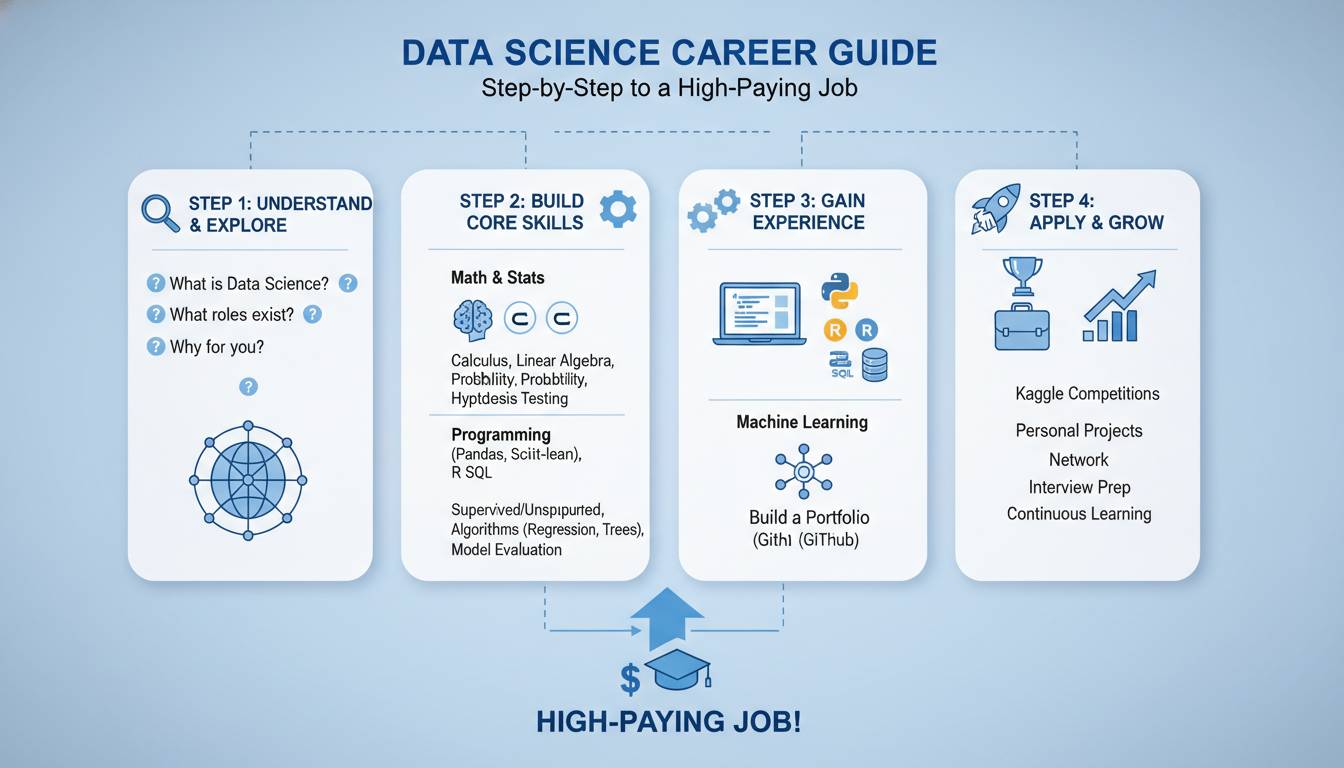
The data science profession offers one of the most lucrative career paths in today’s technology-driven job market. With a median salary exceeding $120,000 and job growth projected at 35% through 2032—far outpacing the average for all occupations—data science consistently ranks among the best jobs in America according to Glassdoor and U.S. News & World Report. Yet breaking into this competitive field requires more than just technical skills; it demands a strategic approach to skill development, networking, and positioning.
This guide walks you through the complete journey of becoming a data scientist, from acquiring the right skills to landing your first role and advancing in your career. Whether you’re a career changer from a non-technical field or a professional looking to upskill, the actionable insights here will help you navigate the path effectively.
Understanding the Data Science Role
Data science sits at the intersection of statistics, programming, and domain expertise. Data scientists extract insights from complex datasets to solve business problems, inform strategic decisions, and build predictive models. The role has evolved significantly since the term was coined in 2008, now encompassing responsibilities that span data engineering, analysis, machine learning, and deployment.
What Data Scientists Actually Do
The daily work varies by organization and seniority level, but core responsibilities include:
- Cleaning and transforming raw data into usable formats
- Conducting exploratory data analysis to identify patterns
- Building and deploying machine learning models
- Communicating findings to technical and non-technical stakeholders
- Collaborating with product, engineering, and business teams
According to a 2023 Anaconda survey, 76% of data scientists spend most of their time on data preprocessing and cleaning rather than model building—a reality that surprises many aspiring professionals. Understanding this helps set realistic expectations for the role.
Data Science vs. Related Roles
The data field includes several adjacent roles that confuse newcomers:
| Role | Primary Focus | Key Skills |
|---|---|---|
| Data Scientist | Predictive modeling, insights | Python, ML, statistics |
| Data Analyst | Reporting, dashboards | SQL, Tableau, Excel |
| Data Engineer | Building data pipelines | SQL, Spark, cloud platforms |
| ML Engineer | Deploying models to production | MLOps, software engineering |
Many organizations use these titles interchangeably, so job descriptions matter more than job titles when searching for positions.
Essential Skills: What You Need to Master
Successful data scientists combine technical proficiency with business acumen. Here’s a breakdown of the skills that matter most in 2024.
Technical Skills
Programming Languages
Python dominates the field, used by 87% of data scientists according to the aforementioned Anaconda survey. R remains popular in academia and certain industries, but Python’s versatility with libraries like pandas, scikit-learn, and TensorFlow makes it the primary recommendation for newcomers. SQL is non-negotiable—understanding database queries forms the foundation of data work regardless of language preference.
Statistics and Mathematics
A solid grasp of probability, linear algebra, and inferential statistics enables meaningful analysis. Machine learning algorithms are essentially applied statistics, and professionals who skip this foundation often struggle with model selection and interpretation.
Machine Learning
Supervised learning (classification, regression) and unsupervised learning (clustering, dimensionality reduction) form the core knowledge areas. Deep learning matters for specific applications like computer vision and NLP but isn’t required for all roles.
Tools and Platforms
Cloud platforms—AWS, Google Cloud, and Azure—have become essential as organizations move data infrastructure to the cloud. Version control with Git and collaborative development through GitHub are industry standards.
Soft Skills
Technical ability alone doesn’t determine success. The 2023 Kaggle Data Science Survey found that communication skills ranked among the top factors for career advancement, yet only 34% of respondents felt their organizations effectively translated data insights into business decisions.
Critical soft skills include:
- Communication: Translating technical findings into business language
- Storytelling: Presenting data in compelling, actionable ways
- Domain knowledge: Understanding the specific industry you work in
- Problem-solving: Defining the right questions before solving
Career Paths and Entry Points
Multiple routes lead to data science careers, each with distinct advantages.
Traditional Education
A master’s degree in data science, statistics, or computer science provides structured learning and credential recognition. Programs typically take 1-2 years and cost $30,000-$80,000. According to the National Center for Education Statistics, STEM master’s degrees saw a 45% increase between 2010 and 2020, reflecting growing demand.
However, degrees aren’t strictly necessary. A 2023 Burtch Works study found that 34% of data scientists held only bachelor’s degrees, while 28% came from non-computer science backgrounds entirely.
Bootcamps and Self-Learning
Coding bootcamps offer intensive, accelerated pathways typically lasting 12-24 weeks. General Assembly, Springboard, and Flatiron School all offer data science programs. According to Course Report, bootcamp graduates see an average salary increase of 56%, though placement rates vary significantly between programs.
Self-learning through platforms like Coursera, edX, and Kaggle provides the most flexibility. Andrew Ng’s Machine Learning course on Coursera has attracted over 5 million learners, demonstrating the massive interest in self-directed learning.
Career Changer Pathways
Professionals from fields like finance, marketing, and engineering often transition successfully by leveraging domain expertise. A former accountant understanding financial data, or a nurse comprehending healthcare systems, brings context that pure technical candidates lack. These professionals typically spend 6-18 months building technical skills while maintaining their current employment.
Building Your Portfolio and Getting Hired
In a competitive job market, your portfolio often matters more than your credentials. Hiring managers want to see practical ability, not just theoretical knowledge.
Projects That Impress
Strong portfolio projects demonstrate end-to-end capabilities:
-
End-to-end machine learning projects: Define a problem, collect data, build a model, and deploy it. Publishing on GitHub with a README showing your process demonstrates reproducibility.
-
Kaggle competitions: Participating in competitions shows competitive spirit and ability to work with real datasets. Even modest rankings demonstrate engagement with the community.
-
Domain-specific analyses: Projects in industries like healthcare, finance, or e-commerce demonstrate you understand business context, not just technical execution.
-
Open source contributions: Contributing to libraries like pandas or scikit-learn signals professional capability and community engagement.
The Resume and Application Process
Data science job searches typically take 3-6 months, so patience and persistence matter. Key strategies include:
- Tailoring applications: Generic applications rarely succeed. Research each company and customize your resume to match their technical stack.
- Leveraging LinkedIn: 87% of recruiters use LinkedIn, according to Jobvite. Optimize your profile with relevant keywords and engage with industry content.
- Networking: The 2023 LinkedIn Workforce Learning Report found that 70% of jobs are filled through networking. Attend meetups, conferences, and engage in online communities.
Interview Preparation
Data science interviews typically include:
- Technical screens: Coding assessments (Python, SQL) and machine learning concepts
- Case studies: Business problems requiring data-driven solutions
- Behavioral questions: Past experiences, collaboration, and problem-solving approaches
- Take-home projects: Extended assignments demonstrating practical skills
Practicing with platforms like LeetCode (for SQL and algorithms) and CaseInterview.com (for business cases) improves performance significantly.
Salary Expectations and Growth Trajectory
Data science offers compensation among the highest in the technology sector, though figures vary substantially by location, experience, and industry.
Salary Overview
According to Glassdoor data from late 2023, data scientist salaries in the United States break down as follows:
| Experience Level | Median Salary | Range |
|---|---|---|
| Entry Level (0-2 years) | $95,000 | $70,000-$130,000 |
| Mid-Level (3-5 years) | $130,000 | $100,000-$175,000 |
| Senior (5-8 years) | $165,000 | $130,000-$220,000 |
| Principal/Lead (8+ years) | $195,000 | $160,000-$280,000 |
These figures represent base salary only; total compensation often includes bonuses, equity, and benefits that can add 20-40% to total pay.
Industry Variation
Compensation varies significantly by sector:
- Technology companies: Highest salaries, particularly at FAANG firms where total compensation can exceed $300,000 for senior roles
- Finance and banking: Competitive pay, especially for quantitative roles; often requires domain expertise
- Healthcare: Growing demand with moderate salaries; strong job security
- Consulting: Variable pay with exposure to diverse industries
Geographic Factors
Major tech hubs offer the highest salaries but also the highest costs of living. San Francisco, Seattle, New York, and Austin lead in compensation. However, remote work has expanded opportunities beyond traditional hubs, with companies increasingly offering location-independent salaries.
Common Mistakes to Avoid
Understanding what trips up aspiring data scientists helps you navigate the path more effectively.
Over-Emphasizing Theory Without Practice
Spending years watching tutorials without building projects leaves you with knowledge you can’t demonstrate. The Kaggle community shows that active participation—competing, sharing code, reviewing others’ work—builds practical skills faster than passive consumption.
Neglecting Communication Skills
Technical brilliance means little if you cannot convince stakeholders to act on your insights. Professionals who develop storytelling abilities alongside technical skills advance faster. Practice explaining complex concepts to non-technical audiences.
Chasing Every New Technology
The field evolves constantly, with new frameworks and tools emerging regularly. Trying to learn everything spreads you thin. Focus on fundamentals that transfer across technologies rather than trendy tools that may become obsolete.
Underestimating the Job Search Timeline
The data science market has become more competitive since the 2020-2022 hiring boom. Applicants now face more rigorous screening processes. Building realistic expectations prevents discouragement during extended job searches.
Frequently Asked Questions
How long does it take to become a data scientist?
The timeline varies based on your background and commitment level. If you can dedicate full-time hours, 6-12 months of intensive learning and project building can prepare you for entry-level positions. Professionals studying while working typically need 12-18 months. Those with strong quantitative backgrounds (statistics, mathematics, economics) often transition faster than those starting from scratch.
Do I need a master’s degree to get hired?
No, a master’s degree is not strictly required. Burtch Works’ 2023 survey found that over one-third of data scientists hold only bachelor’s degrees. What matters most is demonstrating practical ability through projects, a strong portfolio, and relevant skills. However, certain employers (particularly in finance and research) may prefer advanced degrees.
Which programming language should I learn first?
Python is the recommended first language for aspiring data scientists. Its readability, extensive library ecosystem (pandas, NumPy, scikit-learn, TensorFlow), and community support make it ideal for beginners. SQL is equally important and should be learned alongside or immediately after Python.
Is data science oversaturated in 2024?
The market has cooled from the 2020-2022 hiring frenzy, becoming more competitive. However, demand continues to grow—the Bureau of Labor Statistics projects 35% job growth through 2032, much faster than average.Qualified candidates remain in demand, but employers now expect stronger portfolios and demonstrated skills. Standing out requires genuine capability, not just certification collection.
Can I transition from a non-technical career into data science?
Yes, career changers successfully transition regularly. The key is leveraging your existing domain expertise while building technical skills. Professionals from finance, marketing, healthcare, and engineering bring valuable industry knowledge that pure technical candidates lack. Expect to invest 6-18 months in focused skill development.
What industries hire data scientists?
Every industry uses data science now. Technology companies lead in hiring volume, but finance, healthcare, retail, manufacturing, and government all employ significant numbers. Your ideal industry depends on your interests—healthcare offers meaningful impact, finance offers high compensation, and tech offers cutting-edge problems.
Your Path Forward
Data science offers a genuinely rewarding career path with competitive compensation, intellectual challenge, and significant impact potential. The journey requires commitment—typically 6-18 months of dedicated skill-building—but the investment pays dividends.
Start by assessing your current position. Identify gaps between your existing skills and the requirements outlined here, then create a learning plan with specific milestones. Build projects that demonstrate your abilities, contribute to the community, and network with professionals in the field.
Remember that the data science profession values continuous learning. Even after landing your first role, expect to constantly adapt as tools evolve and new techniques emerge. Those who embrace this continuous growth mindset build the most successful careers.
The demand for data-savvy professionals continues to outpace supply in most industries. With strategic preparation and persistent effort, you can position yourself to capture these opportunities and build a career that offers both financial reward and professional satisfaction.