Cryptocurrency Price Prediction: Expert Guide That Works

Cryptocurrency markets are notoriously unpredictable. Bitcoin has experienced single-day swings exceeding 20% multiple times in recent years, while smaller altcoins can gain or lose 50% in hours. Yet thousands of traders and investors attempt to forecast prices daily, some with remarkable success. Understanding how to analyze crypto markets effectively—not with false promises of certainty, but with disciplined methodologies that improve your odds—can provide meaningful advantages in these volatile conditions.
This guide examines the most reliable approaches to cryptocurrency price prediction, from fundamental analysis of network economics to technical indicators, sentiment measurement, and portfolio risk management. Whether you’re evaluating Bitcoin for long-term holding or trading altcoins actively, these frameworks will help you make more informed decisions.
The Reality of Crypto Market Prediction
Before examining specific methodologies, understanding why crypto price prediction is both possible and inherently probabilistic matters. Unlike traditional securities, cryptocurrency markets operate 24/7 with relatively low barriers to entry for participants. This creates unique dynamics: thin order books can amplify price movements, coordinated social media campaigns can spark rapid rallies or sell-offs, and regulatory announcements often trigger immediate, substantial reactions.
Key Market Characteristics
| Factor | Impact on Prediction | Consideration |
|---|---|---|
| 24/7 Trading | No closing prices to anchor analysis | Requires constant monitoring or automated systems |
| Low Capitalization | Higher volatility, easier manipulation | Smaller coins carry greater prediction risk |
| Regulatory Sensitivity | Sudden trend reversals on news | Government announcements can override all technical signals |
| Sentiment-Driven | Social media heavily influences momentum | Community health metrics matter alongside fundamentals |
A 2022 study by the National Bureau of Economic Research found that cryptocurrency returns exhibit significantly higher volatility than traditional assets—their analysis showed Bitcoin’s daily volatility was approximately 3-5 times higher than major stock indices. This doesn’t mean prediction is futile; it means accurate prediction requires appropriate risk management and realistic expectations about forecast reliability.
Technical Analysis: Reading Price Patterns
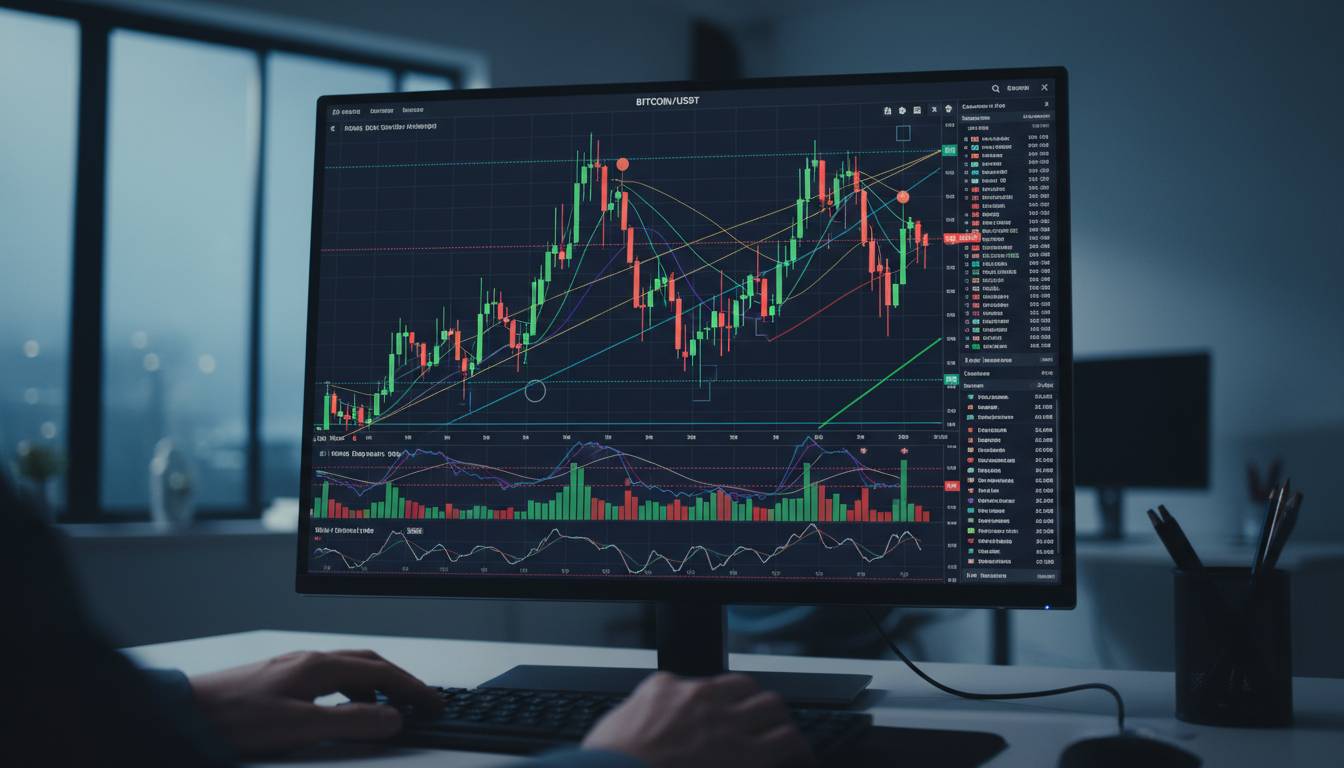
Technical analysis remains the most widely used approach to cryptocurrency price prediction, particularly for short-term trading. The core premise is that historical price patterns repeat, and that supply and demand dynamics leave traceable evidence on charts.
Moving Averages and Trend Identification
Moving averages smooth price data to reveal underlying trends. The 50-day and 200-day moving averages are particularly significant in cryptocurrency analysis.
Common Moving Average Strategies:
- Golden Cross: When the 50-day MA crosses above the 200-day, suggesting bullish momentum
- Death Cross: When the 50-day MA crosses below the 200-day, potentially signaling bearish trends
- Dynamic Support/Resistance: Price often finds support or resistance at major moving averages during trending markets
Research from 2023 examining crypto trading strategies found that simple moving average crossovers produced modest positive returns in backtests, though results varied significantly across different market conditions. No single moving average configuration works universally, making backtesting against historical data essential before deploying any strategy live.
Relative Strength Index (RSI) for Overbought/Oversold Conditions
The RSI measures the magnitude and speed of recent price changes on a 0-100 scale. Readings above 70 typically indicate overbought conditions (potential sell signal), while readings below 30 suggest oversold conditions (potential buy signal).
Cryptocurrency markets tend to remain in overbought or oversold territory longer than traditional markets due to strong momentum trends. Using RSI alone as a trading signal often produces premature entries and exits. Most practitioners combine RSI with other indicators for confirmation.
Volume Analysis and Market Structure
Trading volume provides crucial context for price movements. A price breakout accompanied by high volume carries more conviction than one with declining volume, which might indicate a false signal.
Key Volume Principles:
- Rising prices with increasing volume suggest sustainable bullish momentum
- Declining volume during price increases may indicate weakening conviction
- High volume sell-offs often mark capitulation points where downtrends may exhaust themselves
- Low-volume price movements deserve skepticism regardless of direction
Fundamental Analysis: Evaluating Intrinsic Value
While technical analysis focuses on price movements, fundamental analysis attempts to determine an asset’s underlying value. Applying this to cryptocurrency requires understanding network economics, tokenomics, and adoption metrics.
Network Value to Transaction Ratio (NVT)
Often called “crypto’s P/E ratio,” NVT divides a cryptocurrency’s market cap by its daily transaction volume. High NVT suggests a network is overvalued relative to its actual usage; low NVT may indicate undervaluation.
However, NVT has limitations. Transaction volume on blockchains can be difficult to accurately measure because it includes non-economic activity, wash trading, and wallet transfers between exchanges. Bitcoin’s Lightning Network and layer-2 solutions have also complicated traditional NVT calculations by enabling transactions that don’t appear on-chain.
Tokenomics: Supply and Demand Dynamics
A cryptocurrency’s tokenomics—its issuance schedule, maximum supply, and distribution structure—fundamentally influence long-term price potential.
Critical Tokenomics Factors:
| Factor | Why It Matters | What to Analyze |
|---|---|---|
| Maximum Supply | Scarcity drives value | Is there a hard cap? How many tokens remain? |
| Inflation Schedule | Dilution affects holders | What is the annual issuance rate? Does it decrease? |
| Token Distribution | Centralization risks | How are tokens allocated? What percentage is held by insiders? |
| Utility | Demand drivers | What purpose does the token serve? Is demand growing? |
Bitcoin’s fixed 21 million supply cap fundamentally distinguishes it from inflationary currencies and many altcoins with uncapped or slowly increasing supplies. This scarcity narrative has supported Bitcoin’s store-of-value thesis, though it doesn’t guarantee price appreciation.
Development Activity and Community Health
On-chain developer activity provides signals about project momentum. Active development suggests a project is improving and maintaining relevance; declining activity often precedes project abandonment.
GitHub commit activity, developer counts, and pull request frequency offer quantifiable metrics. However, superficial metrics can be gamed—some projects maintain high commit counts through minimal meaningful contributions. Quality matters more than quantity when evaluating development activity.
Sentiment Analysis: Measuring Market Psychology
Cryptocurrency markets are heavily influenced by collective psychology. Social media sentiment, fear/greed indices, and community dynamics can drive price movements that fundamentals alone cannot explain.
Social Media Monitoring
Twitter (X), Reddit, and specialized platforms like Bitcointalk serve as primary venues for crypto discussion. Sudden shifts in sentiment often precede or accompany price movements.
Traders use specialized tools to track mentions, analyze emotional tone, and identify emerging narratives. However, social media signals require careful interpretation—coordinated campaigns can create artificial sentiment spikes, and the most vocal voices don’t always represent the broader market.
Fear and Greed Index
Popularized by alternative.me, the Crypto Fear and Greed Index aggregates multiple data sources to produce a daily reading from “Extreme Fear” (0) to “Extreme Greed” (100). The premise: extreme fear might indicate oversold conditions and buying opportunities, while extreme greed might signal overbought conditions and potential tops.
Historical data shows the index has occasionally called local bottoms and tops, though counterexamples abound where “extreme” readings persisted for extended periods. Using the index as one input among many—rather than a standalone signal—provides more reliable results.
On-Chain Metrics for Sentiment
Blockchain data reveals participant behavior patterns that signal market sentiment:
- Exchange Netflows: Large inflows to exchanges often indicate selling pressure; outflows suggest accumulation
- HODL Waves: The duration since coins last moved indicates long-term holder conviction
- Wallet Age Distribution: Rising dormant coin activity can signal distribution from old hands to new participants
Glassnode and similar analytics platforms provide these metrics, though interpretation requires experience. Sudden shifts in on-chain behavior often follow rather than precede price movements.
Common Prediction Mistakes to Avoid
Understanding what doesn’t work can be as valuable as learning what does. Several systematic errors plague crypto market analysis.
Overreliance on Single Indicators
No single indicator reliably predicts cryptocurrency prices. Beginners often fixate on one metric—a specific moving average crossover or an RSI reading—while ignoring conflicting evidence from other sources. Professional analysts combine multiple indicators that confirm rather than contradict each other.
Ignoring Market Context
The same indicator produces different signals depending on market conditions. RSI oversold readings during a bear market may lead to “falling knives” rather than buying opportunities. Technical analysis works better in trending markets than in choppy, directionless periods. Understanding broader market context improves signal reliability.
Confusing Correlation with Causation
Cryptocurrency markets exhibit herding behavior—when Bitcoin rallies, altcoins often follow; when Bitcoin falls, the entire market typically declines. This correlation can create false patterns in backtests. A strategy that appears profitable in historical testing may simply be capturing correlation rather than predictive skill.
Neglecting Risk Management
Perhaps the most critical error in crypto prediction is ignoring position sizing and loss management. Even accurate predictions prove worthless if poorly timed entries or oversized positions wipe out accounts before trends materialize. Professional traders typically limit risk per trade to 1-2% of capital regardless of conviction level.
Building a Personal Prediction Framework
Rather than adopting any single methodology, constructing a personalized framework that combines multiple approaches typically produces better results.
Define Your Time Horizon
Different methodologies excel at different timeframes:
| Time Horizon | Primary Methods | Secondary Methods |
|---|---|---|
| Intraday (minutes to hours) | Technical analysis, order flow | Sentiment, news |
| Swing (days to weeks) | Technical + sentiment | On-chain metrics |
| Position (weeks to months) | Fundamental + on-chain | Technical (entry timing) |
| Long-term (months to years) | Fundamental analysis | Macro economic factors |
Your time horizon should align with your lifestyle, risk tolerance, and available attention. Day trading cryptocurrency requires screen time that most people cannot sustainably maintain.
Establish Entry and Exit Criteria
Before entering any position, define:
- Entry trigger: What specific conditions must be present?
- Exit targets: At what price will you take profits?
- Stop loss: At what price will you accept a loss?
- Position size: How much capital at risk?
This discipline prevents emotional decision-making when prices move unexpectedly.
Document and Review Your Process
Maintaining a trading journal—recording your analysis, rationale, and outcomes—enables continuous improvement. Over time, patterns emerge about what approaches work in your hands versus what looks promising in theory.
Tools and Resources for Analysis
Price and Charting Platforms
TradingView offers the most widely used charting interface with extensive technical analysis tools. CoinGecko and CoinMarketCap provide price data and basic metrics. For more sophisticated on-chain analysis, Glassnode, IntoTheBlock, and CryptoQuant offer tiered subscription plans with varying data depth.
News and Information Sources
Staying informed about developments that move markets requires reliable information sources. CoinDesk and CoinTelegraph provide general crypto news coverage. For specific projects, official blog posts, governance forums, and developer Discord servers offer deeper information—though verification remains essential given the prevalence of misinformation.
Portfolio Tracking
Delta, CoinStats, and Portfolio Visualizer help track performance across exchanges and wallets. Understanding your actual returns—versus your perceived returns—is crucial for evaluating prediction effectiveness.
Frequently Asked Questions
Can anyone consistently predict cryptocurrency prices accurately?
No individual or algorithm consistently predicts cryptocurrency prices with high accuracy. The efficient market hypothesis suggests that predictable patterns get arbitraged away, and crypto markets remain inefficient enough that patterns do exist—but they change and disappear. Successful market participants focus on probabilistic analysis and risk management rather than certainty.
Which cryptocurrency is most predictable?
Bitcoin, as the largest and most liquid cryptocurrency, tends to exhibit more predictable patterns than smaller altcoins. Its deeper markets reduce manipulation effects, and its longer history provides more data for analysis. However, Bitcoin remains highly volatile and unpredictable compared to traditional assets.
Is technical analysis effective for cryptocurrency trading?
Technical analysis provides a framework for analyzing price action and market structure, but its effectiveness varies with market conditions and the skill of the practitioner. Studies show that simple technical strategies often produce mixed results in backtests, while more sophisticated approaches require significant expertise. Technical analysis works best as one input among many rather than a standalone prediction method.
How long does it take to learn cryptocurrency price prediction?
Mastering cryptocurrency analysis requires ongoing learning with no definitive endpoint. Most traders require 1-2 years of dedicated study and practice before achieving consistent results—though “consistent results” often means not losing money rather than consistent profits. The volatile nature of crypto markets means that even experienced traders face strategies that stop working and require adaptation.
Conclusion
Cryptocurrency price prediction remains an inherently probabilistic exercise. The methodologies outlined in this guide—technical analysis, fundamental analysis, and sentiment measurement—provide frameworks for making informed decisions rather than guarantees of success. Understanding market structure, evaluating project fundamentals, and monitoring collective psychology can improve your odds, but uncertainty is irreducible in these markets.
Perhaps the most valuable insight is that prediction skill matters less than risk management. Professional traders who survive and compound returns focus primarily on preserving capital during adverse periods and letting winning positions run during favorable ones. Building a personal framework that matches your time horizon, risk tolerance, and analytical strengths—then documenting and refining your process over time—offers the most sustainable path to improved market outcomes.
The cryptocurrency market will continue its characteristic volatility. Rather than seeking impossible certainty, focus on building robust processes that perform reasonably well across varied conditions while limiting the downside of inevitable mistakes. This disciplined approach, more than any particular prediction method, determines long-term success in crypto markets.