Cryptocurrency Investing for Beginners: Your Complete Guide

Cryptocurrency has transformed from a niche technology experiment into a mainstream asset class worth over $2 trillion in total market capitalization. For beginners, navigating this volatile yet potentially rewarding landscape can feel overwhelming. This comprehensive guide breaks down everything you need to know to start investing in cryptocurrency with confidence—from understanding blockchain fundamentals to executing your first trade and securing your digital assets.
What Is Cryptocurrency and How Does It Work?
Cryptocurrency is a digital or virtual currency that uses cryptography for security and operates on decentralized networks, unlike traditional currencies issued by governments and central banks. The foundation of most cryptocurrencies is blockchain technology, a distributed ledger that records all transactions across a network of computers, making the system nearly impossible to alter retroactively.
Bitcoin, created in 2009 by an anonymous person or group known as Satoshi Nakamoto, was the first cryptocurrency and remains the largest by market capitalization. Since then, over 23,000 cryptocurrencies exist, though only a fraction maintain significant trading volume. Ethereum, launched in 2015, introduced smart contracts—self-executing agreements with terms directly written into code—enabling decentralized applications (dApps) and the bulk of the DeFi (decentralized finance) ecosystem.
When you buy cryptocurrency, the transaction is broadcast to the network, verified by miners or validators through complex mathematical puzzles (Proof of Work) or by staking existing tokens (Proof of Stake), and then added to the blockchain. This process typically takes seconds to minutes for most transactions, depending on the network’s congestion and the fee paid.
Key Components of Cryptocurrency:
| Component | Description |
|---|---|
| Blockchain | Distributed digital ledger recording all transactions |
| Wallet | Digital tool to store, send, and receive cryptocurrency |
| Private Key | Secret password that authorizes transactions from your wallet |
| Public Address | Shareable identifier where others can send you cryptocurrency |
| Node | Computer that maintains a copy of the blockchain |
Understanding these fundamentals helps you grasp why cryptocurrency offers potential advantages over traditional finance: faster borderless transactions, lower fees for international transfers, 24/7 market availability, and financial sovereignty without intermediary dependence.
Why Consider Cryptocurrency Investing?
The decision to invest in cryptocurrency should stem from understanding both its potential benefits and inherent risks. According to a 2023 survey by the Pew Research Center, approximately 17% of Americans have invested in cryptocurrency, with higher adoption rates among younger demographics—38% of adults under 30 report some cryptocurrency involvement.
Potential Benefits of Cryptocurrency Investment:
The cryptocurrency market operates 24 hours a day, 365 days a year, unlike stock markets with fixed trading hours. This accessibility appeals to investors who want to react to global events in real-time. Additionally, cryptocurrency offers fractional ownership—you can purchase small amounts (even fractions of a single Bitcoin), making it accessible regardless of initial capital.
Diversification represents another compelling reason. Cryptocurrency often behaves differently from traditional asset classes like stocks and bonds, potentially reducing overall portfolio volatility when included as part of a balanced investment strategy. Many institutional investors now allocate small percentages to cryptocurrency as a portfolio diversifier.
Perhaps most significantly, cryptocurrency represents technological innovation in finance. Early investors in Bitcoin who purchased tokens when they traded for less than $100 have seen extraordinary returns, though past performance never guarantees future results.
Understanding the Risks:
The same volatility that creates profit potential also generates substantial risk. Bitcoin has experienced multiple drawdowns exceeding 50% from its all-time highs, including an 80% decline during the 2022 bear market. The cryptocurrency market remains largely unregulated in many jurisdictions, leaving investors without protections typically available in traditional finance. Scams, fraud, and hacks continue to plague the ecosystem—investors lost approximately $4 billion to cryptocurrency scams in 2023 alone, according to the FBI.
Never invest more than you can afford to lose, especially as a beginner. Cryptocurrency should typically represent only a small percentage of a diversified investment portfolio.
Essential Cryptocurrency Investment Strategies
Approach cryptocurrency investing with the same discipline applied to traditional investments. Several proven strategies help beginners navigate market volatility while building positions over time.
Dollar-Cost Averaging (DCA)
This strategy involves investing a fixed dollar amount at regular intervals regardless of price, purchasing more coins when prices are low and fewer when high. DCA removes emotional decision-making from investing and historically performs well in volatile markets. For example, investing $100 monthly in Bitcoin since 2019 would have produced significant returns despite multiple market crashes along the way.
Buy the Dip
Experienced investors often increase positions during market corrections, believing that quality assets will eventually recover. However, “buying the dip” requires strong conviction and risk tolerance—prices can continue falling substantially before recovering.
Diversification Across Assets
Rather than concentrating all funds in Bitcoin, consider allocating across multiple cryptocurrencies with different use cases. A common beginner approach divides holdings: 50-60% in established cryptocurrencies (Bitcoin, Ethereum), 20-30% in established altcoins (Solana, Cardano), and 10-20% in higher-risk, higher-reward tokens.
Long-Term Holding (HODLing)
The term, originating from a misspelling of “hold,” describes buying cryptocurrency and holding for extended periods regardless of market fluctuations. This strategy assumes the underlying technology and adoption will increase value over time. Bitcoin holders who ignored the volatile price action over the past decade have generally been rewarded, though this strategy requires patience and conviction.
How to Buy Your First Cryptocurrency
Purchasing cryptocurrency has become increasingly straightforward, with multiple regulated platforms serving US investors. Here’s a step-by-step process:
Step 1: Choose a Reputable Exchange
US-based cryptocurrency exchanges must comply with regulations, including Know Your Customer (KYC) requirements. Leading platforms include:
| Exchange | Best For | Fees |
|---|---|---|
| Coinbase | Beginners, mobile app | Higher fees (0.5-4.5%) |
| Kraken | Advanced trading | Lower fees (0-0.4%) |
| Binance.US | Low fees, variety | Moderate fees |
| Gemini | Security, regulatory compliance | Moderate fees |
Step 2: Create and Verify Your Account
After selecting an exchange, create an account and complete identity verification. This process typically requires a government-issued ID and may take from minutes to several days, depending on verification volume.
Step 3: Fund Your Account
Link a bank account via ACH transfer, wire transfer, or debit card. ACH transfers usually take 1-3 business days but often have lower fees than instant purchases.
Step 4: Place Your First Order
Navigate to the trading platform, select your desired cryptocurrency (Bitcoin is recommended for beginners), choose order type, and execute the purchase. Market orders execute immediately at current prices, while limit orders execute only when the price reaches your specified level.
Step 5: Transfer to Personal Wallet (Recommended)
For holdings you plan to keep long-term, transferring cryptocurrency to a personal wallet provides greater security than leaving funds on exchanges, which can be vulnerable to hacks.
Cryptocurrency Wallets: Securing Your Digital Assets
Cryptocurrency wallets store the private keys that authorize transactions. Understanding wallet options proves essential for protecting your investment.
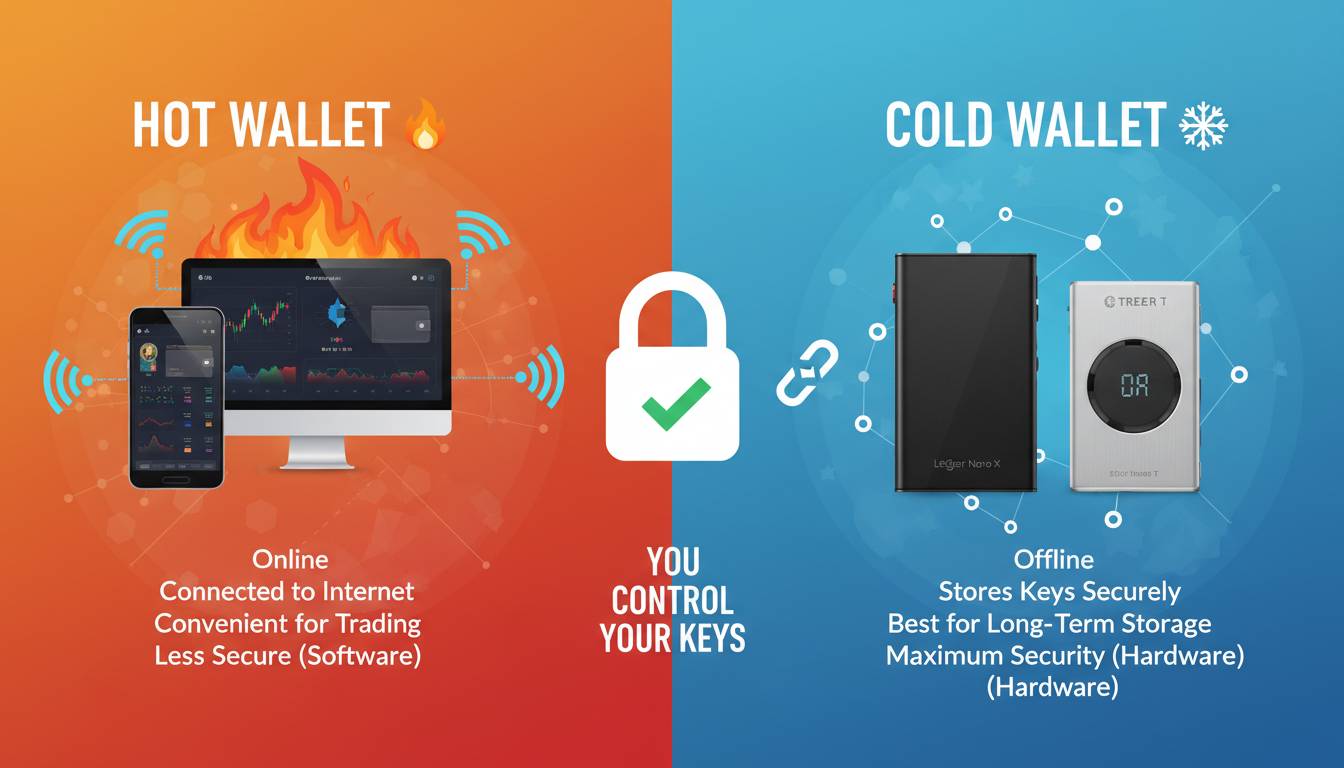
Hot Wallets (Online)
Hot wallets connect to the internet, providing convenient access for trading. Exchange wallets, mobile apps, and browser extensions fall into this category. While user-friendly, hot wallets remain vulnerable to hacking and phishing attacks. Use hot wallets only for amounts you’re actively trading.
Cold Wallets (Offline)
Cold storage keeps private keys offline, providing superior security against online threats. Hardware wallets (physical devices like Ledger or Trezor) represent the most popular cold storage solution, costing $50-200. Paper wallets—printed private keys—provide another cold storage option though require careful handling to avoid loss or damage.
Custodial vs. Non-Custodial Wallets:
| Type | Control | Security | Convenience |
|---|---|---|---|
| Custodial (exchange) | Third party | Lower (you don’t control keys) | Higher |
| Non-custodial (self) | You | Higher (you control keys) | Lower |
For beginners, starting with an exchange wallet for small purchases is acceptable, but transferring significant holdings to a hardware wallet provides essential security.
Common Mistakes to Avoid as a Beginner
Entering the cryptocurrency market without awareness of frequent pitfalls has cost investors billions. Avoid these common errors:
Investing More Than You Can Afford to Lose
The extreme volatility in cryptocurrency means prices can drop 50-80% rapidly. Only invest funds you won’t need for essential expenses, and never borrow money to invest in cryptocurrency.
Falling for Scams and Ponzi Schemes
Promises of guaranteed returns, “once-in-a-lifetime” opportunities, and celebrity endorsements frequently mask scams. Research any investment thoroughly, and remember: if something sounds too good to be true, it probably is. The FBI Internet Crime Report indicated cryptocurrency investment scams resulted in losses exceeding $2.5 billion in 2022.
Ignoring Security Practices
Never share your private keys, seed phrases, or login credentials. Enable two-factor authentication (2FA) on all exchange accounts—preferably using a hardware security key rather than SMS. Be wary of phishing emails and fake websites mimicking legitimate exchanges.
FOMO-Driven Decisions
Fear Of Missing Out (FOMO) leads investors to buy at market peaks, often followed by panic selling during corrections. Develop a clear investment plan before entering any position and stick to it regardless of market noise.
Neglecting Tax Implications
The IRS treats cryptocurrency as property, meaning capital gains and losses must be reported. Maintain detailed records of all transactions, including purchases, sales, and transfers between wallets.
Tax Implications and Legal Considerations
US cryptocurrency investors face specific tax obligations that have evolved significantly in recent years.
Tax Treatment:
The IRS classifies cryptocurrency as property, not currency. Selling cryptocurrency for more than you paid results in capital gains tax, while selling at a loss creates a capital loss that can offset other gains. Trading one cryptocurrency for another (e.g., trading Bitcoin for Ethereum) triggers a taxable event because you’re disposing of property.
Reporting Requirements:
Form 8949 reports capital gains and losses from cryptocurrency sales. The Infrastructure Investment and Jobs Act (2021) required brokers—including cryptocurrency exchanges—to report customer transactions to the IRS using Form 1099-DA starting in 2025 (delayed from 2024).
Legal Status:
Cryptocurrency remains legal in the United States, though subject to anti-money laundering (AML) and know-your-customer (KYC) regulations. Some states impose additional requirements, and certain municipalities have specific regulations. While the SEC has increased enforcement actions against unregistered securities offerings, cryptocurrency itself is not illegal.
Consult a tax professional experienced with cryptocurrency for personalized advice, as tax laws continue evolving.
Frequently Asked Questions
Is cryptocurrency a good investment for beginners?
Cryptocurrency can be appropriate for beginners who understand the risks and invest conservatively. Start with a small amount, begin with established cryptocurrencies like Bitcoin and Ethereum, and never invest more than you can afford to lose. Education before investment is essential.
How much money do I need to start investing in cryptocurrency?
You can start with very little—some exchanges allow purchases of $1 or less. Bitcoin trades in fractional units called satoshis (one hundred millionth of a Bitcoin), making it accessible regardless of capital. However, account minimums and transaction fees may make very small investments impractical.
Which cryptocurrency should I buy first as a beginner?
Most financial advisors recommend starting with Bitcoin (BTC) due to its established track record, institutional adoption, and network stability. Ethereum (ETH) represents the second-largest option and offers additional utility through smart contracts. Avoid “meme coins” or newly launched cryptocurrencies as a beginner.
Is it safe to keep cryptocurrency on an exchange?
Exchanges provide convenience but carry risks, including potential hacks, regulatory actions, or platform failures. For long-term holdings, transferring cryptocurrency to a personal hardware wallet provides significantly better security. Only keep trading amounts on exchanges.
How do I know if a cryptocurrency is legitimate?
Research thoroughly before investing: check the project’s whitepaper, understand the team behind it, evaluate the technology and use case, verify the code is open-source, and assess community engagement. Be skeptical of projects promising guaranteed returns or lacking clear utility. Scrutinize whether the token qualifies as a security under SEC guidelines.
Can I lose all my money in cryptocurrency?
Yes, cryptocurrency investments can become worthless. Projects fail, prices collapse, and some tokens are outright scams. Unlike bank accounts, cryptocurrency investments lack federal insurance protections. Diversification, thorough research, and only investing what you can afford to lose help manage this risk.
Conclusion
Cryptocurrency investing offers genuine opportunities for portfolio diversification and participation in financial technology innovation, but it demands careful approach, continuous learning, and disciplined risk management. Start small, prioritize security, understand tax implications, and never let emotion drive investment decisions.
Begin by researching reputable exchanges, consider a small initial purchase of Bitcoin or Ethereum, and immediately transfer holdings to a hardware wallet if you plan to hold long-term. The cryptocurrency market rewards patient, informed investors who treat it as one component of a diversified financial strategy rather than a get-rich-quick scheme.
As you gain experience, expand knowledge beyond Bitcoin to understand blockchain technology’s broader applications, but maintain the fundamental investment discipline that protects your capital through market volatility. The cryptocurrency landscape will continue evolving—stay informed, remain cautious, and invest wisely.