ChatGPT vs Claude: Which AI Assistant Should You Choose?

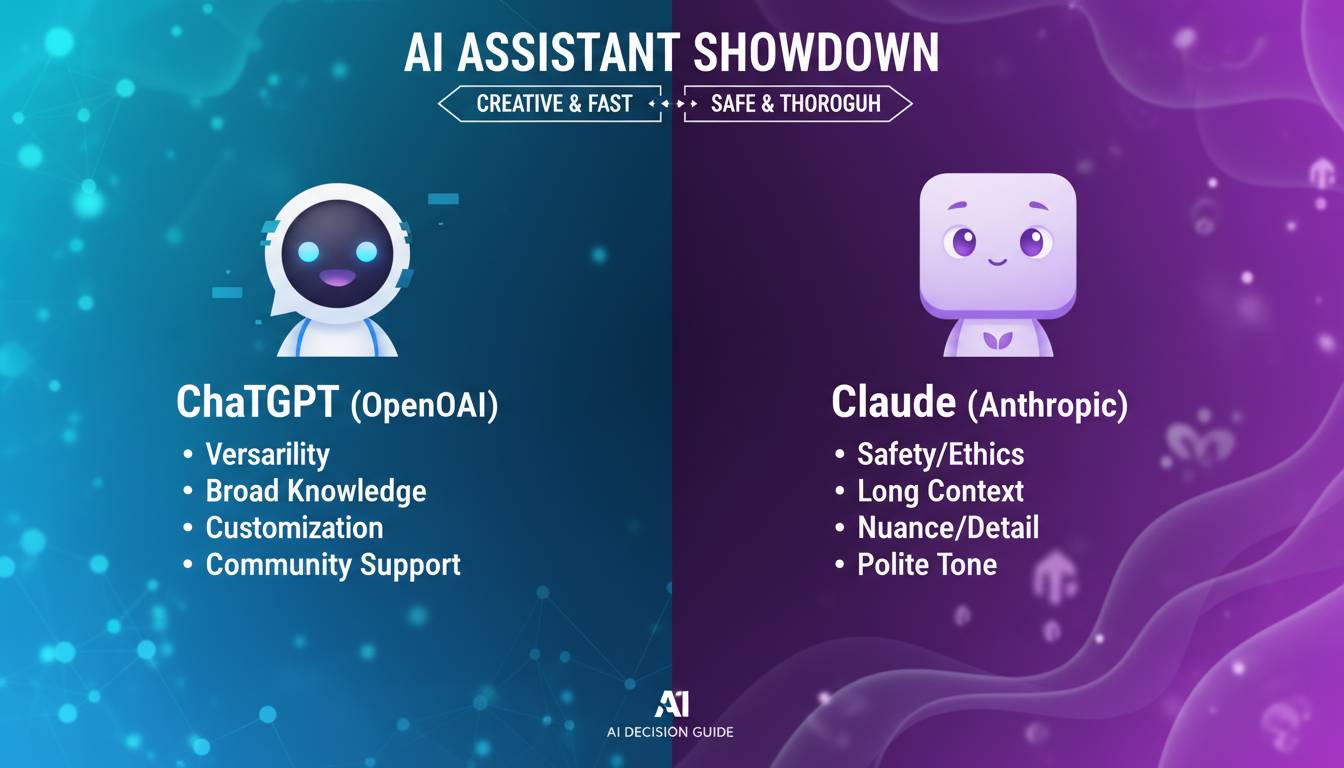
The short answer: Choose ChatGPT if you want a versatile, widely-integrated assistant with strong multimodal capabilities. Choose Claude if you prefer thoughtful, nuanced responses with industry-leading context windows and a focus on safety. Both are exceptional, but they serve different priorities.
For users deciding between these two dominant AI assistants, the choice isn’t about which is “better” — it’s about which aligns with your specific workflow, use case, and values. This comprehensive comparison breaks down everything you need to make an informed decision in 2024.
Understanding the Core Differences
ChatGPT and Claude represent two distinct philosophies in AI development, and understanding these foundational differences shapes everything about how each assistant behaves.
ChatGPT, built by OpenAI, launched in November 2022 and quickly became the fastest-growing consumer application in history. It operates on the GPT architecture (currently GPT-4o) and emphasizes broad capability, continuous feature expansion, and ecosystem integration. OpenAI’s approach has been to build a general-purpose assistant that excels across nearly every task category — from coding to creative writing to data analysis.
Claude, developed by Anthropic and launched in March 2023, was founded by former OpenAI researchers who prioritized a different direction. Anthropic emphasizes “constitutional AI” — a framework where assistant behavior is guided by a set of explicit principles designed to make outputs helpful, harmless, and honest. Claude tends to produce more measured, thoughtful responses and has historically led in context window length, allowing it to maintain coherence across much longer documents.
These founding philosophies create measurable differences in how each assistant approaches the same prompt. When asked to analyze a complex topic, Claude often provides more nuanced consideration of edge cases and potential implications. ChatGPT tends toward more direct, executable responses that prioritize getting to the answer quickly.
Pricing and Accessibility
Both assistants offer free tiers with significant capabilities, plus paid plans that unlock additional features and higher usage limits.
| Tier | ChatGPT | Claude |
|---|---|---|
| Free | GPT-4o mini access, limited prompts | Claude 3.5 Sonnet, standard limits |
| Plus | $20/month — GPT-4o, higher limits | $20/month — priority access, latest model |
| Pro | $200/month — unlimited access, o1 model | Coming soon |
ChatGPT’s pricing structure has evolved to include a Pro tier at $200/month that provides unlimited access to both GPT-4o and the o1 reasoning model. This makes it attractive for heavy users who need consistent access without worrying about rate limits.
Claude’s pricing remains simpler, with the $20/month Claude Pro representing the primary paid option. The free tier provides substantial capability — many users report the free version handles most tasks adequately — but the Pro tier ensures faster response times during peak usage periods.
For casual users, both free tiers offer enough capability to evaluate which assistant suits your needs before committing to a paid plan.
Performance and Capability Comparison
Coding and Technical Tasks
Both assistants excel at coding, but with different strengths that matter depending on your workflow.
ChatGPT integrates tightly with development environments through plugins and the Code Interpreter (now Advanced Data Analysis). It handles boilerplate code generation quickly and excels at explaining existing code in accessible terms. Its integration with GitHub Copilot (both are Microsoft/OpenAI products) means developers get AI assistance directly in their IDE.
Claude has earned particular praise in the developer community for its ability to handle large codebases. The extended context window means you can paste entire files or multiple files and get coherent analysis across them. Developers report that Claude often catches subtle bugs and suggests more elegant solutions, though this varies by task.
For pure code generation speed, ChatGPT holds a slight edge. For understanding and improving existing large codebases, Claude often performs better.
Writing and Content Creation
Writing tasks reveal more philosophical differences between the two assistants.
ChatGPT produces content efficiently and can match various tones and styles with minimal guidance. It generates quickly and handles follow-up requests well. The limitation: outputs sometimes feel generic or require more editing for truly polished prose.
Claude tends to produce more naturally flowing prose with better structural coherence. Users report that Claude’s writing feels more “human” in longer documents, with better transitions and a more consistent voice. The trade-off is that Claude sometimes takes longer to generate responses.
For drafting blog posts, emails, or marketing content, both work well. For nuanced long-form writing where voice consistency matters, many users prefer Claude.
Research and Analysis
When processing information and synthesizing insights, the assistants show meaningful differences.
ChatGPT with GPT-4o can browse the web in real-time, access uploaded files, and process images. This multimodal capability means it can analyze charts, diagrams, and screenshots directly. The integration with Microsoft services (Bing search, Azure) provides strong enterprise data access.
Claude leads in pure text analysis and has recently added PDF and document understanding. Its strength lies in deep textual reasoning — analyzing long documents, extracting nuanced insights, and maintaining coherence across extensive information. Claude often provides more careful consideration of limitations and uncertainties in its analysis.
For quick factual lookups, ChatGPT’s browsing capability is valuable. For deep analysis of complex documents, Claude often produces more thorough results.
Context Window and Memory
The context window — how much information the model can consider in a single conversation — represents a meaningful technical difference with practical implications.
Claude has historically led here, with context windows up to 200,000 tokens (approximately 150,000 words) in Claude 2.1. This allows pasting entire books, lengthy legal documents, or extensive codebases and maintaining coherent conversation across them. This is particularly valuable for research, legal work, and coding tasks involving large files.
ChatGPT offers 128,000 tokens in GPT-4o, which remains substantial but behind Claude’s current maximum. For most users, this difference is negligible — 128,000 tokens handle essentially any reasonable document. However, for specialized use cases involving very long documents, Claude holds an edge.
Neither assistant has perfect memory across sessions (though Claude’s “projects” feature helps organize conversations), so if you need persistent memory, you’ll need to use external tools or the paid tiers’ enhanced capabilities.
Safety, Alignment, and Ethical Considerations
This is where the assistants differ most philosophically, and the differences are worth understanding.
Anthropic built Claude from the ground up around “constitutional AI” — a framework that uses explicit principles to guide behavior rather than relying solely on reinforcement learning from human feedback. The result is an assistant that more frequently refuses potentially harmful requests with nuanced explanations, and that tends to flag limitations and uncertainties in its responses.
OpenAI’s approach with ChatGPT has evolved rapidly. GPT-4o includes significant safety improvements over earlier versions, and the system has become more willing to engage with challenging topics when users have legitimate purposes. However, some users report that Claude feels more “cautious” overall.
For users with legitimate professional needs, both assistants are highly capable. The differences become noticeable primarily at the margins — requests that push boundaries — where Claude more consistently errs on the side of caution.
Ecosystem and Integration
Your existing tools and workflow significantly influence which assistant provides more value.
ChatGPT benefits from OpenAI’s ecosystem: direct integration with Microsoft products (Teams, Office, Bing), the ability to generate images via DALL-E 3, voice conversation capabilities, and the extensive plugin ecosystem. If you already use Microsoft 365, the integration provides tangible workflow benefits.
Claude integrates well with common tools but lacks the same depth of ecosystem connection. Anthropic has focused on API partnerships and enterprise integrations rather than consumer ecosystem expansion. The Claude desktop app provides local file access, and various third-party tools have added Claude support, but the integration depth differs.
For individual users, both work well. For enterprises already invested in Microsoft products, ChatGPT’s integration advantages are meaningful.
Use Case Recommendations
Based on the strengths outlined above, here’s a decision framework:
Choose ChatGPT if:
– You need real-time web browsing and current information
– You want image generation capabilities
– You use Microsoft products and want deep integration
– Speed and directness matter more than nuanced depth
– You want the widest range of third-party integrations
Choose Claude if:
– You work with long documents and need to maintain context
– You value thoughtful, nuanced responses over fastest answers
– Safety and careful consideration of implications matter
– You prioritize natural prose quality in generated content
– You prefer AI that more frequently acknowledges limitations
The Reality of Both
It’s worth noting: both assistants are remarkably capable, and the differences that matter for most users are smaller than the differences from a year ago. Many users benefit from maintaining accounts with both — using ChatGPT for quick tasks and research, Claude for deeper analysis and writing.
The “right choice” depends heavily on your specific use case, and the best approach may be using both strategically rather than committing exclusively to one.
Frequently Asked Questions
Can I use both ChatGPT and Claude for free?
Yes, both offer capable free tiers. ChatGPT free provides access to GPT-4o mini with limited daily prompts, while Claude free gives you access to Claude 3.5 Sonnet with standard usage limits. Both free versions handle most everyday tasks effectively.
Which is better for coding?
Both are excellent for coding, with different strengths. ChatGPT integrates more seamlessly with development environments and handles quick code generation slightly faster. Claude often provides better understanding of large codebases due to its larger context window. Many developers use both depending on the specific task.
Is Claude actually safer than ChatGPT?
Both have strong safety measures, but Claude’s constitutional AI approach tends to be more conservative in its responses. For typical professional use cases, both are safe. The differences become noticeable primarily with requests that push boundaries, where Claude more consistently provides nuanced refusals.
Do they have mobile apps?
Yes, both offer mobile apps. ChatGPT has iOS and Android apps with voice capabilities. Claude’s mobile app is available on both platforms and includes the same capabilities as the web version.
Which one has better memory?
Neither has perfect long-term memory across sessions. Both offer limited memory within conversations and use features like “projects” (Claude) or custom instructions (ChatGPT) to provide some context persistence. For truly persistent memory, you’ll need external tools.
Can I use either for commercial work?
Yes, both allow commercial use of outputs. Both also offer API access for building applications. Check each platform’s current terms of service for specific commercial licensing details, as these evolve.