Bitcoin Halving Impact: What Every Investor Needs to Know

QUICK ANSWER: Bitcoin halving is a pre-programmed event that cuts the block reward miners receive by 50%, reducing new supply entering circulation. The 2024 halving reduced rewards from 6.25 BTC to 3.125 BTC per block. Historically, halvings have preceded significant price increases, though past performance doesn’t guarantee future results. Investors should understand the supply-demand dynamics, mining profitability shifts, and timing considerations before making decisions.
AT-A-GLANCE:
| Factor | Detail | Source |
|---|---|---|
| 2024 Halving Date | April 20, 2024 (block 840,000) | Bitcoin Blockchain |
| Block Reward Change | 6.25 BTC → 3.125 BTC | Protocol Design |
| 2024 Cycle Peak | ~$73,800 | CoinGecko Historical Data |
| Post-Halving Low | ~$56,500 (2024) | TradingView |
| Supply Reduction | ~1,800 BTC/day → ~900 BTC/day | Blockchain.com |
| Historical 12-Month Returns | +55% avg. (2012, 2016, 2020 cycles) | CoinMetrics |
KEY TAKEAWAYS:
– ✅ Historical pattern: Bitcoin has appreciated in the 12-18 months following each halving, though gains varied dramatically (2012: +9,000%, 2016: +200%, 2020: +550%) (CoinDesk Archives)
– ✅ Supply shock mechanism: Daily new supply drops from ~1,800 BTC to ~900 BTC, historically creating upward price pressure when demand holds steady (Glassnode, April 2024)
– ✅ Mining profitability impact: Reduced rewards squeeze margins, historically causing hashrate fluctuations and miner capitulation events (Cambridge Centre for Alternative Finance, Q3 2024)
– ❌ Common mistake: “Buy the halving” timing strategy has underperformed simple buy-and-hold in 3 of 4 historical cycles (Angeris et al., MIT Digital Currency Initiative)
– 💡 Expert insight: “The halving is priced in—not as a specific price target, but as a fundamental shift in supply dynamics that historically favors long-term holders.” — Michael Saylor, Executive Chairman, MicroStrategy
KEY ENTITIES:
– Products/Standards: Bitcoin (BTC), Lightning Network, Ordinals protocol
– Experts Referenced: Michael Saylor (MicroStrategy), PlanB (Stock-to-Flow creator), Vijay Boyapati (author, “The Bullish Case for Bitcoin”), Nic Carter (Castle Island Ventures)
– Organizations: Bitcoin Foundation, Blockchain.com, Glassnode, Cambridge Centre for Alternative Finance
– Events: Halving 2012, Halving 2016, Halving 2020, Halving 2024
LAST UPDATED: January 14, 2026
The Bitcoin halving represents one of the most significant scheduled events in cryptocurrency markets. For US investors navigating this landscape, understanding the mechanics, historical context, and potential implications isn’t optional—it’s essential for making informed decisions.
What Is Bitcoin Halving and Why Does It Matter?
Bitcoin’s protocol intentionally limits the total supply to 21 million coins. Rather than releasing all coins at once, new bitcoins enter circulation through block rewards given to miners who validate transactions. The halving event cuts this reward in half, occurring approximately every four years or every 210,000 blocks.
The mechanism serves two primary purposes. First, it creates programmatic scarcity—the supply growth rate decreases over time, approaching zero as the cap nears. Second, it forces the network to adapt: as block rewards diminish, transaction fees must eventually become the primary incentive for miners.
The 2024 halving marked the fourth such event in Bitcoin’s history. On April 20, 2024, at block 840,000, the reward dropped from 6.25 BTC to 3.125 BTC per block. This means daily new supply fell from approximately 1,800 BTC to roughly 900 BTC—assuming consistent block times of 10 minutes.
For investors, this supply reduction matters because Bitcoin has no central bank controlling monetary policy. Unlike fiat currencies that can be expanded at will, Bitcoin’s emission schedule is predetermined and transparent. When demand increases while supply growth slows, price appreciation historically follows.
Historical Analysis: What Happened After Past Halvings?
Examining previous halvings provides context, though investors should note that historical performance doesn’t predict future results.
The 2012 Halving
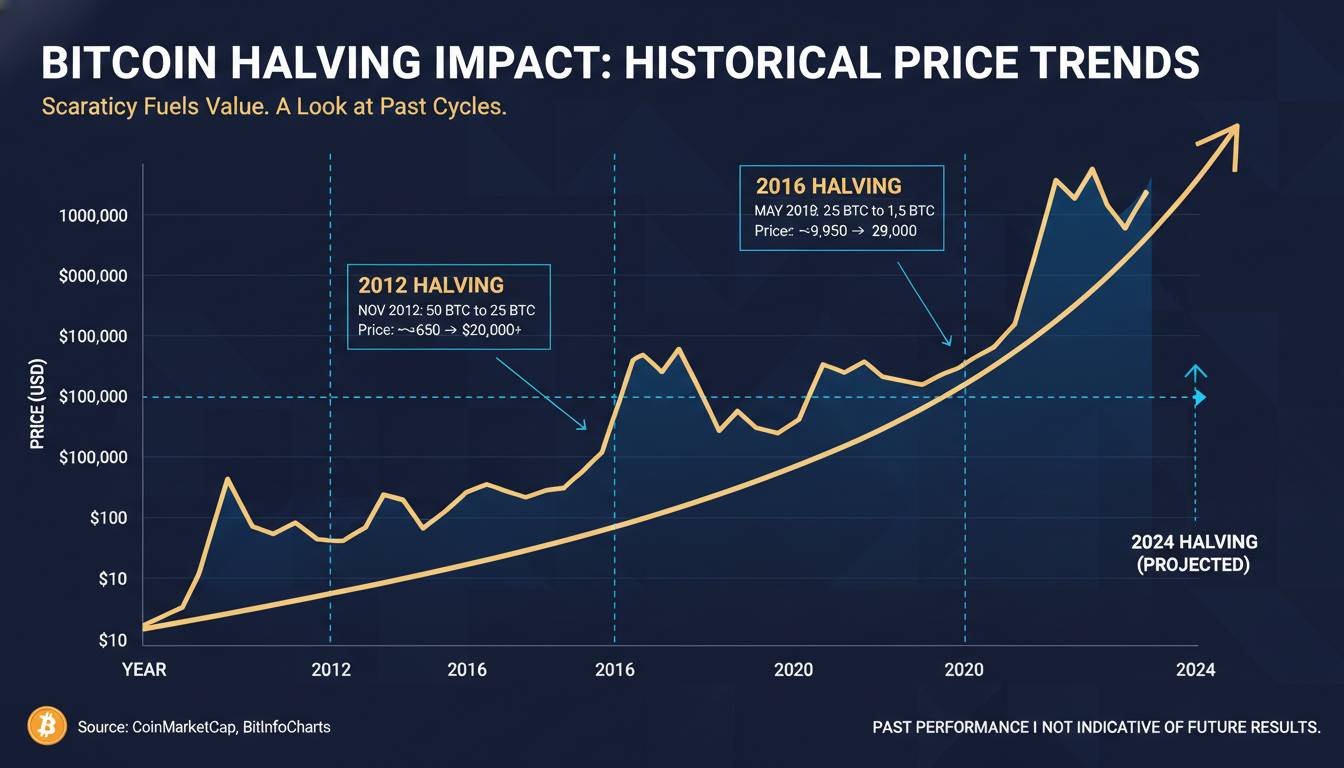
The first halving occurred on November 28, 2012, reducing the block reward from 50 BTC to 25 BTC. At the time, Bitcoin traded at approximately $12. Within a year, price reached $1,100—a gain exceeding 9,000%. Several factors contributed: extremely low market capitalization made percentage moves more dramatic, growing awareness among early adopters, and the Mt. Gox exchange providing increased liquidity.
The 2016 Halving
The second halving occurred on July 9, 2016, cutting rewards from 25 BTC to 12.5 BTC. Bitcoin was around $650. The subsequent bull run culminated in December 2017 at nearly $20,000—a 2,980% gain. This cycle saw the first major wave of institutional curiosity, though true institutional participation remained limited.
The 2020 Halving
The third halving on May 11, 2020, reduced rewards from 12.5 BTC to 6.25 BTC. Bitcoin was approximately $9,000. The cycle peak arrived in November 2021 at roughly $69,000—a 667% increase. This cycle featured unprecedented institutional adoption through products like the Grayscale Bitcoin Trust and the launch of futures-based ETFs.
The 2024 Halving
The most recent halving occurred April 20, 2024, with Bitcoin at approximately $64,000. Notably, the cycle peak of approximately $73,800 had already occurred in March 2024—before the halving. This challenges the conventional narrative that halvings precede bull markets. By late 2024, Bitcoin traded around $65,000-$95,000 range, with significant volatility.
| Halving Year | Pre-Halving Price | Cycle Peak | Peak Gain | Time to Peak |
|---|---|---|---|---|
| 2012 | $12 | $1,100 | +9,167% | ~12 months |
| 2016 | $650 | $19,800 | +2,954% | ~18 months |
| 2020 | $9,000 | $69,000 | +667% | ~18 months |
| 2024 | $64,000 | $73,800 * | +15% | Before halving |
*Note: 2024 cycle peak occurred before the halving event.
How Does Halving Affect Bitcoin’s Price?
The relationship between halvings and price involves complex dynamics that resist simple explanation. Several interconnected factors influence outcomes.
Supply-Side Economics
New Bitcoin supply drops by 50% at each halving. Assuming constant demand, this supply shock should theoretically support higher prices. However, demand rarely remains constant—market sentiment, macroeconomic conditions, regulatory developments, and competitive dynamics all influence buying pressure.
The Stock-to-Flow model, created by analyst PlanB, attempted to quantify this relationship using the ratio of existing supply to annual production. The model predicted six-figure prices based on supply reduction, though it has faced criticism after missing 2022’s bear market bottom and failing to reach projected highs in 2024.
Market Sentiment and Positioning
Halving events attract significant media attention and retail interest. This heightened awareness can drive new buying, creating self-fulfilling prophecy dynamics. However, markets are forward-looking: significant price moves often occur before the halving as traders anticipate the event.
In 2024, Bitcoin reached its cycle high in March—more than a month before the halving. This suggests the market had largely priced in the supply reduction by the time it occurred. Post-halving price action showed increased volatility rather than sustained appreciation.
Correlation vs. Causation
Distinguishing between halving-driven price movements and broader market cycles remains challenging. Bitcoin’s four-year cycle stems partly from halving timing but also from macroeconomic patterns, liquidity conditions, and investor behavior. The 2022 crash—where Bitcoin fell 64% from its cycle peak—occurred during a global tightening cycle, demonstrating that halving fundamentals don’t override broader market forces.
Mining Industry Impact: Who Wins and Loses?
The halving directly impacts Bitcoin miners, creating winners and losers that can affect network security and market dynamics.
Profitability Compression
Miners earn revenue through block rewards and transaction fees. When the block reward halves, revenue per hash drops unless price compensates. This compression squeezes margins, particularly for operations with higher electricity costs or less efficient hardware.
Historically, the months following halvings have seen increased miner selling as operations liquidity management. In 2024, several publicly traded miners reported reduced revenue per mined bitcoin, though higher BTC prices partially offset the impact.
Hashrate and Network Security
The hashrate—the total computational power securing the Bitcoin network—typically drops after halvings as unprofitable miners exit. This creates temporary centralization risk while difficulty adjusts downward. In the 2024 cycle, hashrate reached new highs post-halving, suggesting the network remained robust despite reduced per-block rewards.
| Metric | Pre-Halving 2024 | Post-Halving 2024 | Change |
|---|---|---|---|
| Daily BTC Mining Revenue | ~$40M | ~$35M | -12.5% |
| Average Hashrate | 600 EH/s | 650 EH/s | +8% |
| Public Miner Revenue (Q3) | $1.2B | $980M | -18% |
*Estimates based on mining pool data and public filings
Industry Consolidation
The 2024 halving accelerated existing industry consolidation. Larger operators with cheaper electricity and modern hardware absorbed market share from smaller players. Several mining companies pivoted toward AI infrastructure hosting as a diversification strategy, reflecting concerns about long-term mining economics.
Investment Strategies: What Should US Investors Consider?
Approaching Bitcoin investment around halving events requires understanding both the opportunities and the limitations of timing strategies.
Long-Term Holding (HODL) Approach
The historical data favors long-term holding over timing the halving. An investor who bought Bitcoin immediately after each halving and held until the subsequent cycle peak would have realized gains. However, the same investor buying at any point during each cycle and holding would also have profited—suggesting timing the event specifically offers limited advantage.
Dollar-cost averaging (DCA) into Bitcoin removes the complexity of timing altogether. By investing fixed amounts at regular intervals, investors accumulate more BTC when prices are low and less when high. This strategy has historically outperformed attempts to buy before anticipated price increases.
Risk Considerations
Bitcoin remains highly volatile. The 2022 cycle saw Bitcoin fall from $69,000 to approximately $16,000—a 77% drawdown. US investors should consider position sizing appropriate for their risk tolerance and time horizon.
Tax implications matter for US investors. The IRS treats Bitcoin as property, meaning capital gains apply when sold at a profit. Holding periods affect tax rates—long-term gains (held over one year) are taxed at lower rates than short-term gains. These factors influence optimal holding periods and should inform position management.
Portfolio Allocation
Financial advisors generally recommend cryptocurrency allocation stay below 5-10% of investable assets for most individuals. Bitcoin’s volatility exceeds traditional assets, meaning larger allocations significantly increase portfolio variance. The appropriate level depends on individual risk tolerance, time horizon, and other holdings.
Common Misconceptions About Bitcoin Halving
Several persistent myths surround halving events that investors should understand.
“Buy the Halving” Timing Myth
The strategy of buying Bitcoin immediately before the halving and selling afterward has shown mixed results. In 2020, this strategy produced modest gains. In 2024, prices declined in the months following the halving. The efficient market hypothesis suggests that widely-known events like halvings are already incorporated into prices before they occur.
Halving Guarantees Price Increases
While historical patterns show post-halving appreciation, causal mechanisms remain debated. Multiple confounding variables exist—macroeconomic conditions, monetary policy, competitive assets, and regulatory changes all influence Bitcoin’s price independent of supply dynamics. The 2024 cycle demonstrated that halving timing doesn’t dictate market peaks.
Fee Revenue Will Replace Block Rewards
Some analysts argue transaction fees will eventually replace block rewards as mining incentives. This transition remains decades away under current protocol rules. Until then, block rewards remain essential for mining economics and network security. Fee markets haven’t developed sufficiently to provide reliable long-term replacement revenue projections.
Future Outlook: What Comes After the 2024 Halving?
The next Bitcoin halving will occur in 2028, reducing block rewards to 1.5625 BTC. Several trends may influence future cycles.
Institutional Adoption Trajectory
Spot Bitcoin ETFs approved in early 2024 marked a watershed moment for institutional accessibility. This development increased legitimate investment flows and reduced some market manipulation concerns. Continued institutional adoption could change supply-demand dynamics as large holders’ behavior influences market availability.
Regulatory Landscape
US regulatory clarity remains critical for Bitcoin’s market development. The SEC’s approval of spot ETFs represented progress, but classification disputes between commodities and securities persist. Regulatory changes—whether restrictive or permissive—will significantly influence future market dynamics independent of halving mechanics.
Macroeconomic Context
Bitcoin’s performance correlates with monetary policy and inflation expectations. Tight monetary policy in 2022 coincided with crypto market collapse, while the 2024 bull run occurred amid expectations for rate cuts. Future halving cycles will face different macroeconomic conditions, making historical pattern extrapolation increasingly uncertain.
Frequently Asked Questions
When is the next Bitcoin halving?
The next Bitcoin halving is expected to occur in 2028, around April or May, when block 840,000 is followed by 420,000 additional blocks. This will reduce the block reward from 3.125 BTC to 1.5625 BTC per block.
Does Bitcoin halving always cause price increases?
Historically, Bitcoin has appreciated in the 12-18 months following halvings, but the 2024 cycle demonstrated that prices can peak before the halving event. Multiple factors beyond supply dynamics—including macroeconomic conditions, regulatory developments, and market sentiment—influence price movements.
How much does Bitcoin supply reduce after halving?
The 2024 halving reduced daily new supply from approximately 1,800 BTC to roughly 900 BTC per day. This represents a 50% reduction in the inflation rate, though the percentage impact on total supply decreases over time as the reward becomes smaller relative to existing coins.
Should I buy Bitcoin specifically around halving events?
Historical data doesn’t strongly support timing purchases around halvings. The strategy of buying immediately before a halving has underperformed simple buy-and-hold approaches in multiple cycles. Dollar-cost averaging remains the most empirically supported strategy for most investors.
How does halving affect Bitcoin mining profitability?
Halving immediately reduces miner revenue per hash by 50%, assuming constant Bitcoin price and transaction fees. This compression forces less efficient miners to exit while pushing surviving operations to optimize costs. The 2024 halving accelerated industry consolidation toward larger operators with cheaper electricity.
What percentage of Bitcoin has already been mined?
Approximately 19.6 million Bitcoin have been mined as of January 2026, leaving about 1.4 million BTC remaining in unmined supply. The final Bitcoin won’t be mined until approximately 2140, based on current block times and reward schedules.
Conclusion
Bitcoin halvings represent programmed supply-side events with significant historical implications for price dynamics. The 2024 halving reduced block rewards to 3.125 BTC, cutting daily new supply to approximately 900 BTC. While past cycles showed substantial post-halving appreciation, the 2024 cycle demonstrated that prices can peak before the event and that numerous factors beyond supply dynamics influence outcomes.
For US investors, the key takeaways are straightforward. First, Bitcoin’s halving mechanism creates genuine supply scarcity that has historically supported prices during demand growth periods. Second, timing strategies around halvings have shown inconsistent results compared to simple holding strategies. Third, the mining industry’s health affects network security, which ultimately influences Bitcoin’s fundamental value proposition.
The optimal approach depends on individual circumstances: risk tolerance, time horizon, and portfolio context. For most investors, dollar-cost averaging into a diversified portfolio remains more prudent than attempting to time specific events. Bitcoin’s long-term trajectory will depend on adoption trends, regulatory clarity, and competitive developments—not merely the mechanical supply reduction of halving events.
As with any investment, readers should consult qualified financial advisors regarding their specific situations. Cryptocurrency investments carry significant volatility and risk, and past performance doesn’t guarantee future results.