Biometric Security Devices for Home: Complete Guide

Biometric security devices for home use authenticate identity through unique physiological characteristics—fingerprint patterns, facial features, iris scans, and voice recognition—replacing traditional keys, PINs, and passwords. These devices provide homeowners with keyless entry, real-time access monitoring, and enhanced protection against unauthorized entry. The residential biometric security market has expanded rapidly as technology costs decreased and consumer awareness increased, making sophisticated access control accessible to average homeowners rather than limited to commercial or high-net-worth applications.
This comprehensive guide examines the technology behind biometric home security, evaluates available device categories, outlines critical purchasing considerations, and provides actionable recommendations for implementing biometric access control in residential settings.
Understanding Biometric Technology for Residential Security
Biometric authentication relies on the fundamental principle that certain physiological and behavioral characteristics are unique to each individual and remain relatively stable over time. Unlike keys that can be copied or passwords that can be forgotten, biometric markers cannot be easily duplicated or transferred. This inherent uniqueness makes biometric verification significantly more secure than traditional authentication methods.
Fingerprint recognition remains the most widely adopted residential biometric technology. Capacitive sensors in modern devices read the ridges and valleys of fingerprint patterns, creating a detailed digital map that cannot be replicated from a latent print left on surfaces. Leading manufacturers achieve false acceptance rates below 0.001% with sophisticated algorithms that detect liveness—distinguishing between living tissue and artificial replicas.
Facial recognition technology has achieved mainstream adoption primarily through smartphone integration, but residential applications have expanded substantially. These systems capture multiple data points across facial geometry—eye spacing, nose bridge width, jawline structure, and other distinguishing features—to create a three-dimensional biometric template. Modern residential devices incorporate infrared sensors to function effectively in low-light conditions and resist spoofing attempts using photographs or videos.
Iris scanning represents one of the most accurate biometric modalities, with false acceptance rates potentially below one in ten billion. While historically associated with high-security commercial applications, iris recognition has begun entering the residential market through advanced smart locks and multi-modal devices that combine multiple biometric verification methods.
The technology operates through a three-phase process: enrollment captures the initial biometric sample and converts it to a digital template; storage maintains this template securely within the device or cloud infrastructure; and verification compares subsequent scans against stored templates using algorithmic matching that produces a confidence score determining access approval or denial.
Types of Biometric Security Devices Available for Homes
The residential biometric security market offers several distinct device categories, each addressing specific security requirements and integration preferences.
Smart Locks with Biometric Access
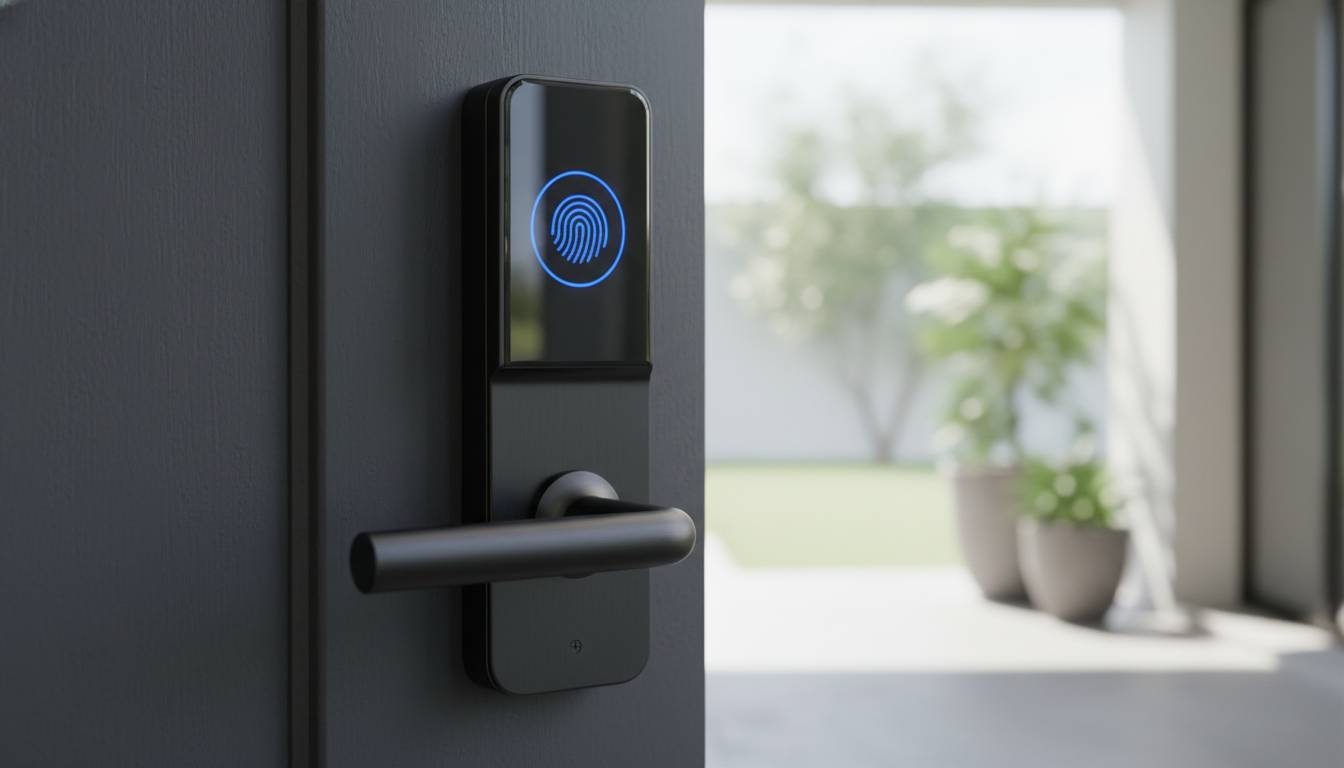
Biometric smart locks represent the largest product category in residential biometric security. These devices replace or augment traditional deadbolts with electronic locking mechanisms controllable through fingerprint, facial recognition, or combined authentication methods. The integration of biometric sensors directly into door locks eliminates the need for keys entirely while providing multiple access methods for family members, guests, and service personnel.
Leading smart lock manufacturers including Schlage, Yale, August, and Samsung offer fingerprint-enabled models priced between $150 and $350, with premium options incorporating multiple biometric modalities. Most devices store between 20 and 100 individual fingerprint templates locally, sufficient for typical household needs. Battery life typically ranges from six months to two years depending on usage frequency and connectivity options.
Video Doorbells with Facial Recognition
Smart video doorbells have evolved beyond simple motion-activated cameras to incorporate facial recognition capabilities. Devices from Ring, Google Nest, and Arlo can identify registered household members and frequent visitors, sending smartphone notifications that specify who arrived at the door. This functionality proves particularly valuable for monitoring deliveries, identifying visitors before answering, and maintaining awareness of household comings and goings.
Facial recognition doorbells typically require cloud processing for the actual identification algorithm, raising legitimate privacy considerations that warrant careful evaluation. However, these devices provide substantial security benefits through continuous exterior monitoring and intelligent alerting that distinguishes between people, vehicles, animals, and other motion triggers.
Biometric Safe Boxes and Cabinets
Residential biometric safes protect valuable items, documents, weapons, and medications through fingerprint or facial recognition access. These devices range from small desktop safes suitable for jewelry and important documents to larger floor-mounted units capable of securing multiple weapon storage or substantial valuable collections. SentrySafe, Boltaway, and Fingerprintjs offer residential biometric safe options across various price points from $100 to $800 depending on capacity and security rating.
Multi-Modal Biometric Systems
Advanced residential security installations increasingly incorporate multi-modal biometric systems that require verification through multiple characteristics simultaneously or sequentially. These systems might combine fingerprint and facial recognition, or integrate biometric access with traditional PIN codes for enhanced security. Multi-modal approaches significantly reduce false acceptance rates and provide redundancy if one biometric modality fails or becomes unavailable.
The Samsung SHP-DS510 and comparable premium smart locks offer dual biometric verification options, while integrated home security platforms from ADT, Vivint, and Honeywell can coordinate multiple biometric entry points throughout a residence within a unified security ecosystem.
Benefits of Implementing Biometric Home Security
The advantages of biometric residential security extend beyond simple keyless convenience, encompassing meaningful security improvements, operational benefits, and long-term value considerations.
Enhanced Security Performance
Biometric authentication eliminates the most vulnerable elements of traditional access control—lost, stolen, or duplicated keys and forgotten or shared codes. A study by the Security Industry Association found that 28% of residential burglars gain entry through unlocked doors, while an additional percentage exploit weak lock mechanisms. Biometric access virtually eliminates unauthorized entry through key duplication or code discovery.
The FBI’s Uniform Crime Reporting Program indicates that law enforcement clears only approximately 13% of reported burglaries, making prevention substantially more valuable than post-incident resolution. Biometric security devices provide meaningful deterrent effects and access logging that assists investigation if incidents occur.
Operational Convenience and Access Management
Modern families benefit from sophisticated access management without the complexity of physical key distribution. Biometric smart locks allow homeowners to grant temporary access to house cleaners, dog walkers, or guest visitors with scheduled time windows, then revoke access instantly through smartphone applications. This capability proves particularly valuable for rental property owners managing short-term or seasonal tenants.
Access logs maintained by biometric devices provide detailed records of entry times and authenticated users. Parents can monitor children’s arrival times, homeowners can verify service provider visits, and property managers can maintain comprehensive access audit trails—all information impossible to obtain from traditional lock-and-key systems.
Integration with Smart Home Ecosystems
Biometric security devices integrate seamlessly with broader smart home platforms, enabling automated responses triggered by authorized entry. Upon recognizing an authorized fingerprint or face, smart locks can trigger lighting adjustments, climate control changes, or security system disarming through routines established through platforms like Apple HomeKit, Google Home, Amazon Alexa, or dedicated security applications.
This integration extends to voice assistants, enabling commands like “Hey Google, unlock the front door” after voice recognition confirms the homeowner’s identity. The convergence of biometric verification with ambient computing creates increasingly sophisticated residential security environments that respond intelligently to occupant presence and preferences.
Critical Features to Evaluate When Purchasing
Selecting appropriate biometric security devices requires evaluation of multiple technical specifications, integration capabilities, and practical considerations that determine real-world performance.
Authentication Accuracy and Speed
False acceptance rate (FAR) and false rejection rate (FRR) represent the fundamental accuracy metrics for biometric devices. FAR measures the probability that an unauthorized individual gains access incorrectly, while FRR measures the probability that authorized users are incorrectly denied. Premium residential devices achieve FAR below 0.001% and FRR below 1%, though these specifications vary substantially across manufacturers and price points.
Verification speed matters practically—fingerprint recognition should complete within one second, while facial recognition typically requires two to three seconds. Slower verification creates frustration and encourages workarounds that undermine security. Many devices offer adjustable security settings that balance speed against stricter verification requirements.
Power Management and Connectivity
Battery-powered biometric locks require careful power consideration. Most devices utilize four AA batteries providing six months to two years of operation depending on traffic volume and connectivity features. Low-battery warnings should arrive well before power exhaustion, and physical key overrides or external battery connections should provide backup entry options.
Connectivity options—Bluetooth, Wi-Fi, Z-Wave, or Zigbee—determine integration capabilities and remote access features. Bluetooth offers reliable short-range connectivity without Wi-Fi network dependence, while Wi-Fi enables remote monitoring and control from anywhere with internet access. Z-Wave and Zigbee protocols support integration with broader smart home ecosystems but require compatible hubs.
Physical Security and Durability
Biometric devices provide electronic authentication but must integrate with physically secure door preparation. Smart lock deadbolts should meet ANSI/BHMA Grade 2 or Grade 1 standards for residential lock security, indicating resistance to forced entry, kick-in attempts, and environmental degradation. Weather resistance ratings (IP codes) matter for exterior installations, particularly in regions with extreme temperature variations or precipitation.
The sensor itself requires evaluation—capacitive fingerprint sensors resist spoofing better than optical sensors, while premium devices incorporate additional liveness detection mechanisms that verify blood flow, temperature patterns, or other living tissue indicators to prevent authentication using artificial replicas.
Data Security and Privacy Practices
Biometric templates stored locally on devices provide superior privacy compared to cloud-stored data, which introduces potential interception or breach risks. However, even local storage requires evaluation of encryption practices and manufacturer security histories. The biometric template should be stored in encrypted format inaccessible to unauthorized parties.
For devices requiring cloud processing—particularly facial recognition systems—understanding manufacturer data handling practices becomes essential. Review privacy policies regarding data retention, sharing practices, and compliance with relevant regulations like California’s CCPA or emerging state biometric privacy laws.
Top Biometric Security Device Recommendations
Based on feature sets, authentication performance, integration capabilities, and consumer testing, several devices stand out in their respective categories.
Best Fingerprint Smart Lock: Schlage Encode Plus
The Schlage Encode Plus combines built-in Wi-Fi connectivity, Apple HomeKit compatibility, and fingerprint-free integration that works with Apple Watch and iPhone for keyless entry. For traditional fingerprint recognition, the Schlage Sense provides dedicated fingerprint authentication storing up to 30 fingerprints with quick verification under one second. Both devices meet ANSI/BHMA Grade 1 security standards and offer robust physical construction backed by Schlage’s established reputation in lock manufacturing.
Best Value Biometric Lock: Yale Assure Lock 2
The Yale Assure Lock 2 offers excellent value with optional fingerprint modules available for approximately $250 total cost. The modular design allows initial purchase with keypad-only functionality, adding fingerprint capability later if desired. The device integrates with major smart home platforms and provides reliable performance with straightforward installation—Yale’s century of lock-making experience evident in mechanical quality.
Best Video Doorbell with Facial Recognition: Google Nest Doorbell (Wired)
The Google Nest Doorbell (wired) incorporates intelligent alerting that recognizes familiar faces when enrolled through Google Home, delivering person-specific notifications rather than generic motion alerts. The device records continuous video with HDR quality, provides two-way talk functionality, and integrates deeply with Google Home ecosystems for automated responses. While facial recognition requires a Nest Aware subscription, the overall package provides substantial security value.
Best Budget Option: Eufy Smart Lock S230
The Eufy Smart Lock S230 delivers fingerprint recognition, app control, and physical key backup at approximately $130—substantially below competitors for comparable features. The device stores up to 50 fingerprints locally, offers six-month battery life, and includes an IP65 weather resistance rating. While the physical construction and integration ecosystem fall short of premium alternatives, the value proposition proves compelling for budget-conscious homeowners.
Installation and Implementation Best Practices
Successful biometric security implementation requires attention to physical installation, user enrollment procedures, and ongoing maintenance.
Physical Installation Considerations
Biometric smart locks require standard door preparation—most devices accommodate doors 1.375 to 2 inches thick with appropriate backset measurements (distance from door edge to hole center). Measure existing door preparations carefully before purchasing, and verify that new hardware matches or exceeds current lock security ratings.
Exterior sensor placement should consider environmental exposure and lighting conditions. Facial recognition devices require clear sightlines without obstructions, while fingerprint sensors benefit from covered installation protecting against direct sunlight and precipitation. Many homeowners position fingerprint scanners on interior sides of doors while integrating exterior entry with other authentication methods or keypad access.
Enrollment Best Practices
Proper enrollment dramatically affects biometric authentication success. For fingerprint enrollment, position fingers at multiple angles during the registration process—center, left side, right side, and various pressures—to create comprehensive templates that accommodate natural variation in finger placement during verification. Enroll two or three fingers per household member to provide alternatives if minor injuries or contamination affect typical placement.
Facial recognition enrollment requires capturing reference images under various lighting conditions that typically occur at the entry point. Position faces at natural standing and sitting heights during enrollment, and ensure the device’s field of view accommodates typical approach angles without requiring users to stop and present specifically to the camera.
Ongoing Maintenance
Fingerprint sensors accumulate oils, dirt, and debris that degrade recognition performance. Periodic cleaning with microfiber cloth maintains sensor clarity without damaging delicate components. Avoid chemical cleaners that might damage sensor coatings, and ensure fingers are relatively clean and dry before authentication attempts.
Battery replacement should occur at manufacturer-recommended intervals rather than waiting for complete exhaustion. Keep spare batteries available, and test backup entry methods (physical keys, external battery connections) periodically to ensure functionality when needed.
Addressing Privacy and Security Concerns
Biometric residential security raises legitimate privacy considerations that informed consumers should evaluate carefully.
Data Protection Considerations
Unlike passwords that can be changed following a breach, compromised biometric characteristics cannot be replaced—you possess limited fingerprints and one facial structure. This permanence underscores the importance of selecting devices with strong security architectures and favorable manufacturer practices.
Local-only storage provides the strongest privacy protection, ensuring biometric templates never leave the device. However, this approach limits features requiring cloud processing, particularly facial recognition in video doorbells. Evaluate the tradeoffs between functionality and privacy based on personal comfort levels and specific use cases.
Regulatory Environment
Biometric privacy regulations remain fragmented, with Illinois’ BIPA (Biometric Information Privacy Act) representing the most comprehensive state-level protection, requiring informed consent before collection and establishing private rights of action for violations. California’s CCPA and similar state laws provide some biometric protections, though less specifically than BIPA.
The absence of comprehensive federal biometric privacy legislation creates uneven protection across jurisdictions. Consumers should understand manufacturer data practices and consider privacy implications particularly for cloud-connected devices that transmit biometric data for processing.
Physical Security Integration
Biometric devices should complement rather than replace comprehensive security strategies. Smart locks provide convenient access control but remain vulnerable to physical attack, environmental manipulation, or connectivity exploits. Optimal residential security integrates biometric access with security cameras, alarm systems, motion sensors, and professional monitoring services.
Conclusion
Biometric security devices have transitioned from luxury installations to practical residential security solutions offering meaningful protection improvements over traditional lock-and-key access control. Fingerprint smart locks, facial recognition doorbells, and biometric safes provide tangible benefits including elimination of lost key vulnerabilities, sophisticated access management capabilities, and integration with broader smart home ecosystems.
Successful implementation requires careful evaluation of authentication accuracy, connectivity options, physical security ratings, and data privacy practices against individual requirements and budget constraints. Premium devices from established manufacturers like Schlage, Yale, and Nest deliver reliable performance backed by security industry experience, while budget options like Eufy provide accessible entry points for cost-conscious consumers.
The residential biometric security market continues evolving rapidly, with declining costs, improving accuracy, and expanding capabilities making sophisticated access control achievable for mainstream homeowners. By understanding available technologies, evaluating key features, and implementing devices thoughtfully within comprehensive security strategies, homeowners can meaningfully enhance residential protection through biometric authentication.
Frequently Asked Questions
How secure are biometric smart locks compared to traditional locks?
Biometric smart locks with ANSI/BHMA Grade 1 or Grade 2 certification provide physical security comparable to traditional high-quality deadbolts while adding authentication security that eliminates key duplication risks. The electronic components introduce potential vulnerabilities (connectivity exploits, software bugs), but premium devices incorporate encryption, security certifications, and regular firmware updates that address emerging threats. Most security professionals consider properly implemented biometric locks more secure than traditional locks when considering the complete threat landscape including lost key recovery.
Can biometric fingerprint scanners be fooled by fake fingerprints?
Modern capacitive fingerprint sensors with liveness detection resist spoofing attempts using artificial replicas. Advanced sensors detect blood flow, temperature patterns, and other living tissue characteristics that distinguish authentic fingers from gelatin, silicone, or other materials. However, lower-cost devices with basic optical sensors remain vulnerable to sophisticated spoofing attempts. Selecting devices with demonstrated liveness detection capabilities and strong manufacturer security practices provides meaningful protection against replay attacks.
What happens if the biometric device malfunctions or batteries die?
Quality biometric locks include multiple backup entry methods: physical key overrides, external battery connections providing temporary power, and alternative authentication (keypad codes, smartphone Bluetooth). Always keep a physical key accessible for emergency situations, test backup methods periodically, and maintain spare batteries. Most devices provide low-battery warnings weeks before exhaustion, allowing proactive replacement.
Do biometric devices require internet connectivity?
No—biometric authentication occurs locally on most devices, enabling function without internet connectivity. However, Wi-Fi connectivity enables remote access features including smartphone notifications, app-based lock control, and integration with voice assistants. Bluetooth connectivity allows nearby smartphone control without Wi-Fi. For maximum security and offline operation, select devices with local-only storage and optional connectivity that can be disabled.
How many fingerprints can residential biometric locks store?
Most residential smart locks store between 20 and 100 fingerprint templates, sufficient for typical households plus temporary guest or service provider access. If more templates required, multi-user systems or networked access control solutions provide larger capacity. For rental properties or frequent visitor scenarios, consider devices offering scheduled temporary access codes that don’t require biometric enrollment.
Are biometric security devices worth the investment for renters?
Renters can benefit from biometric security while maintaining portability. Many smart locks install without permanent modification, allowing removal when relocating. However, lease agreements typically require landlord approval for lock modifications—review lease terms or seek permission before installation. For renters unable to modify entry doors, biometric video doorbells, door sensors, and interior cameras provide security enhancements without landlord approval requirements.