Best High Yield Savings Accounts to Grow Your Money Fast

High yield savings accounts have become essential tools for Americans seeking to maximize their returns while keeping their money accessible. With traditional banks offering a mere 0.01% to 0.05% APY on standard savings accounts, high yield alternatives now deliver 10 to 100 times more in interest income. As of mid-2024, the best high yield savings accounts offer rates between 4.25% and 5.30% APY, making them one of the safest vehicles for growing emergency funds and short-term savings. This comprehensive guide explores the top performers, compares their features, and helps you choose the right account to accelerate your wealth-building journey.
📊 STATS
• 5.30% APY — Current top rate available on select high yield savings accounts (Multiple sources, June 2024)
• $10,000 — Average amount Americans hold in savings
• 4.50% APY — Average rate among leading high yield savings accounts
• $450+ — Additional annual interest earned on $10,000 at 4.5% vs. 0.5% APY
Key Takeaways
• Top rates: Leading accounts offer 4.75%-5.30% APY with no minimum deposit requirements
• Accessibility: Most online banks provide mobile apps, ATM access, and free transfers
• FDIC insured: All recommended accounts are FDIC-insured up to $250,000 per depositor
• No fees: Top performers eliminate monthly maintenance fees entirely
• Compounding: Monthly compounding maximizes your returns over time
The gap between traditional and high yield savings has never been wider. With inflation hovering around 3-4%, earning 5% APY means your money actually gains purchasing power rather than losing it to inflation. Whether you’re building an emergency fund, saving for a down payment, or accumulating cash for future investments, these accounts deserve a place in your financial strategy.
What Is a High Yield Savings Account?
A high yield savings account is a type of savings account that offers a significantly higher annual percentage yield (APY) than traditional brick-and-mortar banks. These accounts are typically offered by online banks and credit unions, which have lower overhead costs and pass those savings on to customers through competitive rates.
How High Yield Savings Accounts Work
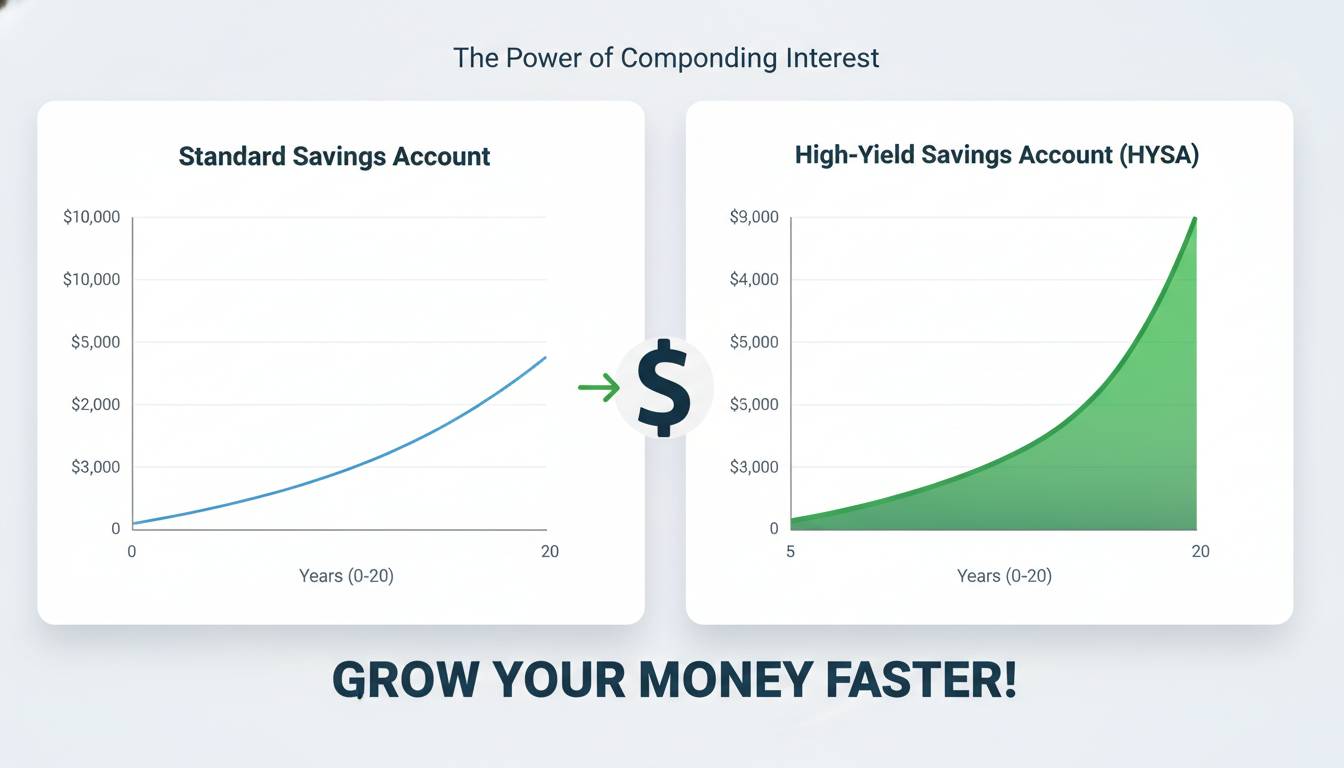
High yield savings accounts function identically to traditional savings accounts in terms of accessibility and security. You can deposit and withdraw money, though federal regulations typically limit you to six transactions per month. The key difference lies in the interest rate. When you deposit money, the bank pays you interest calculated daily and credited monthly. With compound interest, you earn interest on your interest, creating exponential growth over time.
For example, if you deposit $10,000 in a high yield savings account earning 5.00% APY with monthly compounding, you would earn approximately $511 in interest over one year. The same deposit in a traditional savings account at 0.05% APY would earn just $5.
Key Features
FDIC Insurance: All recommended accounts carry FDIC insurance through the Federal Deposit Insurance Corporation, protecting your deposits up to $250,000 per account ownership category. This means your principal is guaranteed even if the bank fails.
No or Low Minimums: Many top high yield savings accounts require no minimum opening deposit, making them accessible to anyone regardless of their starting balance. Some accounts do require minimum balances to earn the advertised APY, so it’s crucial to understand the terms.
Accessibility: Online banks have developed robust mobile apps and websites, allowing you to manage your money from anywhere. Most offer ATM networks or reimburse ATM fees, and transfers to other banks typically process within 1-3 business days.
💡 STAT: High yield savings account rates have increased by over 400% since early 2022 as the Federal Reserve raised interest rates to combat inflation
Benefits of High Yield Savings Accounts
High yield savings accounts offer numerous advantages that make them superior to traditional savings options. Understanding these benefits helps you make informed decisions about where to park your cash.
Superior Returns
The primary benefit is obvious: significantly higher interest rates. While traditional banks offer pennies on the dollar, high yield accounts multiply your interest income substantially. On a $50,000 emergency fund, the difference between 0.05% APY and 5.00% APY amounts to approximately $2,475 in annual interest—money that would otherwise go to the bank.
| Account Type | APY | Annual Interest on $25,000 |
|---|---|---|
| Traditional Bank | 0.05% | $12.50 |
| High Yield Savings | 5.00% | $1,250.63 |
| Difference | $1,238.13 |
Safety and Security
Your money remains protected through FDIC insurance, covering losses up to $250,000 per depositor, per account type. Unlike stocks or cryptocurrencies, there’s no risk of losing your principal. These accounts are among the safest financial products available, backed by the full faith of the U.S. government.
Liquidity and Flexibility
Unlike certificates of deposit (CDs) that lock your money away, high yield savings accounts allow unlimited withdrawals (subject to the six-transaction monthly limit). This makes them ideal for emergency funds and short-term goals where you might need access to cash quickly.
📈 CASE: Marcus by Goldman Sachs has grown to over $100 billion in deposits since launching in 2015, demonstrating the massive consumer shift toward high yield options
No or Low Fees
Most top high yield savings accounts have eliminated monthly maintenance fees entirely. Unlike traditional banks that often charge $10-15 monthly unless you maintain minimum balances, these accounts let you keep every penny you earn. Watch out for excessive withdrawal fees, but most reputable accounts don’t impose penalties for reasonable activity.
Top High Yield Savings Accounts for 2024
Selecting the right account requires balancing APY, fees, accessibility, and features. Based on current rates and customer experience, these are the standout performers.
Comparison of Top Accounts
| Account | APY | Min. Deposit | Monthly Fee | ATM Access | Key Feature |
|---|---|---|---|---|---|
| Yotta Savings | 5.30%* | $0 | $0 | 70,000+ ATMs | Prizes + Lottery |
| CIT Platinum | 5.25% | $1,000 | $0 | Global ATM | Highest standard rate |
| Bread Savings | 5.25% | $0 | $0 | Mastercard ATM | No minimums |
| Marcus by Goldman Sachs | 4.80% | $0 | $0 | Goldman’s network | Brand reliability |
| Ally Bank | 4.75% | $0 | $0 | Allpoint network | Excellent app |
| Discover Online Savings | 4.75% | $0 | $0 | 60,000+ ATMs | No fees, great app |
*Yotta’s rate includes promotional yield; rates subject to change
Yotta Savings
✅ Pros: Highest advertised APY, prize-linked savings model, no minimum deposit, excellent for savers who enjoy gamification
❌ Cons: Rate includes promotional elements, prize structure means returns aren’t guaranteed
💰 Price: Free to open and maintain
🎯 For: Savers who want excitement and potential prize winnings alongside interest
Yotta Savings offers up to 5.30% APY through a combination of base interest and a prize-linked structure. Every dollar in your account earns entries into weekly prizes ranging from $0.01 to $10,000. The account has no minimum deposit and no monthly fees, making it accessible to everyone. While the prize element introduces some variability, the minimum guaranteed rate remains competitive.
CIT Platinum Savings
✅ Pros: Consistently competitive rates, no monthly service fees, strong customer service
❌ Cons: $1,000 minimum deposit to open, no physical branches
💰 Price: No monthly fees with $1,000 minimum balance to earn stated APY
🎯 For: Savers with $1,000+ who want reliable, high rates
CIT Bank’s Platinum Savings account has consistently ranked among the highest-yielding options. With a $1,000 minimum deposit requirement, it requires slightly more capital than competitors but rewards you with premium rates. The account has no monthly maintenance fees, and CIT offers solid customer support through phone and email.
Marcus by Goldman Sachs
✅ Pros: Trusted brand name, no fees, excellent mobile app, automatic savings tools
❌ Cons: Rates occasionally trail competitors, no ATM card (requires transfers)
💰 Price: No monthly fees, no minimum deposit
🎯 For: Investors who prioritize brand trust and want a simple, reliable experience
Marcus by Goldman Sachs has become synonymous with online savings. Backed by one of the world’s most prestigious investment banks, Marcus offers 4.80% APY with no minimum deposit and no monthly fees. The mobile app receives consistently high ratings, and features like automatic transfers help you build savings consistently. The main tradeoff is that you cannot access ATM networks directly—you must transfer funds to an external account for cash.
Ally Bank
✅ Pros: 4.75% APY, zero minimum deposit, excellent customer service, 24/7 support, innovative tools
❌ Cons: Rates have been slightly below leaders in 2024
💰 Price: No monthly fees, no minimum balance
🎯 For: Users who want a feature-rich banking experience with round-the-clock support
Ally Bank has built a reputation for exceptional customer service and innovative features. The 4.75% APY applies from day one with no minimum deposit required. Ally’s app allows you to create “buckets” for different savings goals, making it easy to organize your money. Customer support is available 24/7 via phone, chat, and email, a significant advantage for those who value accessibility.
Discover Online Savings
✅ Pros: 4.75% APY, no minimums, excellent customer service, 60,000+ free ATMs
❌ Cons: No physical branches, rate fluctuations
💰 Price: No monthly fees, no minimum balance
🎯 For: Those who want ATM access and a trusted financial brand
Discover offers 4.75% APY with the convenience of a massive ATM network exceeding 60,000 locations. Like other online banks, Discover has no physical branches, but it compensates with outstanding customer service and a polished mobile experience. The account is completely fee-free with no minimum balance requirements.
How to Open a High Yield Savings Account
Opening a high yield savings account takes approximately 15-20 minutes and can be completed entirely online. Follow these steps to ensure you choose the right account and complete the application successfully.
Prerequisites
- [ ] Valid government-issued ID (driver’s license, passport, or state ID)
- [ ] Social Security number or Tax Identification Number
- [ ] External bank account for funding (checking account)
- [ ] Basic personal information (address, employment status, income)
- [ ] Valid email address and phone number
Steps
1. Research and Compare Accounts
Before applying, compare current APY rates, minimum requirements, fee structures, and user reviews. Consider whether you need ATM access, mobile app features, or specific customer service hours. Create a shortlist of 2-3 accounts that match your priorities.
⏱ Time: 20-30 minutes | 💡 Tip: Bookmark rate comparison sites like Bankrate or NerdWallet to monitor changes
2. Gather Required Documents
Have your ID, Social Security number, and external bank routing and account numbers ready. Most applications require these immediately, and having them handy prevents delays.
3. Complete the Online Application
Navigate to your chosen bank’s website and select “Open Account.” You’ll provide personal information including your name, address, date of birth, and employment details. The process typically takes 10-15 minutes.
⚠️ Avoid: Providing inconsistent information across applications → Fix: Use exact name and address as they appear on your ID
4. Fund Your Account
Link your external bank account to transfer funds. Initial funding requirements vary—some accounts allow you to open with $0, while others require an initial deposit. Transfers typically complete within 1-3 business days.
5. Set Up Automatic Transfers
Once open, establish recurring transfers from your checking account. Automating your savings ensures consistency and maximizes compound interest over time. Even $100 monthly adds up significantly.
| Problem | Fix |
|---|---|
| Application stuck on “processing” | Contact customer support; may need additional verification |
| Can’t verify external bank | Ensure online banking credentials are current; try manual account entry |
| Rate lower than advertised | Some banks offer promotional rates for limited periods; check terms |
| Identity verification failed | Upload clear ID images; try during business hours for faster support |
Common Mistakes to Avoid
Many savers undermine their efforts by making avoidable errors when selecting and managing high yield savings accounts. Here’s how to sidestep the most costly pitfalls.
Chasing Maximum Rates Blindly
The highest APY doesn’t always equal the best account. Some banks offer teaser rates that drop significantly after an initial period. Others have complex tier structures where only balances above certain thresholds earn the advertised rate. Always read the fine print regarding rate stability and minimum balance requirements.
📉 Impact: Switching accounts repeatedly to chase 0.1% higher APY costs time and may result in gaps between closing old accounts and opening new ones.
Prevent: Choose accounts with consistently competitive rates and stable fee structures. The hassle of frequent switching rarely justifies minimal extra earnings.
Ignoring Fee Structures
Monthly maintenance fees, excessive withdrawal fees, and balance minimums can erode your earnings substantially. An account offering 5.25% APY but charging $15 monthly fees actually costs you money if your balance is under $3,400.
Prevent: Select fee-free accounts with no minimum balance requirements. Every account in our recommended list meets these criteria.
Not Considering Accessibility
Some online banks have limited customer service hours or slow response times. Others lack mobile apps or ATM access, making it difficult to manage your money conveniently. If you value in-person support or frequent cash access, ensure your chosen account meets those needs.
Prevent: Test the bank’s app and customer service before committing substantial funds. Use small initial deposits to evaluate the experience.
⚠️ CRITICAL: Failing to monitor rates after opening an account means you may miss better opportunities. Rates change frequently—review your options quarterly to ensure you’re still earning competitive APY.
Prevent: Set calendar reminders every 3-6 months to compare your current rate against market alternatives. Banks rarely notify you when they lower rates.
Expert Insights
Financial experts emphasize the importance of high yield savings accounts in a comprehensive financial strategy, particularly in the current interest rate environment.
👤 Greg McBride, CFA, Chief Financial Analyst at Bankrate
“High yield savings accounts have become the default destination for emergency funds and short-term savings goals. The difference between earning 5% and 0.05% on your savings is night and day—it’s essentially free money for minimal effort.”
Data: Bankrate’s weekly rate survey shows high yield savings accounts have averaged 4.5-5.0% APY throughout 2024
👤 Andrew Rosen, Certified Financial Planner and President of Dynamic Wealth Advisors
“I recommend clients keep 3-6 months of expenses in high yield savings accounts. The liquidity combined with competitive rates makes them ideal for emergency reserves. Unlike CDs, you can access funds immediately without penalties.”
Advice: Start with whatever you can—even $500-$1,000 in an emergency fund provides a buffer while you build toward the full recommendation.
Frequently Asked Questions
What is the difference between APY and APR?
APY (Annual Percentage Yield) includes the effect of compound interest, while APR (Annual Percentage Rate) does not. For savings accounts, APY is the more accurate measure since interest compounds multiple times throughout the year. Always compare APYs when evaluating savings accounts.
Are high yield savings accounts safe?
Yes, if the bank is FDIC-insured. All accounts recommended in this guide carry FDIC insurance up to $250,000 per depositor, per account ownership category. This protection comes from the federal government, making these accounts among the safest places to store money.
How often do high yield savings account rates change?
Rates can change at any time, though most banks adjust rates in response to Federal Reserve policy changes or market conditions. Some banks change rates weekly, others monthly. During 2022-2024, rates have generally increased as the Fed raised interest rates, though this trend may not continue indefinitely.
Do I need to pay taxes on high yield savings account interest?
Yes, interest earned in high yield savings accounts is considered taxable income by the IRS. You’ll receive a Form 1099-INT from your bank if you earn more than $10 in interest during the year. Report this income on your federal tax return.
Can I have multiple high yield savings accounts?
Yes, you can open multiple accounts at different banks. This can be strategic if you want to organize savings into different “buckets” or take advantage of promotional rates. As long as each account is within FDIC limits, there’s no restriction on the number of accounts you can hold.
Conclusion
High yield savings accounts have transformed from a niche product to an essential component of smart financial planning. With top rates exceeding 5% APY and zero monthly fees at leading institutions, there’s simply no reason to leave your savings in traditional bank accounts earning pennies. The difference amounts to thousands of dollars in lost interest annually—money that could fund vacation, accelerate debt payoff, or grow your emergency fund faster.
When selecting an account, prioritize a combination of competitive rates, fee-free structure, and accessibility features that match your lifestyle. Whether you choose Yotta for its prize-linked excitement, CIT Platinum for its consistently high rates, or Marcus for brand reliability, you’ll be significantly ahead of keeping money in traditional savings. The key is starting now and letting compound interest work in your favor.
Remember to review your account periodically, as rates and offerings change. The best high yield savings account today may not be the best a year from now. Stay informed, automate your savings, and watch your money grow securely. Your future self will thank you for making this simple but powerful financial decision today.