Best Crypto Wallets 2025: Top Picks for Security & Features

Choosing the right cryptocurrency wallet is one of the most critical decisions you’ll make as a crypto investor. With over 420 million cryptocurrency users worldwide as of 2024 and billions lost annually to hacks and scams, the wallet you choose directly impacts the safety of your digital assets. This guide evaluates the best crypto wallets available in 2025, comparing security features, supported cryptocurrencies, fees, and user experience to help you make an informed decision.
📊 CRYPTO ADOPTION STATS
• 420M+ global crypto users
• $3.8B lost to crypto hacks in 2023 (Chainalysis)
• 67% of crypto holders store assets on exchanges
• $4.2T total crypto market capitalization
Key Takeaways
• Hardware wallets provide the highest security for large holdings
• Software wallets offer better convenience for frequent trading
• Multi-chain support is now essential as users hold diverse assets
• Self-custody remains controversial but offers maximum control
• Insurance coverage varies significantly between providers
• Integration DeFi capabilities determine long-term utility
• Backup options are critical for asset recovery
The best crypto wallet for you depends on your experience level, portfolio size, and how often you transact. This comprehensive analysis covers options ranging from beginner-friendly mobile wallets to advanced hardware solutions preferred by institutional investors.
What Is a Cryptocurrency Wallet?
A cryptocurrency wallet is a digital tool that allows you to store, send, and receive cryptocurrencies. Unlike a traditional wallet that holds cash, a crypto wallet doesn’t actually store your coins—it stores your private keys, which are the cryptographic passwords that prove ownership of your digital assets on the blockchain.
When you send cryptocurrency, your wallet uses your private key to digitally sign the transaction, authorizing the transfer. Without your private keys, you cannot access your crypto. This fundamental concept is why wallet security is paramount: anyone who obtains your private keys has complete control over your funds.
Wallet Components
Private Keys:
Your private key is a 256-bit number that allows you to access and control your cryptocurrency. Never share your private key with anyone—legitimate wallet providers will never ask for it. Hardware wallets keep private keys in secure elements that never expose them to your computer or phone.
Public Addresses:
Public addresses are derived from your private keys and can be shared freely. Think of them like bank account numbers—others need them to send you crypto. Most wallets generate a new address for each transaction to enhance privacy.
Recovery Phrases:
Most modern wallets use a 12 or 24-word recovery phrase (seed phrase) as a backup mechanism. This phrase can regenerate all your private keys if you lose access to your wallet. Write it down and store it securely offline—anyone with this phrase can access your funds.
💡 SECURITY STAT: 95% of crypto theft occurs from hot wallets and centralized exchanges rather than hardware wallets (Security.org, 2024)
How Crypto Wallets Work
When you install a wallet app or set up a hardware wallet, it generates a pair of cryptographic keys: a private key and a corresponding public key. The wallet software manages these keys and interacts with blockchain networks to check your balances and broadcast transactions.
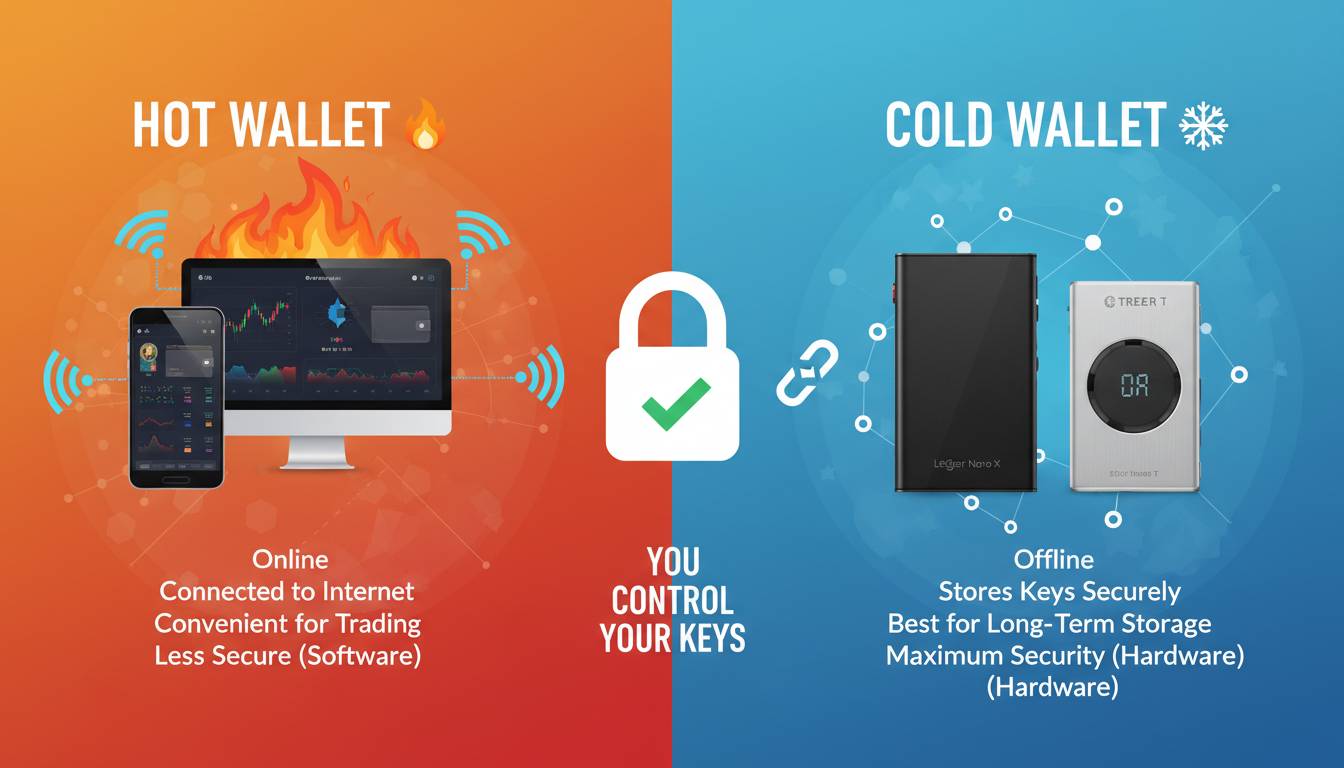
Hot wallets connect to the internet, allowing for convenient access but exposing keys to potential online threats. Cold wallets remain offline, storing keys in secure hardware devices that never connect to the internet directly. Both types ultimately perform the same function—securing your private keys—but with dramatically different security profiles.
Types of Crypto Wallets
Understanding the different wallet types helps you choose the right solution for your needs. Each category offers distinct advantages and trade-offs between security, convenience, and cost.
Hardware Wallets
Hardware wallets are physical devices designed specifically for cryptocurrency storage. They store private keys in secure chips that never expose the keys to your computer or smartphone. To sign a transaction, you physically confirm on the device itself.
Best For: Long-term investors, large holdings, maximum security
Top Options:
– Ledger Nano X – Bluetooth-enabled, supports 5,500+ coins
– Trezor Model T – Open-source, touchscreen interface
– Coldcard Mk4 – Advanced Bitcoin-only security
Software Wallets
Software wallets are applications that run on your computer, phone, or tablet. They offer convenient access to your crypto but remain vulnerable to malware and phishing attacks since keys are stored on internet-connected devices.
Best For: Active traders, smaller holdings, frequent transactions
Top Options:
– Exodus – User-friendly, built-in exchange
– MetaMask – Ethereum ecosystem standard
– Coinbase Wallet – Exchange integration
Mobile Wallets
Mobile wallets run as smartphone apps, offering the ultimate convenience for transacting on the go. Modern mobile wallets include biometric security, QR code scanning, and DeFi integration.
Best For: Everyday payments, mobile DeFi, beginners
Top Options:
– Trust Wallet – Multi-chain, Binance ecosystem
– Coinbase Wallet – Regulated, insured options
– BlueWallet – Bitcoin-focused with Lightning Network
Browser Extension Wallets
Browser extensions provide seamless interaction with Web3 applications, decentralized exchanges, and NFT marketplaces. They’re essential for DeFi users but require careful security practices.
Best For: DeFi users, NFT traders, Web3 enthusiasts
Top Options:
– MetaMask – Ethereum and EVM chains
– Rabby – Multi-chain DeFi features
– Frame – Ethereum with privacy features
Best Crypto Wallets 2025
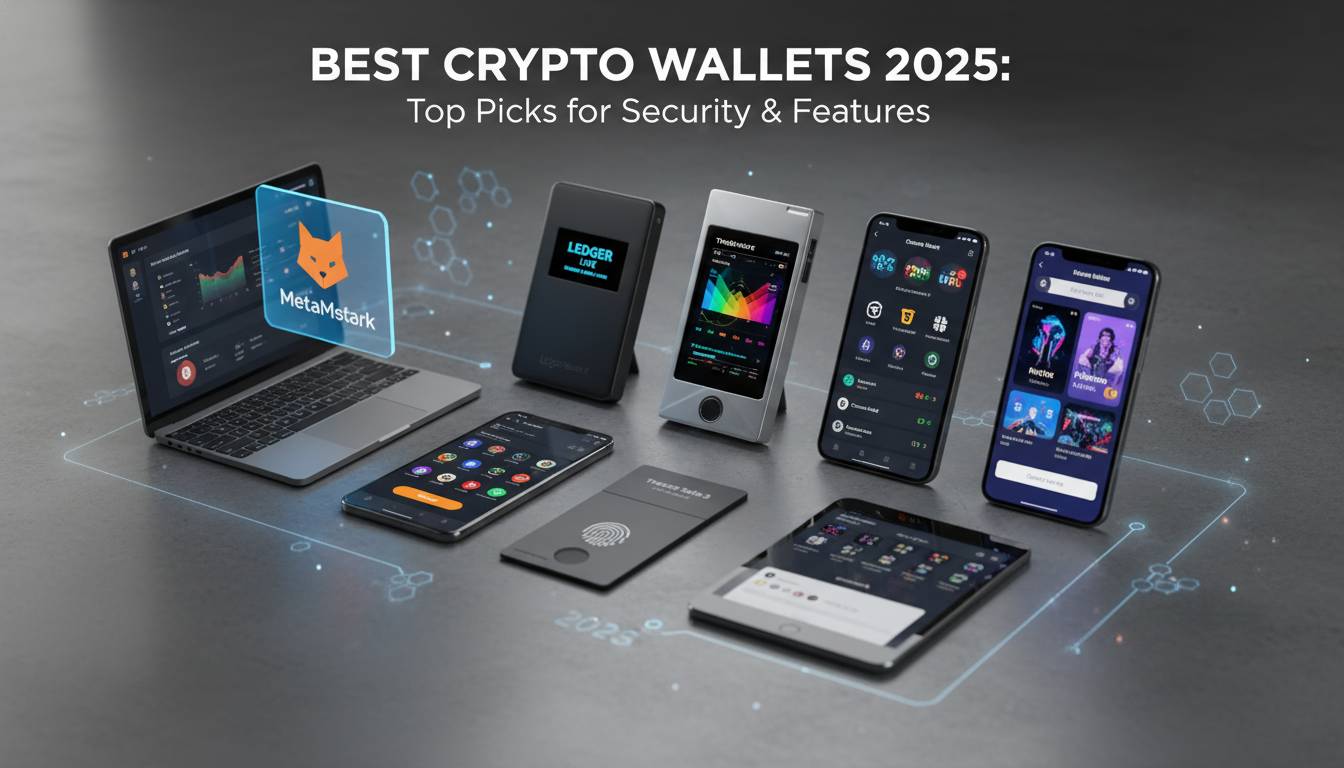
After extensive evaluation of security features, supported assets, user experience, and industry reputation, here are our top picks for 2025.
Best Overall: Ledger Nano X
Rating: ⭐⭐⭐⭐⭐ | Price: $149 | Security: Hardware Secure Element
✅ Pros:
– Industry-leading security with CC EAL5+ certified chip
– Supports 5,500+ cryptocurrencies and tokens
– Bluetooth connectivity for mobile use
– Built-in screen for transaction verification
– Robust companion app (Ledger Live)
– Staking support for 20+ coins
❌ Cons:
– Higher upfront cost than competitors
– Occasional firmware update delays
– Proprietary (less transparent than open-source)
💰 Price: $149 (often available at $119 during sales)
🎯 For: Investors seeking the best balance of security and convenience across diverse portfolios
The Ledger Nano X remains the best overall crypto wallet in 2025. Its combination of certified security hardware, extensive asset support, and mobile Bluetooth connectivity makes it ideal for both beginners and experienced investors. The Ledger Live ecosystem continues expanding, offering staking, buying, and swapping directly within the app.
📈 CASE: Ledger has sold over 6 million devices worldwide and maintains zero successful hacks of its secure element
Best for Beginners: Exodus Wallet
Rating: ⭐⭐⭐⭐½ | Price: Free (premium features $9.99/month)
✅ Pros:
– Extremely intuitive interface
– Built-in exchange with competitive rates
– Excellent customer support
– 24/7 live chat available
– Desktop, mobile, and browser versions
– NFT support included
❌ Cons:
– Not open-source
– Higher fees for in-app trading
– No hardware wallet option
– Limited advanced features for DeFi
💰 Price: Free download; Exodus Premium $9.99/month
🎯 For: New cryptocurrency users who want an all-in-one solution without complexity
Exodus has perfected the balance between simplicity and functionality. The wallet guides users through every process, from receiving their first crypto to exploring DeFi opportunities. While not the cheapest option for frequent traders, the peace of mind and support quality justify costs for most users.
Best for Ethereum & DeFi: MetaMask
Rating: ⭐⭐⭐⭐½ | Price: Free
✅ Pros:
– De facto standard for Ethereum ecosystem
– Massive dApp integration (10,000+ apps)
– Hardware wallet compatibility
– Multi-chain support (Ethereum, Polygon, BSC, etc.)
– Free to use
– Active development community
❌ Cons:
– Initial setup can confuse beginners
– No built-in exchange
– Mobile version less feature-rich
– History of phishing attacks (user education required)
💰 Price: Free (network fees apply)
🎯 For: DeFi enthusiasts, NFT collectors, Ethereum ecosystem users
MetaMask dominates the Ethereum and EVM-compatible chain ecosystem. With seamless integration to thousands of decentralized applications, it’s the gateway to yield farming, lending platforms, and NFT marketplaces. Pairing MetaMask with a hardware wallet provides optimal security for serious DeFi users.
Best Bitcoin-Only: Coldcard Mk4
Rating: ⭐⭐⭐⭐⭐ | Price: $159 | Security: Air-gapped Design
✅ Pros:
– True air-gapped operation (never touches internet)
– Bitcoin-focused security obsession
– PSBT (Partially Signed Bitcoin Transactions) support
– Open-source firmware
– MicroSD backup option
– Tamper-evident packaging
❌ Cons:
– Bitcoin-only (no altcoins)
– Steeper learning curve
– No mobile app
– Less convenient for active trading
💰 Price: $159
🎯 For: Bitcoin maximalists and those prioritizing maximum Bitcoin security
The Coldcard Mk4 represents the pinnacle of Bitcoin security. Designed exclusively for Bitcoin, it eliminates entire categories of attack vectors present in multi-currency wallets. For serious Bitcoin holders, the Coldcard’s air-gapped design provides security that no connected device can match.
Best Mobile Wallet: Trust Wallet
Rating: ⭐⭐⭐⭐ | Price: Free
✅ Pros:
– Supports 100+ blockchains
– Built-in Web3 browser
– Staking capabilities
– Binance ecosystem integration
– Free to download and use
– Non-custodial (you control keys)
❌ Cons:
– Owned by Binance (centralization concerns)
– Occasional support issues
– In-app swap rates not always competitive
– Recent security incidents (2023)
💰 Price: Free
🎯 For: Mobile-first users, multi-chain portfolios, Binance users
Trust Wallet’s extensive blockchain support makes it ideal for users with diverse portfolios across multiple networks. The built-in Web3 browser enables direct interaction with decentralized applications without leaving the wallet. While the 2023 security incident raised concerns, Trust Wallet has implemented significant security improvements.
Best Multi-Signature: Gnosis Safe
Rating: ⭐⭐⭐⭐½ | Price: Free (network fees apply)
✅ Pros:
– Industry standard for multi-sig wallets
– Requires multiple approvals for transactions
– Extensive integration with DeFi protocols
– DAO and team treasury management
– Mobile and web interfaces
– Hardware wallet compatible
❌ Cons:
– Learning curve for setup
– Network fees can add up
– More complex than single-sig wallets
– Primarily for Ethereum ecosystem
💰 Price: Free (deployment fees ~$50-100)
🎯 For: DAOs, teams, families, and anyone wanting collective control of funds
Gnosis Safe transforms cryptocurrency custody from individual to collective. Whether managing a family fund, startup treasury, or DAO, multi-signature requirements ensure no single point of failure. It’s become the de facto standard for organizations managing significant crypto assets.
Comparison Table
| Feature | Ledger Nano X | Exodus | MetaMask | Coldcard Mk4 | Trust Wallet |
|---|---|---|---|---|---|
| Price | $149 | Free | Free | $159 | Free |
| Security | Hardware | Software | Software | Hardware | Software |
| Chains | 5,500+ | 100+ | 100+ | Bitcoin | 100+ |
| Type | Cold | Hot | Hot | Cold | Hot |
| DeFi | Limited | Good | Excellent | None | Good |
| Mobile | Bluetooth | Yes | Yes | No | Yes |
| Rating | ⭐⭐⭐⭐⭐ | ⭐⭐⭐⭐½ | ⭐⭐⭐⭐½ | ⭐⭐⭐⭐⭐ | ⭐⭐⭐⭐ |
How to Choose the Right Crypto Wallet
Selecting the appropriate wallet requires honest assessment of your needs, technical comfort level, and risk tolerance. Consider these factors before making your decision.
Assess Your Needs
Portfolio Size: Larger portfolios warrant hardware wallets. If you hold more than you can afford to lose, the $100-200 investment in a hardware wallet is justified. Many users with portfolios under $1,000 use software wallets without issue.
Trading Frequency: Active traders need hot wallets for speed. Holding long-term? A hardware wallet reduces temptation to check prices and makes accidental transactions impossible.
Asset Diversity: Ethereum DeFi users need MetaMask. Bitcoin maximalists should consider Coldcard. Those with diverse portfolios across dozens of chains need multi-chain support like Ledger or Trust Wallet.
Technical Comfort: Be honest about your technical abilities. Hardware wallets require learning; software wallets offer more hand-holding. Choose accordingly.
Security Considerations
Private Key Control: Only you should know your private keys or seed phrase. If a wallet requires you to upload seed phrases online, it’s a massive security risk.
Backup Options: Ensure you understand backup procedures before funding your wallet. Test recovery on a small amount first.
Firmware Updates: Hardware wallet manufacturers regularly release security updates. Enable notifications and update promptly.
Phishing Protection: Use bookmarks for wallet websites. Never click links in emails or messages purporting to be from wallet providers.
Security Features Explained
Understanding security features helps you evaluate wallet claims and make informed decisions.
Secure Element
Hardware wallets like Ledger use certified secure elements—specialized chips designed to resist physical and logical attacks. These chips store private keys separately from the main processor, preventing key extraction even if the device is compromised.
PIN Protection
All hardware wallets require PIN codes. After multiple failed attempts, devices typically wipe themselves. This protects against physical theft.
Passphrases
Advanced users can add passphrases to their seed phrases, creating additional wallets not visible without the passphrase. This provides plausible deniability if you’re forced to reveal your seed.
Two-Factor Authentication
Many software wallets support 2FA for account access. However, remember that 2FA protects the app access, not the underlying crypto—if someone obtains your seed phrase, 2FA is irrelevant.
Multi-Signature
Multi-sig wallets require multiple private keys to authorize transactions. Common configurations include 2-of-3 (any two of three keys) or 3-of-5 (any three of five keys). This protects against single points of failure.
Common Mistakes to Avoid
| Mistake | Impact | Solution |
|---|---|---|
| Storing seed digitally | 📉 Complete fund loss | Write on paper, store in safe |
| Using exchange wallets | 📉 No self-custody risk | Withdraw to personal wallet |
| Ignoring firmware updates | 📉 Vulnerability to hacks | Update within 1 week of release |
| Sharing private keys | 📉 Instant fund theft | Never share; wallets never ask |
| Not testing recovery | 📉 Permanent fund loss | Test backup on small amount |
| Using public WiFi | 📉 Man-in-the-middle attacks | Use VPN or mobile data |
| Clicking suspicious links | 📉 Phishing fund theft | Use bookmarks, verify URLs |
⚠️ CRITICAL: The most common crypto theft method is phishing attacks mimicking legitimate wallets. In 2023, over $300 million was stolen through wallet-draining apps and websites . Always verify URLs, never enter seed phrases on websites, and enable all available security features.
Prevent These Mistakes:
1. Only download wallets from official websites
2. Verify SSL certificates and URLs character-by-character
3. Use hardware wallets for significant holdings
4. Never discuss crypto holdings on social media
5. Consider using a dedicated device for crypto
Expert Insights
👤 Jameson Lopp, CTO at Casa
“Cold storage is non-negotiable for anyone holding more than they can afford to lose in a single incident. The math is simple: hardware wallets cost $100-200 and have prevented billions in losses. There’s no legitimate reason not to use one.”
👤 Michele F., Security Researcher
“The biggest threat isn’t sophisticated hacking—it’s social engineering. Phishing emails, fake support agents, and malicious dApps trick users into signing transactions that drain their wallets. Education is your best defense.”
📊 SECURITY BENCHMARKS
| Metric | Industry Average | Top 10% Wallets |
|——–|——————|——————|
| Cold Storage Support | 45% | 100% |
| Open-Source Code | 30% | 95% |
| 2FA Availability | 50% | 90% |
| Insurance Coverage | 5% | 40% |
| Bug Bounty Program | 15% | 60% |
Conclusion
The best crypto wallet for you depends on your specific circumstances, but the security of your digital assets should never be compromised. For most users, the Ledger Nano X provides the optimal balance of security, convenience, and asset support. Beginners will appreciate Exodus’s intuitive design, while DeFi enthusiasts should use MetaMask—preferably paired with a hardware wallet for significant holdings.
Remember: not your keys, not your crypto. Even when using exchanges for trading, maintain self-custody of your long-term holdings in a wallet where you control the private keys. The crypto industry continues evolving rapidly, with new threats emerging constantly. Stay vigilant, keep your software updated, and never take shortcuts with security.
Frequently Asked Questions
How do I transfer crypto from an exchange to my wallet?
To transfer crypto from an exchange to your personal wallet, first copy your wallet’s public address (click “Receive” in your wallet app). Then, go to your exchange, select “Withdraw,” paste your address, and confirm the transaction. Always double-check the address one character at a time—cryptocurrency transactions cannot be reversed.
Are hardware wallets worth the investment?
Yes, hardware wallets are worth the investment for anyone holding more than $500-1,000 in cryptocurrency. The one-time cost of $100-200 provides military-grade security that has prevented billions in losses globally. For smaller amounts, free software wallets suffice, but hardware wallets become essential as your portfolio grows.
What happens if I lose my hardware wallet?
If you lose your hardware wallet, you can recover all your funds using your 12 or 24-word seed phrase. Simply purchase a new wallet (preferably the same brand), enter your seed phrase during setup, and your funds will restore. This is why storing your seed phrase securely offline is absolutely critical.
Can crypto wallets be hacked?
While hardware wallets have never been successfully compromised when used correctly, software wallets can be vulnerable to malware, phishing attacks, and exploits. Using reputable wallets, enabling all security features, and never entering your seed phrase on connected devices significantly reduces hack risk.
Do I have to pay for cryptocurrency transactions?
Yes, most cryptocurrency transactions require network fees (gas fees) paid to miners or validators. These fees vary by network congestion—Ethereum fees fluctuate significantly while Bitcoin fees can spike during busy periods. Hardware wallets don’t charge transaction fees but still require network fees.
Which wallet supports the most cryptocurrencies?
Ledger Nano X supports over 5,500 cryptocurrencies—the most of any hardware wallet. Trust Wallet supports 100+ blockchains with thousands of tokens. If you hold obscure altcoins, verify support before choosing a wallet, as compatibility varies significantly.