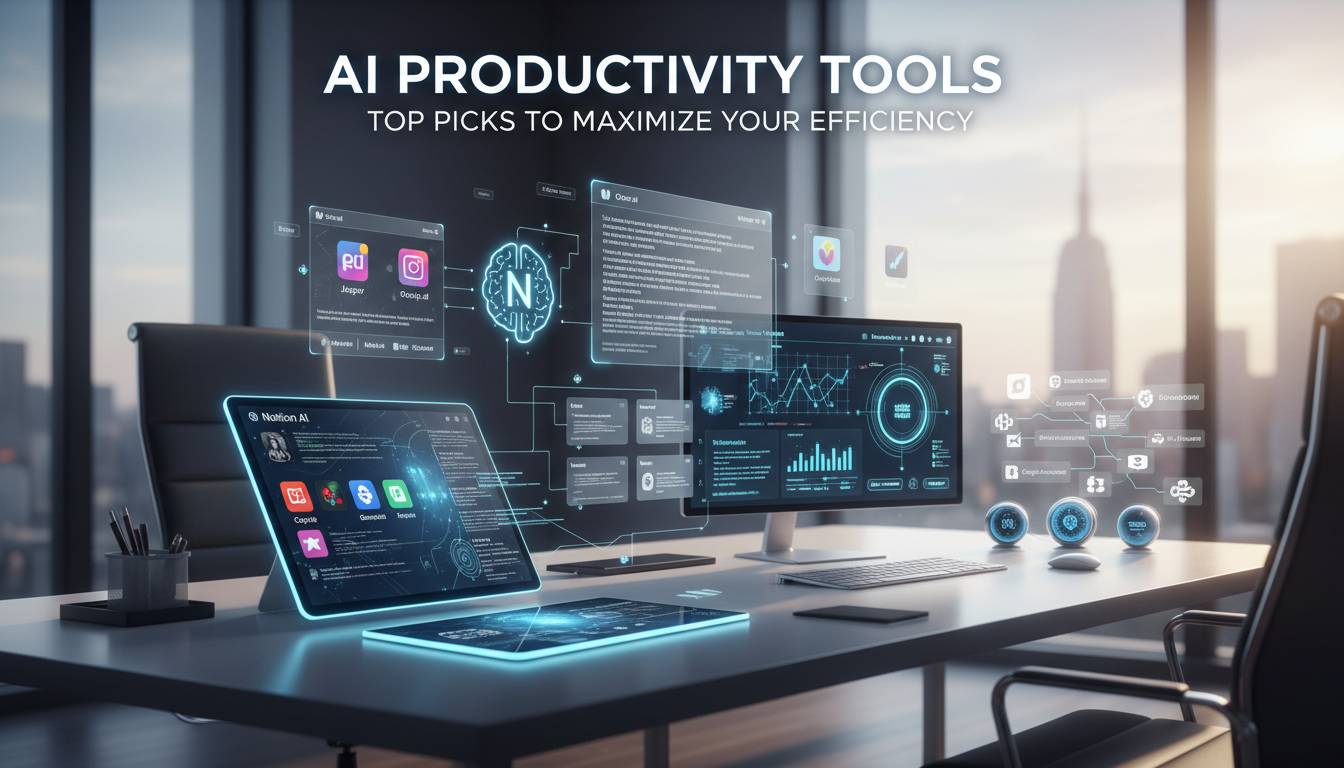

Artificial intelligence has changed how professionals work. AI tools for productivity at work now help with automated note-taking, project management, and content creation. According to a 2024 McKinsey report, businesses using AI see about 20% productivity gains. This guide looks at the most useful AI solutions available in 2025.
Understanding AI Tools for Workplace Productivity
AI productivity tools are software applications that use artificial intelligence to handle repetitive tasks, help with decisions, and improve workflow efficiency. These tools range from AI assistants that help write emails to platforms that analyze large datasets quickly. The market has grown significantly—over 1,500 AI-powered productivity applications are now available.
Adoption accelerated after ChatGPT launched in late 2022. Gartner projects that by late 2025, about 75% of enterprise applications will include some AI capability. This isn’t just a tech upgrade—it’s changing how work gets done.
Best AI Writing and Content Assistants
ChatGPT (OpenAI)
ChatGPT remains the most widely used AI writing assistant. The tool works well for drafting emails, generating reports, brainstorming, and handling repetitive communication tasks. Its natural language processing lets users refine outputs through conversation, so workers without technical backgrounds can use it effectively.
OpenAI’s enterprise version offers better security for corporate use, including data encryption and compliance certifications. Pricing starts at $25 per user monthly for the Team plan, with enterprise options available.
Claude (Anthropic)
Claude has become a solid competitor, especially good at handling long documents and maintaining context across extended conversations. The tool performs well on analytical tasks, which makes it useful for research-heavy roles. Anthropic’s focus on safety means Claude tends to produce more careful outputs—some enterprises prefer this for sensitive applications.
Jasper AI
Jasper AI targets marketing and content teams with templates for advertising copy, blog posts, and social media content. The platform includes SEO features and brand voice customization, so organizations can keep messaging consistent across AI-generated materials.
AI Meeting and Communication Tools
Otter.ai
Otter.ai is widely used for automated meeting transcription and summarization. The platform records, transcribes, and creates summaries of meetings in real-time. It works with Zoom, Google Meet, and Microsoft Teams. Users report saving about 30 minutes on post-meeting documentation.
The platform has a free tier with limited monthly minutes. Otter Business plans start at $10 per user monthly, including advanced features like custom vocabulary and enterprise security.
Fireflies.ai
Fireflies.ai offers similar transcription with better analytics. The platform tracks action items, measures who speaks most, and generates meeting insights across an organization’s meeting history. This helps leadership spot communication patterns and find meeting efficiency gains.
EqualTime
EqualTime focuses on meeting equity, analyzing conversation dynamics to ensure balanced participation. The tool alerts teams in real-time when certain people dominate discussions, which helps maintain inclusive meeting cultures. This is useful for organizations prioritizing diversity and inclusion.
AI Project Management and Collaboration
Notion AI
Notion’s AI features work directly in the workspace platform, letting users generate content, summarize pages, and automate database organization. The advantage is that users access AI features without switching between apps.
Asana Intelligence
Asana Intelligence adds AI-powered task management and workflow automation. The system can automatically generate task lists from meeting notes, predict project timelines based on past data, and flag potential bottlenecks before they cause delays. Recent updates expanded these capabilities significantly.
ClickUp AI
ClickUp offers AI assistance built for work, with specialized tools for different team functions. Marketing teams get content creation tools, while project managers receive help with resource allocation and timeline forecasting. The platform’s customization lets organizations tailor AI features to specific workflows.
AI Note-Taking and Knowledge Management
Reflect
Reflect markets itself as a “networked thought” tool, using AI to connect notes and ideas across an organization’s knowledge base. The backward linking feature automatically finds connections between new notes and existing documentation, surfacing relevant information proactively.
Mem
Mem stands out through auto-generated notes that need minimal manual organization. The AI automatically categorizes and surfaces relevant information based on context, reducing time spent organizing digital workspaces.
Obsidian with Plugins
The Obsidian community has created many AI plugins that turn the note-taking app into a powerful knowledge management system. Plugins like Copilot and Smart Connections add conversational AI and semantic search to the already flexible platform.
Pricing and Value Considerations
Most AI productivity tools use per-user monthly pricing, with tiered plans offering more features at higher price points. Free tiers exist for most consumer tools, though enterprise features usually require paid subscriptions.
| Tool Category | Free Tier | Entry Paid Plan | Enterprise |
|---|---|---|---|
| Writing Assistants | Limited | $20-30/month | Custom pricing |
| Meeting Tools | 30-300 min/month | $10-20/month | Custom pricing |
| Project Management | Limited features | $10-25/month | Custom pricing |
| Note-Taking | Limited | $10-15/month | Custom pricing |
The return on investment often exceeds costs within the first few months of adoption. Time savings translate to cost savings when employees accomplish more during standard hours.
How to Choose the Right AI Tools for Your Organization
Picking the right AI tools requires evaluating several factors. First, identify specific pain points in current workflows rather than adopting AI for its own sake. A marketing team struggling with content creation benefits more from Jasper than a development team needing code assistance.
Security and compliance requirements matter heavily in selection. Industries handling sensitive data—healthcare, finance, legal—should prioritize tools with appropriate certifications and encryption standards. Many enterprise AI providers offer data processing agreements and regional hosting options.
Integration capabilities determine how seamlessly AI tools fit into existing technology stacks. Tools with good API access and native integrations with Microsoft 365, Google Workspace, and Slack reduce implementation friction.
Future Trends in AI Workplace Productivity
AI tools for productivity will continue getting more integrated and automated. By 2026, most knowledge work will involve some AI collaboration, though human oversight will stay essential for quality control and strategic decisions.
Emerging trends include AI agents that can execute multi-step tasks on their own, better real-time translation for global teams, and more sophisticated emotional intelligence in AI assistants. Organizations developing AI adoption strategies now will be better positioned as these capabilities mature.
Frequently Asked Questions
What are the best AI tools for productivity at work in 2025?
Top AI workplace productivity tools include ChatGPT and Claude for content creation, Otter.ai and Fireflies.ai for meeting management, Notion AI and Asana Intelligence for project collaboration, and Jasper for marketing teams. The best choice depends on your specific workflow needs and existing tech integrations.
Are AI productivity tools worth the investment?
Most organizations see positive returns within three to six months. Time savings vary by role but typically range from 20-30% reduction in administrative tasks for knowledge workers. Many tools offer free tiers so you can test benefits before committing to paid plans.
What is the best free AI tool for work?
Several good AI tools have free tiers. ChatGPT has robust free functionality, Otter.ai includes 30 free transcription minutes monthly, and Notion AI offers limited free access. Enterprise deployments usually need paid plans for security and admin controls.
How do I integrate AI tools into existing workflows?
Start by identifying specific use cases rather than trying broad implementation. Begin with one or two high-impact applications, measure results, and expand gradually. Most AI tools offer onboarding resources and integration guides.
What industries benefit most from AI productivity tools?
All industries can benefit, but sectors with heavy documentation—legal, healthcare, finance, marketing—often see the quickest returns. Any role involving content creation, data analysis, or meeting management is a strong candidate for AI productivity enhancement.
Can AI tools replace human workers?
AI tools work best as productivity enhancers, not replacements. They automate repetitive tasks and generate first drafts but need human oversight for quality control, strategic thinking, and relationship management. The most effective workplace AI strategies position these tools as assistants that amplify human capabilities.
AI tools for productivity at work have become essential for many professionals. Organizations that thoughtfully adopt these technologies can improve efficiency, while those that ignore them may fall behind. The key is selecting tools that match specific workflow needs, implementing them properly, and maintaining human oversight throughout.