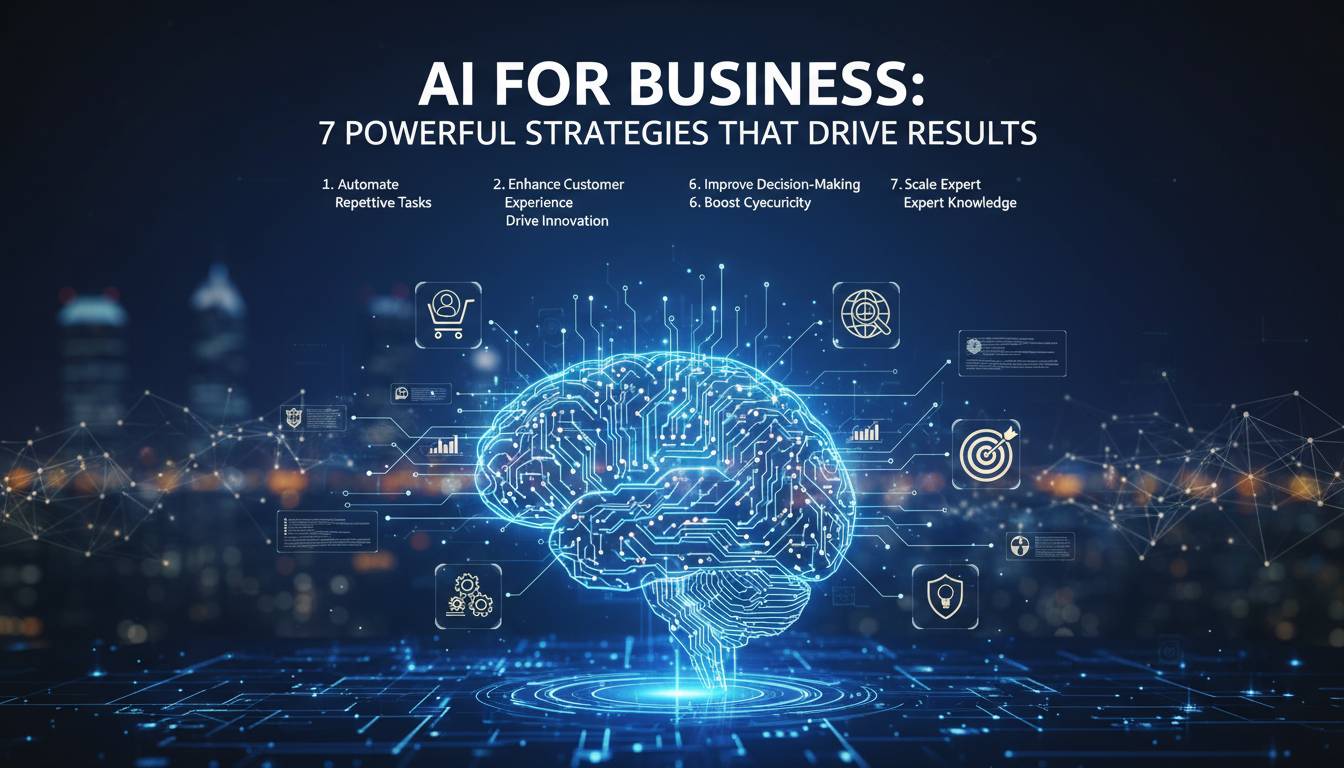
AI for Business: 7 Powerful Strategies That Drive Results

Artificial intelligence has transitioned from experimental technology to essential business infrastructure. Companies that effectively implement AI strategies are seeing measurable improvements in efficiency, customer satisfaction, and bottom-line results. This comprehensive guide examines seven proven strategies that businesses are using to transform operations and gain competitive advantage through artificial intelligence.
The Current State of AI in Business
The adoption of artificial intelligence in enterprise environments has accelerated dramatically over the past five years. According to a 2023 McKinsey Global Survey, 55% of organizations reported using AI in at least one business function, up from 50% in the previous year and just 20% in 2017. This isn’t a trend—it’s a fundamental shift in how successful companies operate.
Key Insights
– Organizations using AI report average revenue increases of 15-20% in affected business functions
– Companies with formal AI strategies outperform competitors by 2-3x in market valuation growth
– 67% of business leaders consider AI critical to their future success
– The global AI market is projected to reach $1.8 trillion by 2030
The businesses seeing the greatest returns aren’t simply adopting technology—they’re implementing strategic approaches that align AI capabilities with specific business objectives. The difference between AI failure and AI success often comes down to strategy, not technology.
Strategy 1: Automate Routine Operations
Operational efficiency remains the most immediate and measurable benefit of AI implementation. Robotic Process Automation (RPA) combined with machine learning capabilities allows businesses to handle repetitive tasks that previously consumed significant human resources.
Companies implementing AI-driven automation are reporting cost reductions of 25-40% in affected processes. JP Morgan Chase deployed machine learning to review commercial loan agreements, reducing 360,000 hours of annual manual review to seconds. The efficiency gains freed skilled employees to focus on higher-value activities that require judgment and creativity.
Where Automation Delivers Greatest Value
Finance and Accounting
AI automates invoice processing, reconciliation, expense categorization, and financial reporting. Automation reduces error rates by up to 90% while processing transactions 10x faster than manual methods.
Customer Service
Intelligent chatbots and virtual assistants handle routine inquiries 24/7, resolving 70-80% of common questions without human intervention. This allows support teams to focus on complex issues requiring empathy and specialized knowledge.
Supply Chain Management
Predictive algorithms optimize inventory levels, reducing carrying costs by 20-35% while simultaneously decreasing stockouts. AI-powered demand forecasting integrates market trends, weather patterns, and economic indicators for unprecedented accuracy.
Human Resources
Automated resume screening, onboarding workflows, and benefits administration reduce administrative burden while improving candidate experience and employee satisfaction.
The key to successful automation is identifying processes with high volume, standardized procedures, and clear rules. Starting with these “low-hanging fruit” opportunities builds organizational confidence and generates quick wins that justify expanded investment.
Strategy 2: Enhance Customer Experience
Customer expectations have evolved dramatically, and AI enables businesses to meet—and exceed—these demands at scale. Personalization powered by machine learning creates experiences that feel individually crafted for each customer.
Amazon attributes 35% of its revenue to AI-powered recommendation engines. Netflix saves approximately $1 billion annually through reduced churn driven by personalized content suggestions. These aren’t exceptions—they’re demonstrations of what’s possible when businesses truly understand individual customer preferences.
Implementing Customer Experience AI
Personalization Engines
Machine learning analyzes browsing history, purchase patterns, and behavioral signals to deliver relevant product recommendations, content, and offers in real-time. The most effective implementations consider hundreds of signals including time of day, device type, location, and even weather conditions.
Sentiment Analysis
Natural Language Processing (NLP) tools monitor customer feedback across reviews, social media, support tickets, and surveys. Businesses can identify emerging issues before they become widespread problems and respond proactively to concerns.
Predictive Customer Service
AI identifies customers likely to experience problems or churn based on behavioral patterns. Proactive outreach—offering solutions before customers encounter issues—transforms potential detractors into loyal advocates.
Visual and Voice Search
Computer vision and speech recognition enable customers to find products using images or natural language queries. Retailers implementing visual search report 30% higher conversion rates compared to traditional keyword searches.
TheCustomer experience improvements directly impact revenue. Research from PwC indicates that 65% of consumers find positive customer experience more influential than advertising, and 86% are willing to pay more for a better experience.
Strategy 3: Data-Driven Decision Making
The volume of data available to businesses has grown exponentially, making human analysis increasingly insufficient. AI transforms raw data into actionable insights, enabling faster and more accurate decision-making across all organizational levels.
Gartner research indicates that data-driven organizations are three times more likely to report significant improvements in decision-making quality. The competitive advantage doesn’t come from data alone—it comes from the ability to extract meaningful patterns and predictions from that data.
Building Decision Intelligence Infrastructure
Analytics Platforms
Modern business intelligence tools incorporate machine learning to surface insights automatically. Rather than requiring analysts to ask the right questions, these platforms identify trends, anomalies, and opportunities independently.
Natural Language Querying
Business leaders no longer need technical skills to access data insights. Natural language processing enables conversational queries like “What drove the sales increase in the Northeast region last quarter?” making data accessible throughout the organization.
Real-Time Dashboards
AI-powered dashboards provide continuous monitoring with intelligent alerting. Rather than static reports, these systems learn normal patterns and flag anomalies that warrant attention.
Prescriptive Recommendations
Beyond descriptive and predictive analytics, AI increasingly provides prescriptive recommendations—suggesting specific actions based on predicted outcomes. This bridges the gap between insight and action.
Decision intelligence requires robust data infrastructure. Businesses must address data quality, integration, and governance before realizing the full potential of AI-driven insights. Organizations with strong data foundations see implementation success rates 2-3x higher than those with fragmented or poor-quality data.
Strategy 4: Predictive Analytics for Business Forecasting
Prediction is where AI delivers transformative business value. Machine learning models trained on historical data can forecast demand, identify risks, and anticipate market shifts with accuracy impossible through traditional methods.
Walmart’s inventory prediction system analyzes hundreds of variables—including weather forecasts, social media trends, and local events—to optimize stock levels across 11,000 stores. The result: reduced waste, improved availability, and billions in savings.
High-Impact Predictive Applications
Demand Forecasting
Machine learning models predict future demand with 90%+ accuracy compared to 60-70% for traditional statistical methods. This precision enables optimal inventory, staffing, and production planning.
Financial Forecasting
AI analyzes cash flow patterns, market conditions, and economic indicators to predict revenue, expenses, and profitability with significantly greater accuracy than manual forecasting.
Risk Assessment
Insurance companies, lenders, and credit analysts use machine learning to evaluate risk profiles. These models consider thousands of factors simultaneously, improving prediction accuracy while reducing bias.
Maintenance Prediction
Industrial manufacturers use sensor data and machine learning to predict equipment failure before it occurs. Predictive maintenance reduces downtime 35-50% while cutting maintenance costs 25-30%.
Customer Lifetime Value
AI models identify high-value customers and predict churn risk, enabling targeted retention efforts that maximize return on customer relationship investment.
The value of predictive analytics compounds over time as models learn from new data. Organizations that invest in predictive capabilities build increasingly sophisticated insights that competitors struggle to replicate.
Strategy 5: Personalized Marketing and Sales
Mass marketing approaches are becoming obsolete as customers expect relevance and personalization. AI enables one-to-one marketing at scale, delivering the right message to the right person at the right time.
Spotify’s Discover Weekly playlist generates 40% of user engagement through personalized recommendations. Spotify’s recommendation system analyzes listening history, skip behavior, and similarity to other users to create individualized playlists each week.
AI-Powered Marketing Transformation
Audience Segmentation
Machine learning identifies natural customer segments based on behavioral patterns, moving beyond demographic categories to psychographic and behavioral targeting.
Content Optimization
AI tests thousands of content variations, automatically optimizing headlines, images, calls-to-action, and send times for maximum engagement. Marketing teams using AI for content optimization see 30-50% improvements in campaign performance.
Lead Scoring
Predictive models evaluate lead quality by analyzing engagement patterns, firmographic data, and intent signals. Sales teams receive prioritized prospect lists that significantly improve conversion rates.
Dynamic Pricing
E-commerce and service businesses use AI to optimize pricing based on demand elasticity, competitor pricing, inventory levels, and customer segments. Airlines and hotel chains have used dynamic pricing for years; now the approach applies broadly across industries.
Churn Prevention
Machine learning identifies subscription and membership customers at risk of leaving, enabling proactive retention interventions. Spotify’s churn prediction model reduced user churn by percentage points that translated to hundreds of millions in retained revenue.
Personalization requires balance. Research from Salesforce indicates that 66% of customers expect companies to understand their unique needs, but 52% are uncomfortable with how companies use their personal information. Transparency and value exchange are essential to successful personalization programs.
Strategy 6: Risk Management and Fraud Detection
Financial losses from fraud, cybersecurity threats, and operational risks represent significant business costs. AI provides powerful tools to identify, predict, and prevent risks before they materialize.
AI in Risk and Compliance
Fraud Detection
Machine learning analyzes transaction patterns in real-time, identifying anomalies that indicate fraudulent activity. PayPal’s AI systems analyze millions of transactions daily, preventing fraud while minimizing false positives that frustrate legitimate customers.
Cybersecurity
AI-powered security systems detect threats by identifying patterns that indicate malicious activity. These systems learn normal network behavior and flag deviations that human analysts might miss. According to IBM, organizations using AI and automation for security respond to breaches 54% faster than those without such tools.
Credit Risk
Lenders use machine learning to evaluate borrower risk with greater accuracy. These models incorporate alternative data sources—including payment history, cash flow patterns, and even educational background—to assess creditworthiness beyond traditional credit scores.
Regulatory Compliance
Natural language processing monitors regulatory changes and automatically assesses compliance requirements. AI also helps identify potential compliance violations before they become regulatory problems.
Supply Chain Risk
AI monitors global supply chains for disruption risks, analyzing news, shipping data, weather forecasts, and geopolitical events to provide early warning of potential problems.
Effective risk management using AI requires careful attention to model accuracy, bias, and explainability. Organizations must balance detection sensitivity with false positive rates and ensure that AI decisions can be explained to regulators and stakeholders.
Strategy 7: Talent Augmentation and Human Capital Optimization
The most successful AI implementations don’t replace humans—they augment human capabilities. AI excels at processing data and identifying patterns, while humans provide creativity, judgment, and emotional intelligence. Together, this combination outperforms either alone.
Human-AI Collaboration Models
Augmented Decision Making
AI provides recommendations and analysis; humans make final decisions. This model works well in medical diagnosis, legal research, and strategic planning where human judgment remains essential.
AI-Assisted Productivity
Tools like GitHub Copilot help developers write code faster. Microsoft 365 Copilot drafts documents and emails, suggest improvements, and automate tasks. These tools amplify human productivity rather than replacing it.
Skills Development
AI identifies skill gaps and recommends personalized learning paths. Organizations using AI for talent development see 35% higher employee engagement and significantly improved retention.
Recruitment Optimization
AI screens candidates, assesses fit, and reduces unconscious bias in hiring. Pymetrics uses neuroscience-based games and AI to match candidates to roles where they’re most likely to succeed, improving hiring accuracy while increasing diversity.
Performance Management
Continuous feedback systems powered by AI identify performance patterns and provide managers with actionable insights for coaching and development.
The World Economic Forum predicts that AI will displace 85 million jobs globally by 2025 but create 97 million new ones. Organizations that prepare their workforce for human-AI collaboration will be best positioned to capture AI’s benefits while maintaining engaged, productive employees.
Implementation Best Practices
Successfully implementing AI requires more than technology—it demands strategic planning, organizational alignment, and change management.
Starting Your AI Journey
Define Clear Objectives
Begin with specific business problems rather than technology for its own sake. Identify processes with clear success metrics where AI can deliver measurable value.
Start Small and Scale
Pilot projects with limited scope allow teams to learn and iterate. Successful pilots build organizational confidence and provide proof points for expanded investment.
Invest in Data Foundation
AI models require quality data. Organizations should address data collection, storage, integration, and governance before attempting sophisticated AI implementations.
Build Cross-Functional Teams
Successful AI projects combine technical expertise with business domain knowledge. Data scientists alone cannot identify the most valuable AI opportunities; they need partnership with operational leaders.
Plan for Change Management
AI implementation affects workflows, skills, and sometimes organizational structure. Proactive change management—including training, communication, and stakeholder involvement—is essential.
Measure and Iterate
Establish clear metrics for success and track progress continuously. AI implementations improve over time as models learn from new data, but only if organizations measure and optimize systematically.
Common Mistakes to Avoid
| Mistake | Impact | Solution |
|---|---|---|
| Starting without clear objectives | Projects lack focus and fail to deliver business value | Define specific, measurable goals before starting |
| Neglecting data quality | AI models produce unreliable results | Invest in data infrastructure and governance first |
| Underestimating change management | Technology implemented but not adopted | Plan for training, communication, and workflow changes |
| Expecting immediate results | Organizations abandon promising initiatives too soon | Plan for 6-12 month maturation periods for AI projects |
| Ignoring ethics and bias | Reputational damage and regulatory problems | Implement fairness audits and ethical AI frameworks |
| Trying to do everything at once | Resources stretched, results diluted | Prioritize and sequence initiatives based on value |
The Future of AI in Business
The next five years will see AI become even more embedded in business operations. Generative AI is already transforming content creation, software development, and customer interactions. Multimodal AI systems that process text, images, and voice simultaneously will open new possibility spaces.
McKinsey projects that AI could contribute $13 trillion to the global economy by 2030. Organizations that build AI capabilities now will have significant advantages as the technology matures.
The most successful businesses won’t be those with the most sophisticated AI—they’ll be those that most effectively align AI capabilities with human creativity and strategic vision. Technology enables; strategy delivers.
Frequently Asked Questions
How much does AI implementation cost for small businesses?
AI implementation costs vary widely based on scope and complexity. Small businesses can start with cloud-based AI services beginning at $100-500 monthly for basic applications. More sophisticated implementations typically range from $10,000-100,000 for initial development, with ongoing costs of $1,000-10,000 monthly. Many AI vendors now offer pay-as-you-go pricing that makes adoption accessible without large upfront investments.
How long does it take to see results from AI implementation?
Simple automation projects can show results within 3-6 months. More complex initiatives—like predictive analytics or customer experience transformation—typically require 12-18 months to demonstrate full business impact. Most organizations see initial wins within the first 6 months that justify continued investment.
Do I need a data science team to implement AI?
Not necessarily for initial implementations. Many AI platforms now offer pre-built models and no-code interfaces that don’t require technical expertise. However, organizations pursuing sophisticated custom AI solutions will eventually need data science capabilities—either through internal hiring, consulting partners, or hybrid models.
What industries benefit most from AI in business?
While AI benefits organizations across all sectors, the largest impacts are seen in industries with high-volume data, significant operational complexity, and clear efficiency opportunities. Financial services, healthcare, retail, manufacturing, and logistics show particularly strong returns. However, every industry can identify valuable AI applications.
How do I measure ROI on AI investments?
Define success metrics before implementation—typically including cost reduction, revenue improvement, error reduction, or time savings. Track these metrics baseline before deployment and compare regularly against pre-AI performance. Calculate ROI by dividing documented value gains by total implementation costs. Plan for 12-24 month evaluation periods for substantial investments.
What are the biggest risks of AI adoption?
Primary risks include: implementation failure due to poor planning, data quality issues causing unreliable results, employee resistance to workflow changes, regulatory compliance challenges, and potential bias in AI decision-making. Organizations should conduct thorough risk assessments and implement governance frameworks before deploying AI at scale.