
AI Career Opportunities: Skills That Lead to Top Salaries

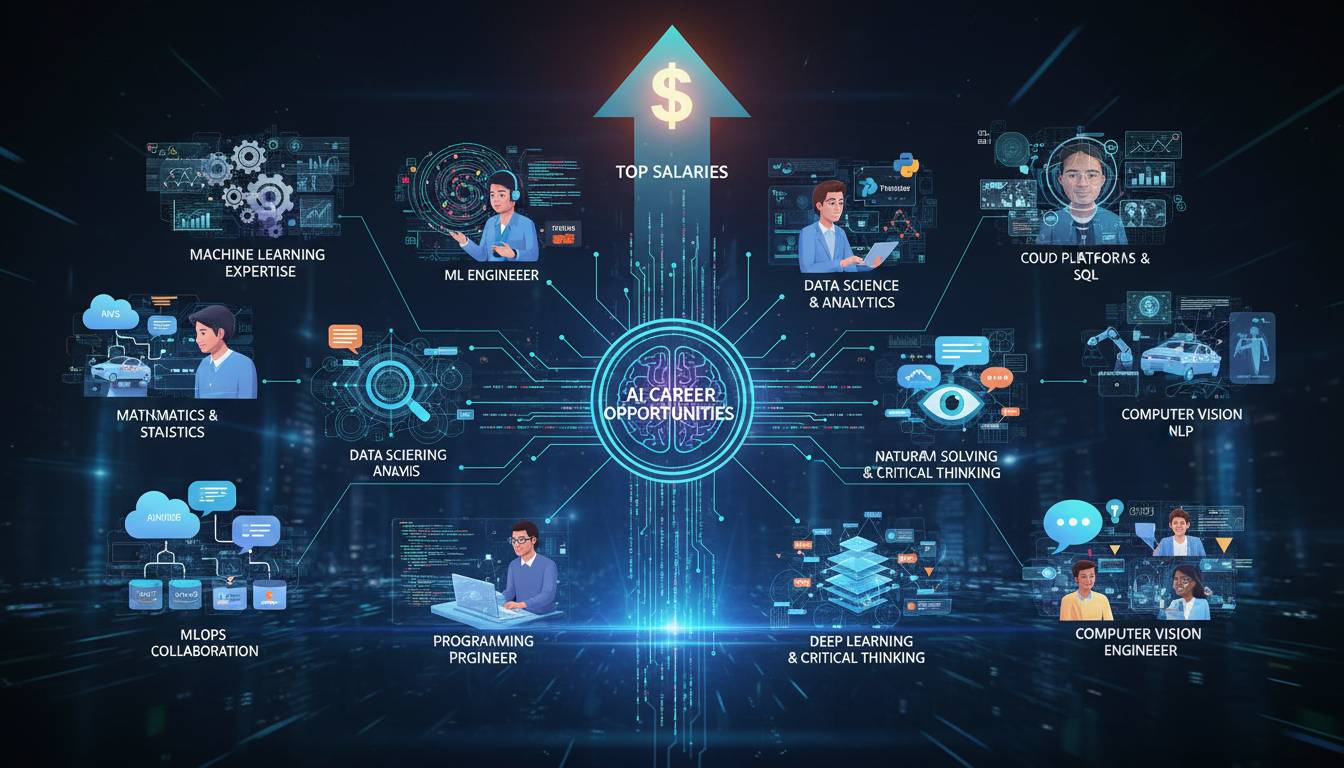
The artificial intelligence job market is experiencing unprecedented growth, with demand outpacing supply by a significant margin. As organizations across every industry race to implement AI solutions, professionals with the right combination of technical skills, domain expertise, and practical experience are commanding record-breaking salaries and enjoying exceptional career security. Understanding which AI career paths offer the highest earning potential—and what it takes to land these positions—has become essential knowledge for anyone looking to advance in today’s technology-driven workforce.
This comprehensive guide examines the current state of AI career opportunities in the United States, breaking down the highest-paying roles, the skills that matter most, and the strategic steps you can take to position yourself for success in this rapidly evolving field.
The State of AI Careers in 2025
The artificial intelligence job market has reached a critical inflection point. According to the Bureau of Labor Statistics, computer and information technology occupations are projected to grow 13% from 2023 to 2033, significantly faster than the average for all occupations. Within this broader category, AI-specific roles are growing at an even more dramatic pace.
LinkedIn’s 2024 Emerging Jobs Report identified machine learning engineer and AI specialist roles among the top fastest-growing job categories, with year-over-year growth rates exceeding 30% for many AI positions. The World Economic Forum’s Future of Jobs Report 2023 projected that AI and machine learning specialists will be among the top-growing roles globally through 2027.
KEY ENTITIES:
- Products/Tools/Methods: Python, TensorFlow, PyTorch, ChatGPT, Midjourney, Hugging Face, AWS SageMaker, Google Vertex AI
- Experts Referenced: Andrew Ng (Stanford University, Coursera), Fei-Fei Li (Stanford AI Lab), Geoffrey Hinton (University of Toronto, Google DeepMind)
- Organizations: Bureau of Labor Statistics, LinkedIn, World Economic Forum, NVIDIA, Google DeepMind, OpenAI, Microsoft AI
- Standards/Frameworks: ISO/IEC 42001 (AI Management System), NIST AI Risk Management Framework
LAST UPDATED: January 2025
This explosive growth creates both opportunity and challenge. Companies are competing aggressively for qualified AI talent, driving salaries to levels that would have seemed implausible just five years ago. However, the technical complexity of AI work means that simply claiming AI expertise is insufficient—employers seek demonstrable skills, proven experience, and the ability to translate technical capabilities into business value.
Top AI Career Roles and Their Salary Ranges
Understanding which AI roles command the highest compensation requires examining both the technical requirements and the market demand for each position. Based on data from multiple industry sources including Glassdoor, levels.fyi, and the 2024 Robert Walters Salary Survey, certain AI roles consistently appear at the top of the compensation hierarchy.
Machine Learning Engineer
Machine learning engineers remain the crown jewel of AI careers, combining software engineering proficiency with deep learning expertise. These professionals design, build, and deploy machine learning models that power everything from recommendation systems to autonomous vehicles.
SALARY DATA:
| Experience Level | Base Salary Range | Total Compensation (with bonuses/stock) |
|---|---|---|
| Entry Level (0-2 years) | $90,000 – $130,000 | $100,000 – $150,000 |
| Mid-Level (3-5 years) | $140,000 – $190,000 | $170,000 – $250,000 |
| Senior (5-8 years) | $180,000 – $240,000 | $250,000 – $400,000 |
| Principal/Distinguished | $220,000 – $300,000 | $350,000 – $600,000+ |
The highest compensation packages for machine learning engineers typically appear at major technology companies including Google, Meta, NVIDIA, and Amazon, where total compensation can exceed $500,000 for experienced engineers, particularly those with specialized expertise in areas like large language models or computer vision.
Data Scientist
Data scientists apply statistical analysis and machine learning techniques to extract insights from complex datasets. While the role has existed for over a decade, the explosion of AI capabilities has elevated both the expectations and compensation for practitioners in this space.
According to the 2024 Burtch Works Salary Survey, data scientists with AI and machine learning specializations command 15-25% higher salaries than generalist data scientists. The median salary for senior data scientists in major tech hubs exceeds $180,000, with total compensation often reaching $250,000 or more at senior levels.
AI Research Scientist
AI research scientists pushing the boundaries of what’s possible with artificial intelligence represent the most academically demanding and highly compensated career path. These roles typically require doctoral degrees and a proven publication record in venues like NeurIPS, ICML, or ICLR.
Compensation at leading AI research labs reflects the intense competition for top talent. Researchers at organizations like OpenAI, Google DeepMind, and Anthropic frequently earn total compensation exceeding $500,000, with some principal researchers earning well over $1 million annually when including equity grants and bonuses.
Prompt Engineer
A relatively new career category emerging from the rise of large language models, prompt engineering has quickly become one of the most accessible entry points into the AI field. Prompt engineers specialize in crafting effective inputs for AI systems to achieve desired outputs.
While still an emerging role, prompt engineers at major technology companies earn between $100,000 and $300,000 annually, depending on their technical background and the complexity of their work. Organizations like Anthropic, OpenAI, and various consulting firms actively recruit for these positions.
Essential Skills for High-Paying AI Careers
The technical skills required for AI success have evolved significantly as the field matures. Understanding which skills drive the highest salaries—and how to develop them strategically—can dramatically impact your career trajectory.
Programming Languages
Python remains the undisputed dominant language for AI development, with over 70% of machine learning projects using Python as their primary implementation language. The language’s extensive ecosystem of libraries including NumPy, Pandas, scikit-learn, TensorFlow, and PyTorch makes it indispensable for any AI career.
Beyond Python, professionals increasingly benefit from familiarity with C++ for performance-critical AI applications, R for statistical analysis and research, and SQL for database operations essential to data pipeline work. Julia has also gained traction in scientific computing and machine learning applications.
Machine Learning Frameworks
Practical framework proficiency distinguishes junior practitioners from senior professionals. TensorFlow, developed by Google, and PyTorch, developed by Meta, represent the two dominant deep learning frameworks in industry use. According to recent developer surveys, approximately 60% of ML practitioners use TensorFlow while 55% use PyTorch, with many professionals using both depending on project requirements.
For large language model work, familiarity with the Hugging Face Transformers library has become essential, as has experience with distributed training frameworks for scaling models across multiple GPUs.
Mathematics and Statistics
The mathematical foundation underlying all AI work includes:
- Linear Algebra: Matrix operations, vector spaces, and eigenvalues critical to understanding neural network architectures
- Probability and Statistics: Bayesian inference, distributions, hypothesis testing, and statistical modeling
- Calculus: Gradient descent, backpropagation, and optimization theory
Professionals with strong mathematical backgrounds typically advance more quickly and command higher salaries, particularly in research-oriented positions.
Cloud Platforms and MLOps
Modern AI deployment increasingly requires cloud platform expertise. Amazon Web Services (AWS), Google Cloud Platform (GCP), and Microsoft Azure all offer machine learning services, and familiarity with at least one platform has become a baseline expectation.
MLOps—the practice of operationalizing machine learning models—has emerged as a critical skill set. Professionals who understand model versioning, automated retraining, containerization with Docker, and orchestration with Kubernetes can command premium compensation due to the operational challenges of deploying AI at scale.
How to Transition into AI From Other Fields
Professionals from diverse backgrounds successfully transition into AI careers each year. Understanding the most effective pathways can significantly accelerate your career change.
From Software Engineering
Software engineers possess a significant advantage when transitioning to AI careers, as they already understand software development principles, version control, and system design. The additional skills required primarily involve machine learning mathematics, framework proficiency, and data engineering knowledge.
Many software engineers transition through internal mobility programs at their current companies, taking on ML-adjacent projects before fully transitioning to dedicated AI roles. This pathway offers lower risk and allows you to build experience while maintaining employment.
From Data Analysis and Statistics
Professionals with backgrounds in data analysis, business analytics, or traditional statistics are well-positioned for AI roles that emphasize statistical modeling and insight generation. The transition typically involves developing deeper programming skills and learning modern machine learning frameworks.
Online courses from platforms like Coursera, edX, and Udacity provide structured learning paths, while projects demonstrating practical AI implementation strengthen your portfolio significantly.
From Academic Research
Academic researchers, particularly those with backgrounds in computer science, mathematics, or physics, frequently transition to industry AI roles. The research methodology and publication experience valued in academia also carry weight in industry, particularly at research-focused organizations.
The primary adjustment involves shifting from pure research to applied work that delivers business value, along with developing software engineering skills that may be less emphasized in academic training.
Industry Demand and Geographic Distribution
The geographic distribution of AI jobs significantly impacts compensation and opportunity. Major technology hubs including the San Francisco Bay Area, Seattle, New York City, Boston, and Austin offer the highest salaries and greatest concentration of opportunities.
According to the 2024 Dice Tech Salary Report, AI professionals in San Francisco earn approximately 30-40% more than the national average, reflecting the intense competition for talent in the Bay Area. However, remote work opportunities have expanded significantly, with many companies now offering remote or hybrid positions at competitive compensation regardless of location.
Industry sectors actively recruiting AI talent include:
- Technology and Software: The largest employer category, with major companies continuously expanding AI teams
- Financial Services: Banks, hedge funds, and fintech companies investing heavily in algorithmic trading, fraud detection, and risk assessment
- Healthcare and Pharmaceuticals: Drug discovery, medical imaging analysis, and predictive diagnostics
- Automotive: Autonomous vehicle development and advanced driver assistance systems
- Retail and E-commerce: Personalization engines, demand forecasting, and inventory optimization
Future Outlook and Emerging Opportunities
The AI career landscape continues to evolve rapidly. Several emerging trends are reshaping opportunity structures and skill requirements.
Generative AI and LLM Applications
The emergence of large language models and generative AI has created entirely new career categories. Beyond prompt engineering, roles in AI application development, AI safety and alignment, and LLM fine-tuning have emerged as high-demand positions.
Organizations across industries seek professionals who can translate generative AI capabilities into practical business applications, creating opportunities for those who combine AI technical skills with domain expertise.
AI Ethics and Governance
As AI systems increasingly impact society, careers in AI ethics, governance, and responsible AI development have gained prominence. These roles require combinations of technical understanding, policy knowledge, and philosophical frameworks.
Major technology companies and regulatory bodies increasingly employ AI ethicists and governance specialists, with salaries competitive with engineering roles for experienced professionals.
AI Infrastructure and Hardware
The computational demands of modern AI have created career opportunities in specialized hardware optimization, AI infrastructure engineering, and high-performance computing. Professionals with expertise in GPU optimization, distributed training systems, and AI-specific hardware are in exceptionally high demand.
Frequently Asked Questions
What is the average salary for an AI engineer in the United States?
The average salary for AI engineers in the United States varies significantly by experience and location. According to data from Glassdoor and levels.fyi, the average base salary for machine learning engineers ranges from $130,000 to $180,000, with total compensation including bonuses and equity ranging from $160,000 to over $400,000 depending on seniority and location. Senior AI engineers at major technology companies frequently earn total compensation exceeding $500,000.
Do I need a PhD to work in AI research?
A PhD is not strictly required for most AI industry positions, including many research roles. While top AI research labs at organizations like Google DeepMind and OpenAI often prefer doctoral qualifications for dedicated research positions, many AI engineers and applied researchers hold master’s degrees or bachelor’s degrees. What matters most is demonstrable skills, relevant project experience, and the ability to contribute meaningfully to AI development.
Which programming language is most important for AI careers?
Python is the most important programming language for AI careers, with virtually all major frameworks and tools supporting Python as a primary interface. According to industry surveys, over 70% of machine learning practitioners use Python as their primary programming language. Learning Python thoroughly, along with gaining proficiency in its ML ecosystem libraries, should be the first priority for anyone pursuing an AI career.
How long does it take to transition into an AI career?
The time required to transition into an AI career depends on your starting point and commitment level. For professionals with strong technical backgrounds, six to twelve months of focused learning and project development can be sufficient. Those transitioning from non-technical backgrounds typically require twelve to twenty-four months to build foundational skills and develop a portfolio of AI projects. Online courses, bootcamps, and self-directed learning can all accelerate this timeline.
What industries pay the highest salaries for AI professionals?
The technology sector generally offers the highest salaries for AI professionals, with companies like Google, Meta, NVIDIA, Amazon, and Microsoft leading compensation. However, financial services, particularly hedge funds and quantitative trading firms, often compete with or exceed technology company compensation for AI talent with specialized skills. Senior AI talent in financial services can earn total compensation exceeding $1 million annually.
Conclusion
The AI career landscape offers exceptional opportunities for professionals willing to invest in developing the right skills. The highest-paying roles—machine learning engineer, AI research scientist, and data scientist—consistently offer compensation exceeding $200,000 at senior levels, with top performers at leading organizations earning significantly more.
Success in AI careers requires a strategic approach combining strong technical foundations in Python and machine learning frameworks, solid mathematical grounding, and practical experience developing and deploying AI systems. The most successful AI professionals continuously update their skills as the field evolves, particularly in areas like generative AI and LLM applications that have emerged as major opportunity areas.
For those willing to commit to continuous learning and practical skill development, AI careers offer not only exceptional financial compensation but also the opportunity to work on genuinely transformative technology that shapes the future. The demand for qualified AI professionals shows no signs of slowing, making this an opportune time to develop the skills that will define the next generation of technology careers.