Cryptocurrency Wallet Types: Complete Guide to Find Yours

Choosing the right cryptocurrency wallet is one of the most critical decisions you’ll make in your crypto journey. A cryptocurrency wallet doesn’t actually store your digital assets—it stores your private keys, which are the cryptographic passwords that prove ownership of your coins and allow you to transact on the blockchain. Understanding the different wallet types, their security characteristics, and their intended use cases will help you protect your investments while maintaining convenient access to your funds.
This guide breaks down every major wallet category, explains how each works, and provides actionable advice to help you select the best option for your specific needs.
Hot Wallets: Convenience at a Cost
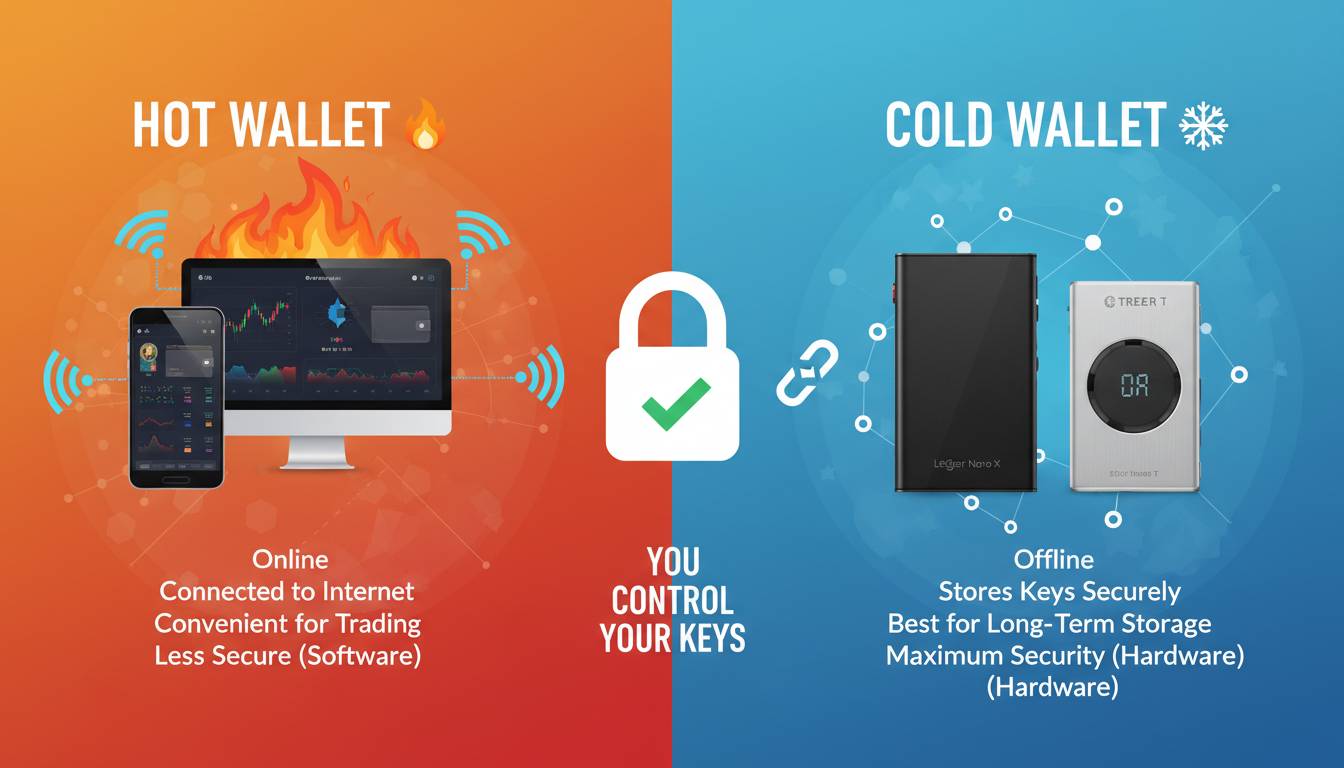
Hot wallets are cryptocurrency wallets that remain connected to the internet. Because they’re always online, they offer the fastest convenient access to your funds—perfect for frequent traders, everyday purchases, or anyone who needs to send and receive crypto regularly.
Types of Hot Wallets
Web wallets operate through browser-based interfaces and are typically provided by cryptocurrency exchanges. Examples include Coinbase Wallet, Binance Wallet, and Kraken’s native wallet. These require no installation and are accessible from any device with a browser, making them incredibly convenient for beginners.
Mobile wallets are smartphone applications that store your private keys locally on your device. Popular options include Trust Wallet, MetaMask (mobile), Coinbase Wallet, and BlueWallet. These leverage your phone’s security features, including biometric authentication, and often include integrated decentralized exchange access.
Desktop wallets install as software on your computer. Examples include Electrum, Exodus, and Atomic Wallet. They offer more robust features than web or mobile alternatives but require you to maintain your computer’s security manually.
Advantages and Disadvantages
Hot wallets excel in usability. Setting one up takes minutes, transactions execute instantly, and you can access your funds from anywhere with an internet connection. Many hot wallets integrate with decentralized finance (DeFi) protocols, non-fungible token (NFT) marketplaces, and blockchain applications seamlessly.
The primary tradeoff is security. Since hot wallets remain connected to the internet, they present a larger attack surface for hackers, malware, and phishing attacks. In 2022 alone, over $3.8 billion was stolen from cryptocurrency platforms and wallets through various attack vectors, according to blockchain security firm Chainalysis. Most major thefts involve hot wallet compromise.
Best for: Small amounts of crypto for daily spending, active trading, DeFi participation, and users who prioritize convenience over maximum security.
Cold Wallets: Maximum Security for Long-Term Storage
Cold wallets keep your private keys offline, completely disconnected from the internet. This air-gapped approach dramatically reduces your vulnerability to remote attacks, making cold storage the gold standard for protecting significant cryptocurrency holdings.
Hardware Wallets
Hardware wallets are dedicated physical devices designed specifically for secure cryptocurrency storage. These devices generate and store your private keys within a secure element—a specialized chip that cannot export the keys, even if the device is compromised.
Ledger (including Ledger Nano X and Ledger Nano S Plus) remains the market leader, having sold over 6 million devices worldwide. Their wallets support over 5,500 different cryptocurrencies and tokens, and all transactions require physical button confirmation on the device itself.
Trezor (including Trezor Model T and Trezor One) pioneered hardware wallets and offers open-source firmware that security researchers can audit. The Model T includes a touchscreen for easier verification of transaction details before approval.
Other notable options include Coldcard (designed specifically for Bitcoin with advanced security features), SafePal (offering air-gapped signing), and BitBox02 (Swiss-made with a focus on simplicity).
Hardware wallets typically cost between $50 and $250, representing a worthwhile investment for anyone holding more than a few hundred dollars in cryptocurrency.
Paper Wallets
A paper wallet is a physical document containing your private keys and public addresses, typically printed as QR codes. To create one securely, you generate the keys on an offline computer, then transfer them to a printer disconnected from any network.
While paper wallets offer excellent security against digital threats, they introduce physical vulnerabilities—paper can be lost, damaged, destroyed, or stolen. Additionally, importing a paper wallet key into any software wallet creates a “hot” situation, since that software is then connected to the internet.
Modern cryptocurrency management has largely moved away from paper wallets toward hardware solutions, though they remain a free option for the security-conscious minimalist.
Best for: Long-term investors holding substantial amounts, “cold storage” for savings you don’t plan to access frequently, and users who prefer tangible, verifiable control over their keys.
Custodial vs. Non-Custodial: Who Holds Your Keys?
This distinction is fundamental to understanding cryptocurrency wallet security.
Custodial wallets hold your private keys on your behalf. When you create an account on an exchange like Coinbase, Kraken, or Gemini, you’re using a custodial wallet. These platforms store your keys in their systems, meaning you trust them to secure your funds and authorize transactions on your behalf.
The advantages include convenience (no seed phrase to manage, easy account recovery), integrated trading features, and insurance coverage (some exchanges provide limited protection against theft). However, you don’t have true ownership—you technically own an IOU from the custodian. If the exchange is hacked, goes bankrupt, or restricts your access, your funds could be at risk.
Non-custodial wallets give you sole control of your private keys. When you set up MetaMask, Trust Wallet, or a hardware wallet, you’re the only person who knows the seed phrase (the 12 or 24 words that generate your keys). This means complete autonomy—no third-party risk, no account freezes, full ownership.
The tradeoff is complete responsibility. If you lose your seed phrase, no one can recover your funds. If someone obtains your seed phrase, they can drain your wallet instantly.
Expert perspective: Most cryptocurrency security professionals recommend non-custodial solutions for any funds you don’t actively trade. As Andreas Antonopoulos, a well-known Bitcoin educator, frequently states: “Not your keys, not your crypto.”
Software Wallets: The Middle Ground
Software wallets occupy the middle ground between hot and cold storage. They run as applications on your devices but often include enhanced security features not found in basic hot wallets.
Desktop Wallets
Desktop wallets like Electrum (Bitcoin-focused, known for its security features and lightweight design), Exodus (multi-currency with integrated exchange), and Atomic Wallet (decentralized, non-custodial) install directly on your computer.
Security depends heavily on your computer’s hygiene. Malware, keyloggers, and remote access tools can compromise these wallets if your system is infected. Running a desktop wallet on a dedicated, security-hardened machine significantly reduces risk.
Mobile Wallets
Mobile wallets have become the most popular software wallet category due to their convenience. MetaMask dominates the Ethereum and EVM-compatible ecosystem, with over 30 million monthly active users. It serves as both a wallet and a gateway to Ethereum-based applications.
Rainbow Wallet offers an elegant Ethereum experience with strong DeFi integration, while BlueWallet provides excellent Bitcoin-focused features including Lightning Network support.
Mobile wallets inherit your phone’s security model—they benefit from hardware encryption, biometric locks, and operating system sandboxing, but are vulnerable to SIM-swapping attacks, malicious apps, and device compromise.
Browser Extension Wallets
MetaMask’s browser extension version pioneered this category, but options like Rabby, Frame, and Coinbase Wallet Extension now compete in this space. Browser extensions offer convenient access to Web3 applications while maintaining non-custodial control.
The attack surface includes browser vulnerabilities, malicious extensions, and phishing websites that trick you into signing malicious transactions. Always verify website URLs carefully and confirm transaction details before approving.
Multi-Signature Wallets: Adding Layered Security
Multi-signature (multi-sig) wallets require multiple private keys to authorize a transaction. For example, a 2-of-3 multisig wallet needs any two of three designated keys to move funds.
This approach distributes trust and reduces single points of failure. A 2-of-3 setup means you could lose one key without losing access to your funds. It also enables scenarios like requiring approval from multiple family members for large transactions, or combining personal and company keys for organizational funds.
Gnosis Safe (now simply Safe) is the leading multi-sig solution for Ethereum and EVM-compatible chains, managing over $40 billion in assets at peak periods. BitPay offers multi-sig Bitcoin wallets, while Casa provides managed multi-sig solutions for high-net-worth individuals.
How to Choose the Right Wallet
Selecting the best wallet depends on your specific situation. Consider these factors:
Amount held: The general guideline is to keep only spending money (1-5% of your crypto) in hot wallets, with the majority in cold storage. Hardware wallets become essential once your holdings exceed what you’d be comfortable losing.
Access frequency: Daily traders need hot wallets for speed. Long-term holders benefit from cold storage’s security.
Technical comfort: Hardware wallets require more setup and responsibility. If the learning curve feels steep, start with a reputable mobile wallet while educating yourself.
Blockchain compatibility: Ensure your chosen wallet supports the specific cryptocurrencies you want to hold. Hardware wallets generally offer the broadest support.
Integration needs: If you plan to use DeFi protocols, NFTs, or specific blockchains, verify your wallet supports those use cases.
Security Best Practices Regardless of Wallet Type
-
Never share your seed phrase: No legitimate service will ever ask for your 12 or 24-word seed phrase. Anyone who has it has complete control over your funds.
-
Store seed phrases securely: Consider steel backup plates (like Cryptosteel or Billfodl) that survive fires and floods. Store in a secure location separate from your wallet.
-
Verify addresses: Always double-check recipient addresses before sending. Cryptocurrency transactions are irreversible.
-
Use hardware wallets for large holdings: The $50-200 investment provides insurance against the vast majority of attack vectors.
-
Enable all available security features: Biometric locks, PINs, two-factor authentication where applicable, and transaction confirmation requirements.
-
Keep software updated: Wallet updates frequently include critical security patches.
-
Be wary of phishing: Verify URLs, don’t click links in unsolicited messages, and never enter your seed phrase on websites.
Conclusion
The cryptocurrency wallet landscape offers options for every use case and security preference. For most users, a practical approach combines multiple wallet types: a small amount in a mobile or web wallet for daily transactions and DeFi engagement, with the majority of holdings secured in a hardware wallet for cold storage.
Remember that wallet security ultimately rests on your practices rather than any single product. Even the most secure hardware wallet cannot protect against social engineering, compromised computers, or careless seed phrase storage. Take time to understand how your chosen wallet works, maintain good security hygiene, and never invest more than you can afford to lose in any cryptocurrency.
The best wallet is one you’ll actually use correctly—one that matches your technical comfort level while providing appropriate security for what you’re holding.
Frequently Asked Questions
Q: What happens if I lose my hardware wallet?
Your funds remain safe as long as you have your seed phrase backed up. When you first set up a hardware wallet, you receive a 12 or 24-word recovery seed phrase. To recover your funds, simply set up a new hardware wallet (or compatible software wallet) and enter that seed phrase. Your private keys—and therefore your cryptocurrency—are regenerated from the seed, giving you complete access to your holdings.
Q: Can cryptocurrency wallets be hacked?
Yes, but the risk varies significantly by wallet type. Hot wallets are more vulnerable to remote attacks because they’re connected to the internet. Hardware wallets are considered nearly unhackable due to their secure element chips that never expose private keys. The most common attack vector isn’t breaking wallet encryption but tricking users into revealing their seed phrases through phishing attacks.
Q: Are exchange wallets safe?
Exchange wallets are convenient but carry counterparty risk. When you hold crypto on an exchange, you’re using a custodial wallet—the exchange controls your private keys. While reputable exchanges implement robust security, you’re exposed to platform hacks, insolvency, or account restrictions. Most security experts recommend only keeping trading balances on exchanges and withdrawing to your own wallet for storage.
Q: How many cryptocurrencies can a typical wallet hold?
This varies significantly by wallet. Hardware wallets like Ledger and Trezor support thousands of cryptocurrencies and tokens. Mobile and software wallets like MetaMask support the Ethereum Virtual Machine (EVM) ecosystem plus Bitcoin in most cases. Bitcoin-specific wallets obviously only hold Bitcoin. Always verify your specific cryptocurrencies are supported before choosing a wallet.
Q: Is it free to set up a cryptocurrency wallet?
Most software wallets are free to download and use. Hot wallets (mobile, web, desktop) are typically free because the provider monetizes through other means like exchange fees or premium features. Hardware wallets cost between $50 and $250, representing a one-time purchase for enhanced security.
Q: Can I have multiple wallets?
Yes, and many users do. There’s no limit on how many wallets you can create. Many experienced crypto users maintain several: a hot wallet for trading, a hardware wallet for long-term holdings, and potentially additional wallets for specific purposes like NFT collecting or DeFi farming. This compartmentalization limits exposure if any single wallet is compromised.