Solana vs Ethereum Fees: Which Blockchain is Cheaper?

When you’re building a DeFi application, minting NFTs, or simply transferring tokens, the blockchain you choose directly impacts your wallet. Ethereum, the second-largest cryptocurrency by market capitalization, has dominated smart contract development for years but has faced persistent criticism for high transaction fees during network congestion. Solana, its high-speed competitor, has emerged as a promising alternative with dramatically lower costs—but the comparison isn’t straightforward.
The answer depends heavily on what you’re doing. A simple token transfer costs pennies on Solana but can run you $2-5 on Ethereum during normal conditions—and spike to $50 or more during peak demand. However, the fee difference tells only part of the story. Network reliability, smart contract capabilities, ecosystem maturity, and your specific use case all factor into which blockchain delivers better value.
This comprehensive comparison breaks down exactly how fees work on each network, examines real-world transaction costs across different scenarios, and provides actionable guidance for choosing the right platform for your needs.
Understanding Ethereum’s Fee Structure
Ethereum employs a market-based fee mechanism that has evolved significantly since the blockchain launched in 2015. The current model, implemented through Ethereum Improvement Proposal 1559 in August 2021, introduced a two-component fee structure that fundamentally changed how users pay for transactions.
Every Ethereum transaction includes a base fee and a priority fee (also called a tip). The base fee is determined algorithmically based on network demand—it’s automatically adjusted per block to target a 50% gas utilization. When the network is congested and blocks are full, the base fee increases exponentially. The priority fee goes directly to validators as an incentive to include your transaction in the next block.
The unit of measurement is “gas,” and every operation on Ethereum requires a specific amount of gas. A simple ETH transfer consumes 21,000 gas units, while complex DeFi interactions or NFT minting can consume 100,000 to 500,000 gas or more. The total fee equals gas units multiplied by the gas price (measured in gwei, where 1 gwei equals 0.000000001 ETH).
During periods of normal network activity, base fees typically range from 10 to 50 gwei, resulting in simple transfer costs of $1-5 at current ETH prices. However, during market frenzies, NFT drops, or popular DeFi launches, base fees can surge to 100-500 gwei or higher, pushing transaction costs into the $20-100+ range. The July 2021 launch of the Bored Ape Yacht Club NFT collection saw average transaction fees exceed $200.
Understanding Solana’s Fee Structure
Solana takes a dramatically different approach to fees. Rather than a dynamic market-based system, Solana implements a fixed-fee structure that makes transaction costs highly predictable and remarkably low.
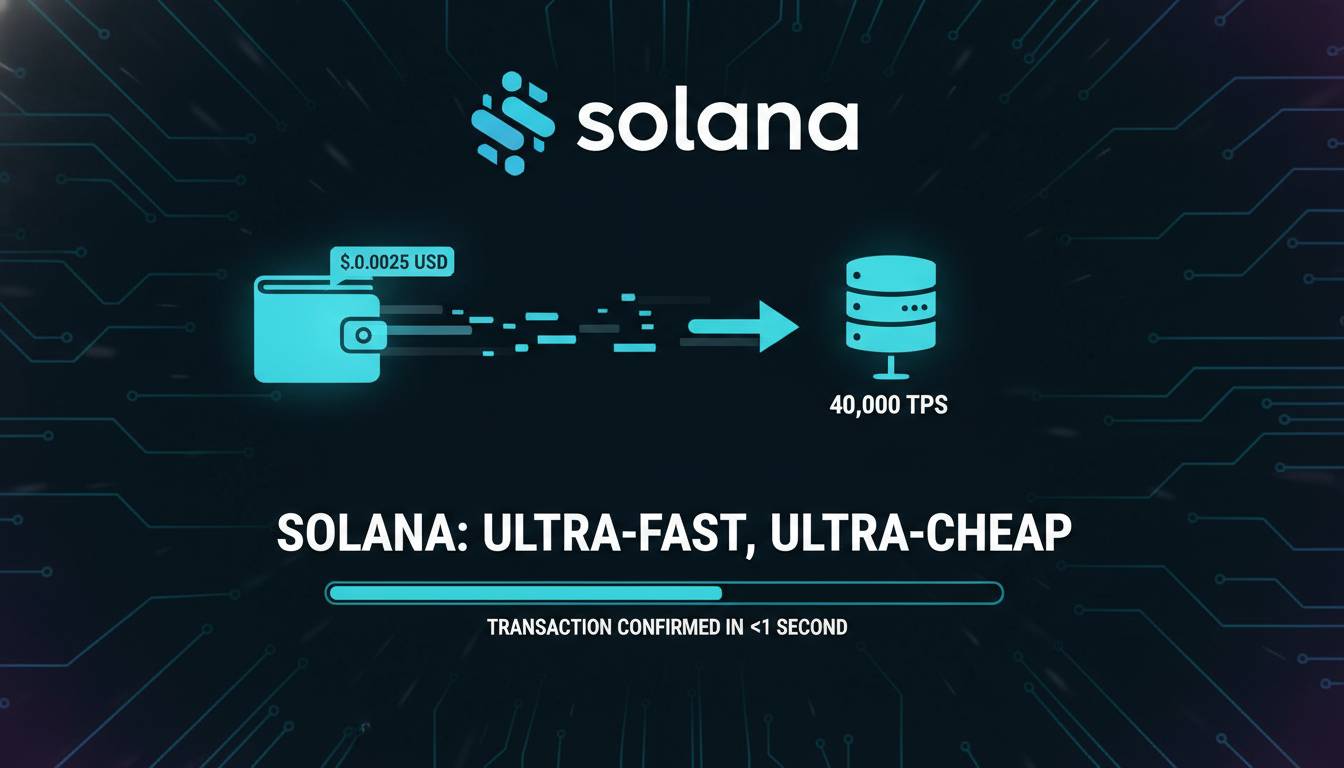
Every transaction on Solana costs a flat 0.000005 SOL (5,000 lamports), regardless of complexity. This equals approximately $0.00025 at current prices—a fraction of a cent. For more complex operations like deploying smart contracts or interacting with multiple programs, fees remain minimal, typically under $0.01.
This fee model is possible because Solana’s architecture was designed for high throughput from the ground up. The network can process thousands of transactions per second, compared to Ethereum’s 15-30 TPS. With ample capacity, there’s no need for a competitive fee market to prioritize transactions.
Solana also implemented Stake-Weighted Quality of Service (StQoS) in 2022, which prioritizes transactions from validators who stake more SOL. This gives high-stake validators and their delegators better transaction inclusion during congestion, though it doesn’t create the extreme fee spikes common on Ethereum.
The tradeoff is that Solana has experienced network instability and outages during periods of extreme demand. In 2022, the network suffered multiple outages when transaction volumes exceeded capacity, raising questions about the reliability of its low-fee model under stress.
Direct Cost Comparison: Real-World Scenarios
The fee difference between Solana and Ethereum becomes striking when examining specific use cases. Here’s how the two networks compare across common blockchain activities:
| Use Case | Ethereum (Average) | Solana (Average) | Savings on Solana |
|---|---|---|---|
| Simple token transfer | $2-5 | $0.00025 | ~99%+ |
| NFT mint (single) | $10-50+ | $0.01-0.05 | ~99%+ |
| DeFi swap (Uniswap) | $15-40 | $0.01-0.02 | ~99%+ |
| Smart contract deployment | $100-500+ | $0.10-0.50 | ~99%+ |
| DAO proposal vote | $5-20 | $0.00025 | ~99%+ |
The savings are substantial and consistent across virtually every transaction type. If you’re a casual user making occasional transactions, the difference might not matter much—you might spend $10 total on Ethereum versus $0.01 on Solana over a month. However, for active DeFi traders, NFT collectors, or applications processing high transaction volumes, the math becomes compelling.
Consider a DeFi trader executing 10 swaps per day. At $20 per swap on Ethereum, that’s $200 daily in fees. The same trading activity on Solana would cost approximately $0.10-0.20 per day—a difference of $200,000 annually. Even accounting for potential slippage and the need to bridge assets between networks, the fee savings are significant.
Fee Volatility and Network Congestion
One of the most critical differences between these blockchains is fee predictability. Ethereum’s dynamic fee market creates wild price swings that can catch users off guard.
When demand surges, Ethereum fees can increase 10x to 50x within hours. The infamous “Crypto Twitter” moments—major NFT drops, token launches, market volatility—consistently result in fee spikes that make ordinary transactions prohibitively expensive. During the peak 2021 bull market, even simple ETH transfers sometimes cost $30-50.
This volatility has practical implications. DApps often implement gas estimation tools and recommend users set high gas limits “just in case.” Users learn to time their transactions for off-peak hours or pay premium fees for urgency. Some DeFi strategies become unviable when fees exceed potential returns.
Solana’s fixed fees provide certainty that Ethereum cannot match. You always know what your transaction will cost before you sign it. This predictability makes Solana particularly attractive for applications requiring consistent economics—gaming, micropayments, automated trading bots, and any use case where fee calculation is essential for business logic.
However, it’s worth noting that Solana’s stability has been tested. During network stress tests and high-traffic events in 2022, the network experienced congestion that slowed transaction processing. While fees remained low (by design), transactions sometimes failed to process or experienced significant delays. The network has since implemented improvements, but this history highlights that low fees come with different tradeoffs than high fees.
Smart Contract Capabilities and Developer Considerations
For developers building decentralized applications, fee structure influences not just user experience but also application design. Ethereum’s higher fees have shaped the evolution of its ecosystem in specific ways.
Many Ethereum DeFi protocols implement batched transactions, gas optimization techniques, and layer-2 solutions specifically to reduce costs. Projects like Yearn Finance automate transactions across multiple protocols to make the economics work despite high fees. This has driven innovation in efficiency but also means users indirectly pay for these complexities.
Ethereum also benefits from the EVM (Ethereum Virtual Machine) ecosystem, meaning applications, tools, and developer expertise transfer easily between Ethereum and other EVM-compatible chains (Polygon, Arbitrum, Optimism, BSC). If you learn Solidity and build on Ethereum, you can deploy to dozens of other chains with minimal adaptation.
Solana programs are written in Rust or C, requiring different expertise. The learning curve is steeper, and the ecosystem is younger. However, the low fees enable entirely different application categories. Micropayment platforms, high-frequency trading systems, gaming economies with thousands of daily transactions, and social media platforms with millions of small interactions—all become economically viable on Solana in ways that would be prohibitively expensive on Ethereum.
The choice between these platforms often comes down to what you’re building. If you need established tooling, broad chain compatibility, and maximum security through network effects, Ethereum remains dominant. If you need high transaction volumes with minimal costs and can accept a younger ecosystem, Solana offers compelling advantages.
Staking, Rewards, and Economic Security
Beyond transaction fees, both networks incorporate staking mechanisms that affect the overall economics of holding and using each cryptocurrency.
Ethereum transitioned to Proof of Stake (PoS) in September 2022 with “The Merge,” eliminating energy-intensive mining. Users can stake 32 ETH to become validators or stake through staking pools. Staking rewards currently yield approximately 4-6% annually, depending on total stake amount and network conditions.
Solana also uses PoS but with a different architecture featuring “Proof of History”—a cryptographic clock that helps the network process transactions faster. Solana staking yields have historically been higher, around 6-8% annually, though this varies with network conditions and token inflation rates.
For users deciding between holding ETH versus SOL as a long-term investment, the staking yield difference is notable but not decisive. Both assets have experienced significant price volatility, and staking rewards must be weighed against potential capital gains or losses.
From a network security perspective, Ethereum’s much larger market capitalization provides superior security guarantees. Attacking Ethereum would require assembling majority stake (currently worth tens of billions of dollars), making it exceptionally secure. Solana’s smaller market cap and different consensus design present different security considerations—lower cost to attack but also less total value secured.
Layer-2 Solutions: Ethereum’s Response to High Fees
Ethereum has developed an extensive Layer-2 ecosystem to address its fee challenges. These scaling solutions process transactions off the main Ethereum chain, then bundle them together before settling on the mainnet—dramatically reducing costs while maintaining Ethereum’s security.
Arbitrum and Optimism are the leading optimistic rollups, offering compatibility with Ethereum’s tooling while reducing fees by roughly 10x. Polygon (PoS) offers even lower fees through a proof-of-stake sidechain approach. Base, launched by Coinbase in 2023, has quickly become a popular Layer-2 for consumer applications.
For users willing to use Layer-2 solutions, the fee gap between Ethereum and Solana narrows considerably. A transaction that costs $0.01 on Solana might cost $0.10-0.50 on Arbitrum or Polygon—still 20-50x higher, but far more manageable than mainnet Ethereum fees.
The tradeoffs include added complexity (managing bridges, understanding rollup economics), slightly delayed finality, and dependence on the Layer-2’s security model. However, for many use cases, Layer-2 solutions now provide a viable middle ground—Ethereum’s security and ecosystem with Solana-like affordability.
Solana doesn’t have an equivalent Layer-2 ecosystem given its architecture is already designed for high throughput. This means users must choose between Solana’s native low fees or Ethereum’s proven (but more expensive) infrastructure.
Future Outlook: Where Fees Are Heading
Both networks continue evolving their fee structures and scaling solutions, making this comparison a moving target.
Ethereum’s roadmap includes “Proto-Danksharding” , implemented in 2024, which introduces data blobs that should further reduce Layer-2 costs by 10x or more. Future full sharding would theoretically allow Ethereum to process over 100,000 transactions per second, potentially eliminating congestion-based fee spikes entirely.
Solana continues optimizing its performance and reliability. The network has implemented various upgrades to handle higher throughput more reliably. Fees are expected to remain low by design, though the team faces ongoing challenges balancing low costs with network stability.
The convergence is worth watching. As Ethereum Layer-2 solutions mature and Solana reliability improves, the fee difference may become less significant than other factors—ecosystem depth, developer tools, specific application requirements, and personal preference.
Frequently Asked Questions
Which blockchain is better for NFT trading?
Solana offers significantly lower fees for NFT transactions, with mint costs typically under $0.05 compared to $10-50+ on Ethereum mainnet. However, Ethereum’s NFT ecosystem is larger and more established, with higher trading volumes and more marketplace options. Serious collectors often use both—Solana for minting and lower-value trades, Ethereum for high-value collectibles where the premium marketplace access justifies higher fees.
Can I use both Ethereum and Solana in the same application?
Yes, but it requires bridging assets between networks. Cross-chain bridges allow you to move tokens from Ethereum to Solana and vice versa. However, bridging introduces complexity, security risks, and additional time delays (typically 10-30 minutes). Many users prefer to choose one network for their primary activities rather than constantly bridging between them.
Why do Ethereum fees fluctuate so much?
Ethereum uses a dynamic fee market where users compete for limited block space. When many people try to transact simultaneously (during popular NFT drops, token launches, or market volatility), the base fee increases exponentially to prioritize transactions. This is by design—it ensures the network remains functional during demand surges by making expensive transactions unappealing.
Are Solana’s low fees permanent?
Solana’s fixed-fee structure is architectural, not temporary. The network is designed to handle high throughput without requiring fee increases. However, if Solana’s usage grows dramatically and the network experiences congestion similar to Ethereum’s, users might face delayed transactions or failed transactions rather than the fee spikes seen on Ethereum.
Is Solana as secure as Ethereum?
Ethereum has significantly higher security due to its larger market cap and more established network effects. Attacking Ethereum would require considerably more resources than attacking Solana. However, Solana implements its own security measures, and the network continues maturing. For high-value transactions, Ethereum remains the more conservative choice.
Should I switch from Ethereum to Solana to save on fees?
The answer depends on your specific needs. If you’re building high-volume applications, gaming platforms, or systems requiring many transactions, Solana offers compelling cost advantages. If you need maximum security, access to the largest DeFi ecosystem, or compatibility with established tools, Ethereum remains dominant. Many users and developers ultimately use both networks for different purposes.
Conclusion
Solana offers dramatically lower fees than Ethereum—often 99%+ cheaper per transaction. For users and applications requiring high transaction volumes, this difference is transformative. A DeFi trader paying $200 daily in Ethereum fees could operate on Solana for less than $0.20.
However, fees represent just one factor in a complex decision. Ethereum provides superior security, a mature ecosystem, extensive tooling, and broad chain compatibility. Its Layer-2 solutions are rapidly improving, narrowing the fee gap while preserving Ethereum’s security guarantees. Solana delivers on its promise of low-cost, high-speed transactions but has experienced reliability challenges and offers a less developed ecosystem.
For most casual users making occasional transactions, either blockchain works fine. The difference matters most for active traders, developers building transaction-heavy applications, and anyone optimizing for cost efficiency. As both networks continue evolving, the gap will likely narrow—making it worth revisiting this comparison periodically as the technology matures.