Snowball vs Avalanche: Best Debt Payoff Strategy for You

Paying off debt is one of the most significant financial challenges Americans face today. With total consumer debt exceeding $17 trillion in the United States, finding an effective strategy to eliminate what you owe can feel overwhelming. Two methods have stood the test of time and gained widespread adoption: the debt snowball method and the debt avalanche method. Both approaches offer structured pathways to becoming debt-free, but they work in fundamentally different ways and suit different types of debtors.
The key difference lies in how each method prioritizes which debts to pay off first. The snowball method focuses on paying smallest balances first, building psychological momentum through quick wins. The avalanche method targets highest-interest debts first, mathematically minimizing total interest paid over time. Choosing the right strategy can save you thousands of dollars and potentially years of payments, making this decision crucial for your financial future.
Understanding your own psychology, your total debt picture, and your financial goals will help you determine which approach aligns best with your situation. This comprehensive guide examines both strategies in detail, provides expert insights, and helps you make an informed decision about which debt payoff method will work best for your specific circumstances.
Understanding the Debt Snowball Method
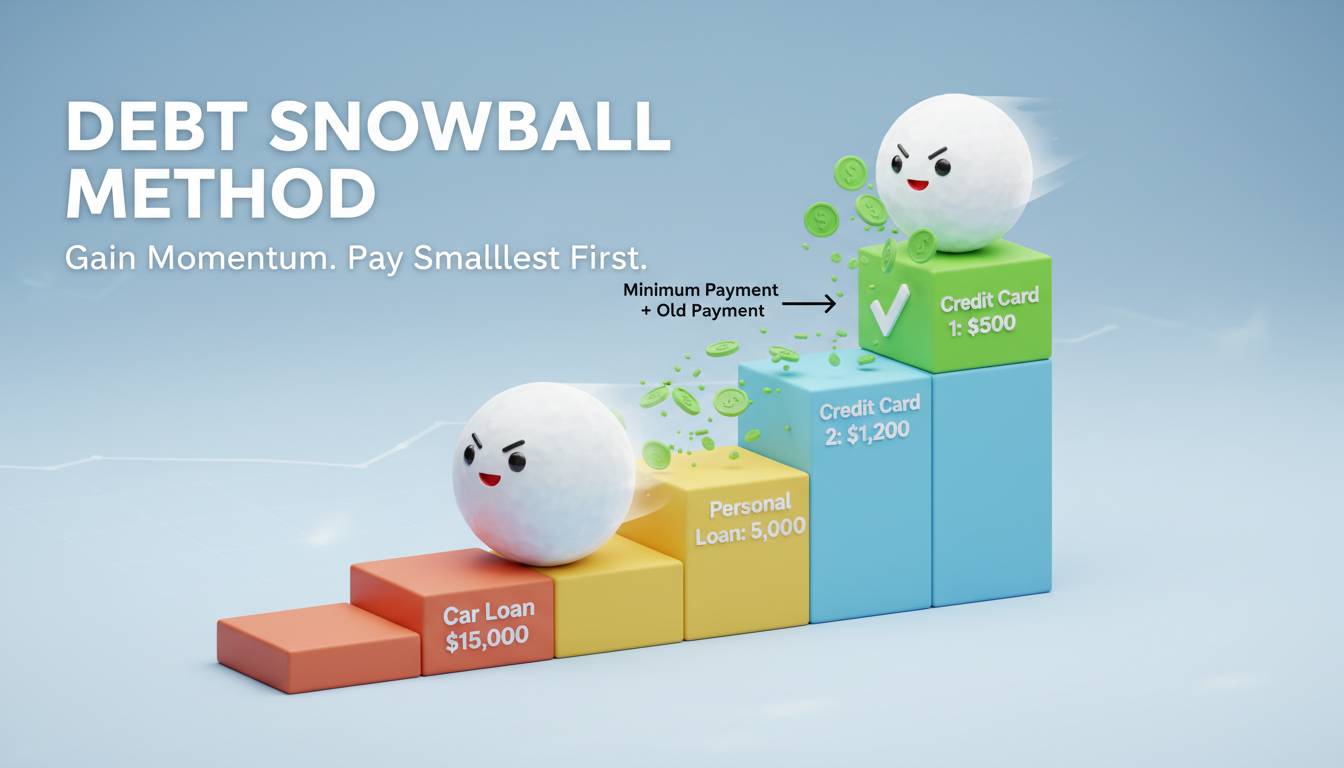
The debt snowball method, popularized by financial expert Dave Ramsey, is a debt reduction strategy that prioritizes paying off smallest balances first while making minimum payments on all other debts. The name comes from the idea that as you pay off each small debt, you roll that payment into the next larger debt, creating a snowball effect that accelerates your progress.
Here’s how the snowball method works in practice. Imagine you have three debts: a $500 credit card balance, a $3,000 personal loan, and a $15,000 car loan. Under the snowball method, you would first throw every extra dollar at the $500 credit card while making minimum payments on the other two. Once that $500 is paid off, you take the money you were paying toward it and apply it to the next smallest balance—the $3,000 personal loan. This process continues until all debts are paid.
The primary advantage of this method is psychological. Paying off a debt quickly—sometimes within a few weeks or months—provides an immediate sense of accomplishment that motivates debtors to continue. For many people struggling with debt, this emotional boost is what keeps them committed to their payoff plan. Research in behavioral economics consistently shows that humans respond more strongly to immediate rewards than future benefits, making the snowball method particularly effective for those who need regular encouragement to stay on track.
The debt snowball method works best for individuals who carry multiple small debts alongside larger ones, those who have struggled with debt payoff attempts in the past, and people who derive significant motivation from seeing quick results. It is also advantageous when the smallest debts carry higher interest rates than larger debts, though this is not a requirement for the method to work.
Understanding the Debt Avalanche Method
The debt avalanche method takes a mathematically different approach, prioritizing debts with the highest interest rates first regardless of balance size. This method gets its name from the concept that tackling the largest interest-bearing debts first creates a cascading effect that reduces your total interest burden more rapidly than other methods.
To implement the avalanche method, you would list all debts from highest to lowest interest rate. You then make minimum payments on all debts except the one with the highest rate, which receives every extra dollar you can afford. Once the highest-rate debt is paid off, you move to the next highest rate, adding the freed-up payment amount to your next target.
Consider a scenario with three debts: a credit card at 24.99% APR with a $2,000 balance, a personal loan at 12% APR with a $5,000 balance, and a mortgage at 6.5% APR with $150,000 remaining. The avalanche method would direct all extra payments toward the credit card until it is eliminated, then the personal loan, and finally the mortgage.
The avalanche method typically saves borrowers the most money over time because interest rates have a compounding effect on debt. Paying off high-interest debt first reduces the total interest that accrues on your remaining balance, meaning more of each payment goes toward principal reduction rather than interest charges. According to calculations from financial analysts, the difference between snowball and avalanche methods can amount to thousands of dollars in interest savings depending on your specific debt amounts and interest rates.
This method suits financially disciplined individuals who can maintain motivation without the quick wins that the snowball method provides. It works particularly well for those with high-interest credit card debt, who have stable income that allows consistent extra payments, and who prioritize mathematical efficiency over psychological reinforcement.
Side-by-Side Comparison: Snowball vs Avalanche
| Factor | Snowball Method | Avalanche Method |
|---|---|---|
| Primary Sort Order | Smallest balance first | Highest interest rate first |
| Total Interest Paid | Higher typically | Lower typically |
| Motivation Factor | High (quick wins) | Lower (slower initial progress) |
| Best For | Psychology-driven individuals | Math-driven individuals |
| Time to First Debt Paid | Shorter | Longer (often) |
| Total Payoff Time | Can be longer | Can be shorter |
| Difficulty Staying Motivated | Easier | Harder |
| Suitable Debt Types | Multiple small debts | High-interest debt |
The choice between these methods depends heavily on your personal financial situation, your psychological makeup, and the specific terms of your debts. Some financial experts recommend a hybrid approach—paying off one small debt quickly using the snowball method to build momentum, then switching to the avalanche method for remaining debts.
When the Snowball Method Makes More Sense
The snowball method demonstrates clear advantages in several specific scenarios. Understanding when to choose this approach can help you select the strategy most likely to lead to success in your particular situation.
People with debt disorders or those who have previously failed at debt payoff attempts often benefit more from the snowball method. The psychological boost of eliminating a debt quickly—sometimes within a month or two—provides proof that debt freedom is achievable. This early victory can be the difference between abandoning a payoff plan and seeing it through to completion.
The snowball method also makes sense when your smallest debts have significantly higher interest rates than your larger debts. While this isn’t necessary for the method to work, it creates a situation where paying off small debts first also happens to reduce your interest burden. Additionally, if your smallest debts are from sources that report to credit bureaus, paying them off quickly can improve your credit score faster, which may help you refinance or consolidate other debts at better rates.
Households with irregular income may find the snowball method easier to manage because it creates small, achievable goals that can be accomplished quickly when money becomes available. Rather than waiting months to make progress on a large debt, you can check off small debts rapidly and maintain momentum through variable income periods.
For those who simply feel overwhelmed by their debt situation, the snowball method provides a more approachable entry point. Looking at a $20,000 debt total can feel paralyzing, but focusing on a $300 credit card balance feels manageable. This psychological reframing can be the key to getting started for people who have been postponing debt payoff due to anxiety or overwhelm.
When the Avalanche Method Makes More Sense
The avalanche method becomes the clear winner in certain financial circumstances, particularly when mathematical efficiency is your priority and you have the discipline to maintain momentum without frequent reinforcement.
If your highest-interest debts are also your largest balances, the avalanche method can save you significantly more money than the snowball approach. Credit card debt, which often carries interest rates of 20% or higher, is the most common example. The mathematics of compound interest mean that every dollar paid toward high-interest debt is worth more than a dollar paid toward low-interest debt.
People with strong financial discipline who have successfully paid off debt before may find the avalanche method more satisfying because it aligns with their analytical approach to money management. If you’ve never struggled with staying on budget and have consistent income, the lack of quick wins in the avalanche method won’t deter you from following through.
The avalanche method is also preferable when you have a clear picture of your complete debt landscape and know that making minimum payments on all but your highest-interest debt is sustainable for the long term. This requires confidence in your income stability and expense management, but when that confidence exists, the avalanche method optimizes your financial outcome.
Finally, if you’re already motivated and have a track record of following through on financial commitments, the avalanche method allows you to achieve the best possible financial result. The key requirement is psychological resilience—you need to be able to continue making payments without the frequent encouragement that comes from checking debts off your list quickly.
Real-World Example: Comparing Both Methods
To illustrate the practical difference between these methods, consider a realistic debt scenario. Suppose you have four debts:
- Credit Card A: $2,000 balance at 24.99% APR ($60 minimum payment)
- Credit Card B: $5,000 balance at 19.99% APR ($125 minimum payment)
- Personal Loan: $8,000 balance at 11% APR ($200 minimum payment)
- Car Loan: $15,000 balance at 6.5% APR ($350 minimum payment)
Your total minimum payment is $735 per month, and you have an extra $265 available for debt payoff, giving you $1,000 total to dedicate to debt elimination.
Using the Snowball Method:
You would first target Credit Card A ($2,000). With $1,000 per month going toward it, you’d pay it off in about two months, saving approximately $83 in interest during that time. You then roll that $1,000 payment to Credit Card B, paying it off in approximately five more months while accruing about $416 in interest. Next, you’d attack the personal loan, paying it off in about eight months with $1,350 in interest, and finally the car loan would be paid off in approximately fifteen months. Total time to debt freedom: roughly 30 months. Total interest paid: approximately $3,200 (estimated).
Using the Avalanche Method:
You would first target Credit Card A (highest interest at 24.99%). Following the same payment schedule, you’d pay it off in two months with $83 in interest. Then you’d move to Credit Card B, paying it off in five months with $416 in interest. The personal loan would take approximately eight months to eliminate with $680 in interest, and the car loan would be paid off in about fifteen months. Total time: approximately 30 months. Total interest paid: approximately $2,850 (estimated).
In this example, the avalanche method saves approximately $350 in interest while taking the same amount of time to complete. The savings would be more significant with larger debt amounts or higher interest rate differences between debts.
Expert Perspectives on Choosing Your Method
Financial advisors generally agree that the best debt payoff method is the one you will actually follow through on consistently. While the avalanche method offers mathematical superiority, it provides no benefit if you abandon your plan midway due to lack of motivation.
Dr. Sarah Mitchell, a certified financial planner based in Chicago, advises clients to consider their personality and history with money. “I’ve seen clients succeed with both methods, but I’ve also seen clients fail with both. The key is honest self-assessment. If you need regular wins to stay motivated, the snowball method is probably right for you, even if it costs more in interest. The cost of extending your debt by giving up completely far outweighs the interest savings of a method you won’t stick to.”
Research from the Journal of Financial Counseling and Planning supports this perspective. A 2022 study found that debtors using the snowball method were 35% more likely to remain in their debt payoff programs after six months compared to those using the avalanche method. However, those who completed their payoff using the avalanche method saved an average of 22% more on interest compared to snowball users.
Some financial experts recommend starting with the snowball method for your first debt payoff, then switching to the avalanche method once you’ve built momentum and confidence. This hybrid approach captures the psychological benefits of quick wins while optimizing interest savings on remaining debt.
Frequently Asked Questions
Which debt payoff method saves more money?
The avalanche method typically saves more money because it prioritizes high-interest debt, reducing the total interest that accrues over time. However, the actual savings depend on your specific interest rates and balances. In some cases, the difference between methods is minimal.
Do I need to pay minimum payments on all debts while using either method?
Yes, both methods require you to make at least minimum payments on all debts except the one you’re actively targeting. Missing minimum payments can result in late fees, penalty interest rates, and damage to your credit score, which undermines your debt payoff efforts.
Can I combine elements of both methods?
Absolutely. Many financial experts recommend a hybrid approach where you pay off one or two small debts first using the snowball method to build motivation, then switch to the avalanche method for remaining debts. This combines psychological benefits with mathematical optimization.
How long does it typically take to pay off debt using these methods?
The timeline depends on your total debt amount and how much you can pay each month beyond minimum payments. On a $20,000 debt with $500 monthly extra payments, most people become debt-free in 3-5 years. Smaller debts can be paid off in months; larger debts may take a decade or more.
What if my income is unstable—can I still use these methods?
Both methods can work with variable income, though the snowball method may be easier to adapt because it allows you to attack small debts quickly when money is available. The key is consistency over time—even small, irregular payments add up.
Should I consider debt consolidation instead?
Debt consolidation can be a good option if you can qualify for a lower interest rate than you’re currently paying. It simplifies payments into one monthly bill, which can help with organization. However, consolidation doesn’t change your spending habits, so it’s most effective when combined with a structured payoff strategy.
Making Your Final Decision
Choosing between snowball and avalanche debt payoff methods is ultimately a personal decision that depends on your financial situation, your psychological relationship with money, and your specific goals. The mathematical advantage of the avalanche method is clear, but the psychological advantage of the snowball method can be equally valuable for the right person.
Before making your decision, take an honest inventory of your situation. Calculate your total debt, interest rates, and minimum payments. Consider whether you’ve struggled with debt payoff in the past and what held you back. Think about whether you need frequent victories to stay motivated or if you can work toward a distant goal without regular reinforcement.
Remember that the best strategy is the one you’ll actually follow through on. You can always recalculate and adjust your approach after paying off your first debt or two. Many people find that their initial method choice evolves as their financial situation changes and as they gain confidence in their ability to manage debt.
The most important step is getting started. Whether you choose snowball or avalanche, beginning your debt-free journey today puts you on the path to financial freedom far more effectively than waiting for the perfect method. Take stock of what you owe, commit to a plan, and begin making payments. Your debt-free future starts with that first payment.