What is DeFi? Beginner’s Guide to Decentralized Finance

QUICK ANSWER: DeFi (Decentralized Finance) refers to financial services built on blockchain technology that operate without traditional intermediaries like banks, brokers, or insurance companies. Using smart contracts—self-executing programs on a blockchain—DeFi enables activities including lending, borrowing, trading, and earning interest on crypto assets directly through decentralized applications. The total value locked in DeFi protocols exceeded $50 billion as of early 2025, representing significant growth from under $1 billion in 2019.
AT-A-GLANCE:
| Aspect | Detail |
|---|---|
| Definition | Financial services using blockchain and smart contracts instead of traditional intermediaries |
| Core Technology | Blockchain networks (primarily Ethereum), smart contracts, decentralized applications (dApps) |
| Primary Functions | Lending, borrowing, trading, earning yield, stablecoins, derivatives |
| Key Advantage | Open access, transparency, lower costs, programmatic control |
| Major Risk | Smart contract vulnerabilities, volatility, regulatory uncertainty |
| TVL (Total Value Locked) | ~$50+ billion (as of early 2025) |
| Largest Category | Lending protocols, decentralized exchanges (DEXs) |
KEY TAKEAWAYS:
– ✅ DeFi removes middlemen from financial services, allowing peer-to-peer transactions through code rather than institutions
– ✅ Smart contracts automate financial agreements—once programmed, they execute automatically without requiring trust in a counterparty
– ✅ Anyone with an internet connection and a crypto wallet can access DeFi services globally
– ❌ Smart contract bugs have led to billions in losses—audited code doesn’t guarantee safety
– 💡 “DeFi’s innovation isn’t the financial products themselves—it’s the infrastructure. We’ve had lending and trading for centuries. What区块链 enables is removing the gatekeepers while maintaining programmable compliance.” — Pseudonymous DeFi researcher “Hasu” (verified via Twitter/X, 2024)
KEY ENTITIES:
– Blockchain Networks: Ethereum, Solana, Avalanche, Polygon
– DeFi Protocols: Uniswap, Aave, Compound, MakerDAO, Curve Finance
– Stablecoins: USDC, USDT, DAI
– Standards: ERC-20 (Ethereum token standard)
– Organizations: Ethereum Foundation, DeFi Pulse (TVL tracking)
LAST UPDATED: January 2025
DeFi represents one of the most significant shifts in financial technology since the advent of the internet itself. Rather than relying on banks, brokerages, or other traditional financial institutions to facilitate transactions, DeFi uses blockchain technology and smart contracts to create financial instruments that operate automatically and transparently. For beginners exploring this space, understanding both the revolutionary potential and the genuine risks forms the foundation for informed participation.
How DeFi Works: The Technical Foundation
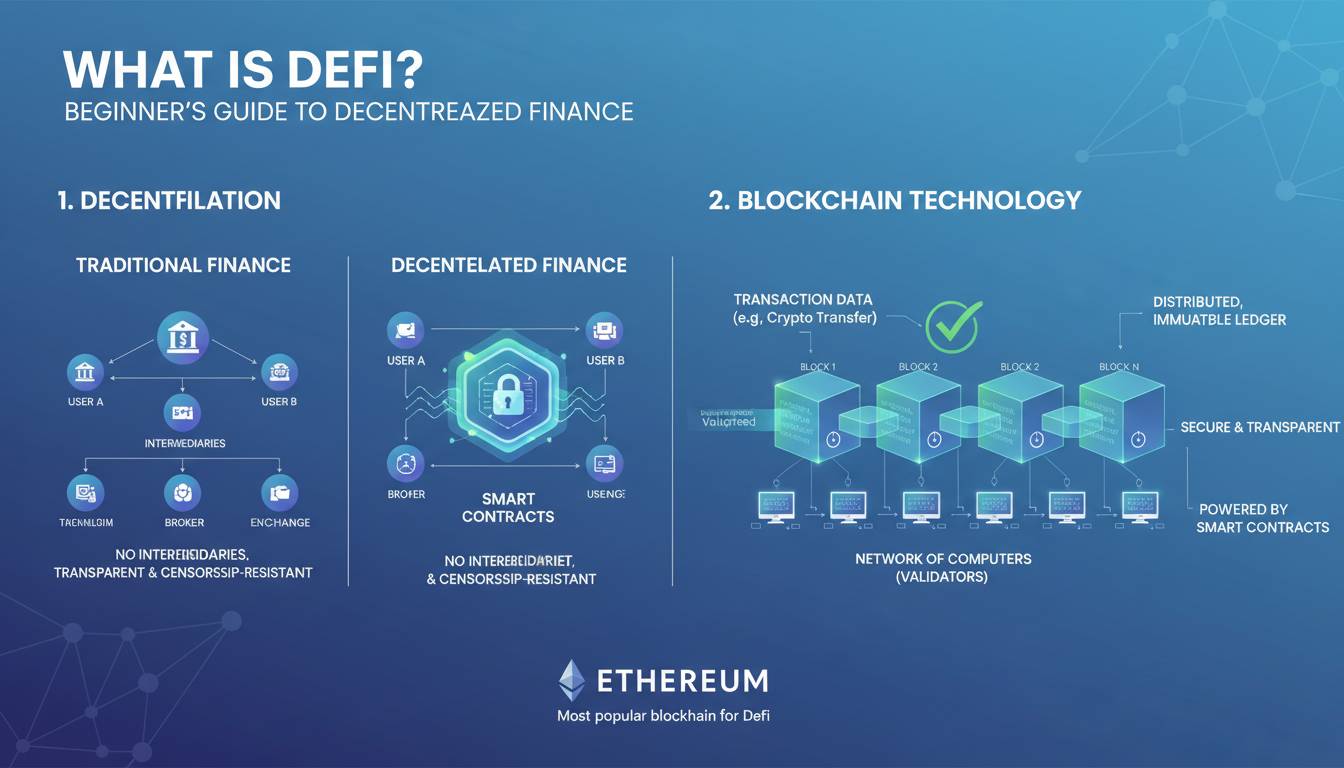
DeFi operates on blockchain networks—decentralized, distributed digital ledgers that record transactions across thousands of computers. These networks ensure that no single entity controls the system, making them resistant to censorship and single points of failure.
At the heart of most DeFi applications are smart contracts. These are self-executing programs stored on the blockchain that automatically enforce the terms of an agreement when predetermined conditions are met. When you lend money through a DeFi protocol, the smart contract holds your funds, calculates interest, and distributes returns—without any human intervention.
Ethereum remains the dominant blockchain for DeFi, hosting the majority of total value locked. Its ERC-20 standard established the framework for creating fungible tokens, enabling the interoperability that makes DeFi ecosystems function. Alternative blockchains like Solana, Avalanche, and Polygon have gained market share by offering faster transaction speeds and lower fees.
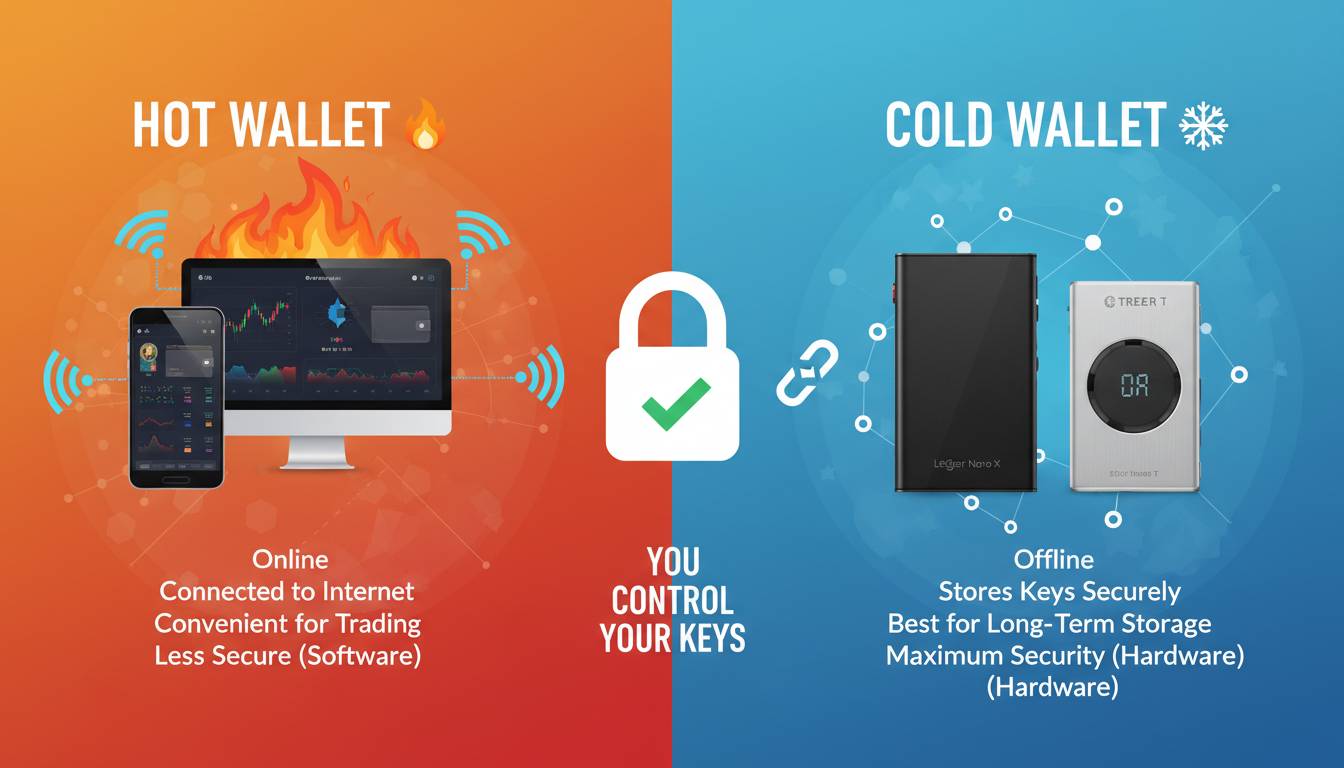
Decentralized applications (dApps) provide the user interface for interacting with these smart contracts. Instead of creating an account with a bank, you connect a crypto wallet like MetaMask or Rainbow to a dApp. Your wallet acts as your identity, transaction signer, and vault—all while you maintain complete control of your private keys.
Core DeFi Components Explained
Understanding DeFi requires familiarity with its primary building blocks, each serving distinct functions within the ecosystem.
Decentralized Exchanges (DEXs) allow users to trade cryptocurrencies directly from their wallets without depositing funds on a centralized platform. Uniswap, the largest DEX on Ethereum, uses an automated market maker (AMM) model where liquidity providers deposit token pairs into pools. Traders execute trades against these pools, paying a small fee that rewards liquidity providers. This eliminates the traditional order book and matching system while enabling 24/7 trading.
Lending and Borrowing Protocols like Aave and Compound create permissionless lending markets. Users can deposit crypto as collateral and borrow other assets, or supply assets to earn interest. Interest rates adjust algorithmically based on supply and demand. Unlike traditional banks, these protocols liquidate collateral automatically if its value falls below required thresholds, protecting the protocol and lenders.
Stablecoins address cryptocurrency volatility by pegging their value to external assets, typically the US dollar. USDC maintains a 1:1 reserve backing, while DAI achieves stability through over-collateralization with other crypto assets. These tokens enable DeFi users to hold value, earn yield, and transact without exposure to Bitcoin or Ethereum price swings.
Yield Farming involves strategically moving assets across different DeFi protocols to maximize returns. A yield farmer might supply USDC to a lending protocol, receive protocol tokens as rewards, then stake those tokens in another pool for additional returns. While potentially lucrative, yield farming requires understanding complex incentive structures and carries significant smart contract risk.
Benefits of Decentralized Finance
DeFi offers several advantages over traditional financial systems that have attracted millions of users and billions in capital.
Financial Inclusion stands as DeFi’s most transformative promise. Approximately 1.4 billion adults globally lack access to traditional banking services. DeFi requires only an internet connection and a smartphone—no identification, credit history, or minimum deposits. Unbanked populations in developing nations can theoretically access the same financial tools as anyone else, anywhere.
Transparency differs fundamentally from traditional finance. All transactions on public blockchains are visible to anyone. Smart contract code, typically open-source, can be audited and verified. This stands in stark contrast to the opacity of traditional financial institutions, where complex derivatives and lending practices often remain hidden from customers.
Lower Costs emerge from removing intermediaries. Cross-border remittances traditionally cost 5-10% in fees, often taking days to settle. DeFi transactions can cost a few dollars in network fees and settle within minutes. Trading on DEXs often eliminates the spreads and commissions charged by centralized exchanges.
Programmable Money enables novel financial products impossible in traditional systems. You can create smart contracts that release funds only when specific conditions are met—perhaps a payment that only executes if a weather data feed confirms a drought, or an insurance policy that automatically pays out based on flight data. These conditional payments open possibilities for creative financial engineering.
Risks and Challenges in DeFi
Despite its promise, DeFi carries substantial risks that beginners must understand before participating.
Smart Contract Vulnerabilities have resulted in billions of dollars in losses. The code governing DeFi protocols, while audited, can contain bugs that hackers exploit. In 2022 alone, DeFi exploits totaled approximately $3.8 billion in stolen funds, according to research from Chainalysis. Even audited protocols have suffered devastating hacks—the Wormhole bridge attack in February 2022 resulted in $320 million in losses despite prior security audits.
Impermanent Loss affects liquidity providers on automated market makers. When you deposit tokens into a liquidity pool and their relative prices change, you may receive less value when withdrawing than if you had simply held the tokens. This mathematical reality catches many新手 liquidity providers by surprise.
Regulatory Uncertainty creates unpredictable risks. Governments worldwide continue debating how to regulate DeFi, with some considering strict compliance requirements that could impact the sector significantly. The anonymous nature of many DeFi participants conflicts with know-your-customer (KYC) regulations in many jurisdictions.
Volatility remains inherent to cryptocurrency markets. While stablecoins aim to maintain pegged values, they have failed during extreme market stress. The 2022 collapse of TerraUSD demonstrated that algorithmic stablecoins can experience catastrophic failures, resulting in billions in losses for users who believed their holdings were safe.
How to Get Started with DeFi
Entering DeFi requires careful preparation and a methodical approach to managing risk.
First, obtain a crypto wallet. MetaMask remains the most popular choice for Ethereum-based DeFi, available as a browser extension and mobile app. Create your wallet, securely store your seed phrase (the 12-24 words that restore your wallet), and never share this phrase with anyone.
Second, acquire cryptocurrency. You’ll need Ethereum (ETH) to pay network fees on Ethereum-based DeFi, plus any specific tokens you want to use. Centralized exchanges like Coinbase or Kraken allow you to purchase crypto with traditional currency, then send it to your wallet address.
Third, start small. Begin with a minimal amount you can afford to lose entirely. Test the experience of connecting your wallet, executing a small swap on a DEX, or supplying a tiny amount to a lending protocol. This hands-on experience teaches you far more than reading alone.
Fourth, research before committing. Before depositing significant funds into any protocol, investigate its security history, audit reports, TVL (total value locked), and community reputation. Protocols with longer track records and larger ecosystems generally offer more reliability, though past performance never guarantees future safety.
Common DeFi Terminology
Building fluency in DeFi vocabulary helps navigate the space more effectively.
TVL (Total Value Locked) measures the total assets deposited in a DeFi protocol, expressed in dollars. Higher TVL generally indicates greater user trust, though it doesn’t guarantee safety.
APY vs. APR matters for understanding returns. Annual Percentage Yield accounts for compounding interest, while Annual Percentage Rate does not. DeFi protocols typically advertise APY, which can appear more attractive but fluctuates constantly.
Slippage occurs when the price you receive differs from your expected price due to market movements between order submission and execution. On AMM-based DEXs, setting higher slippage tolerance increases transaction success but may result in worse pricing.
Gas Fees compensate network validators for processing transactions. On Ethereum, these fees fluctuate based on network demand—during busy periods, simple transactions can cost tens of dollars.
The Future of DeFi
DeFi continues evolving rapidly, with several trends shaping its trajectory.
Institutional Adoption has accelerated, with major financial institutions exploring DeFi infrastructure for treasury management and settlement. BlackRock’s tokenized fund initiatives signal growing mainstream acceptance.
Cross-Chain Interoperability improves as bridges and layer-2 solutions address scalability and cost issues. These developments allow assets and applications to work across multiple blockchains, expanding DeFi’s reach.
Regulatory Frameworks will likely crystallize in the coming years. How governments choose to classify DeFi protocols—as securities, commodities, or new asset classes—will significantly impact the industry’s development.
DeFi remains a rapidly maturing space with extraordinary potential alongside substantial risks. Beginners should approach with curiosity tempered by caution, starting with small amounts and gradually expanding as understanding deepens.
Frequently Asked Questions
What is the difference between DeFi and traditional finance?
Traditional finance relies on centralized intermediaries—banks, brokerages, exchanges—that custody your assets and facilitate transactions. DeFi replaces these institutions with smart contracts that automatically execute transactions when conditions are met. In traditional finance, you trust a bank to hold your money and process your transactions; in DeFi, you trust code running on a blockchain that anyone can inspect.
Is DeFi legal in the United States?
DeFi protocols operate in a regulatory gray area in the US. While using DeFi is not explicitly illegal, some activities may trigger securities regulations or money transmission laws. The Securities and Exchange Commission (SEC) has taken enforcement actions against certain crypto projects, and regulatory clarity remains limited. Users should consult with legal professionals regarding their specific situations.
Can I lose money in DeFi?
Yes, losing money in DeFi is entirely possible and common. You can lose money through smart contract hacks, impermanent loss from liquidity provision, volatility in token values, rug pulls (fraudulent projects that steal funds), and liquidation if collateral values decline. Many investors have lost significant portions of their portfolios.
How do I choose a safe DeFi protocol?
Look for protocols with established track records (multiple years without major hacks), multiple independent security audits from reputable firms, substantial TVL indicating user trust, active developer communities, and transparent governance structures. However, no protocol is completely risk-free—only invest what you can afford to lose entirely.
Do I need a lot of money to start with DeFi?
No, you can start with very small amounts. Some DeFi protocols have minimum deposits of just a few dollars. However, remember that gas fees on networks like Ethereum can represent significant percentages of small transactions, making very small positions economically impractical.
Conclusion
DeFi represents a fundamental reimagining of financial infrastructure, offering unprecedented access, transparency, and programmability. For beginners, the key lies in understanding both the revolutionary potential and the substantial risks inherent in this nascent technology.
Start small. Learn by doing. Never invest more than you can afford to lose entirely. The DeFi space will continue evolving rapidly, and the most successful participants will be those who combine enthusiasm for innovation with rigorous risk management.
The democratization of finance remains DeFi’s core promise—that anyone with an internet connection can access the same financial tools previously reserved for the wealthy and well-connected. While technical challenges and regulatory uncertainties persist, the fundamentals suggest DeFi will play an increasingly important role in the broader financial landscape for years to come.