Blockchain Scalability Solutions That Actually Work

Blockchain technology has revolutionized digital transactions, but scalability remains its most significant challenge. As networks like Ethereum process thousands of transactions per second during peak demand, users face high fees and slow confirmation times. The good news: multiple proven solutions now exist that genuinely improve throughput while maintaining security and decentralization.
This guide examines the scalability technologies working today—from Layer 2 rollups to innovative Layer 1 architectures—and helps you understand which solutions best fit different use cases.
Understanding the Blockchain Scalability Problem
Blockchain networks face an inherent tension between three properties: decentralization, security, and scalability—often called the “trilemma.” Achieving all three simultaneously remains difficult because improving one typically requires compromising another.
The core bottleneck lies in how blockchains process transactions. Traditional networks like Bitcoin and early Ethereum require every node to verify every transaction. This ensures maximum security but limits throughput to approximately 7-15 transactions per second (TPS) for Bitcoin and around 15-30 TPS for Ethereum pre-upgrade.
Compare this to traditional payment networks: Visa processes around 65,000 TPS on average, with capacity for over 24,000 TPS sustained. This disparity becomes critical when blockchain applications demand mainstream adoption.
Why this matters now: Total value locked in DeFi exceeded $280 billion at its peak, and NFT markets generated over $25 billion in trading volume in 2021 alone. Network congestion during major events—like the launch of popular NFT collections—has repeatedly caused transaction fees to spike to $100 or more, making small-value transactions economically unviable.
The scalability solutions below address these problems through different technical approaches, each with distinct trade-offs.
Layer 2 Solutions: Off-Chain Scaling That Works
Layer 2 solutions process transactions off the main blockchain (Layer 1) while inheriting its security. Two primary approaches have demonstrated real-world viability: rollups and validiums.
Optimistic Rollups
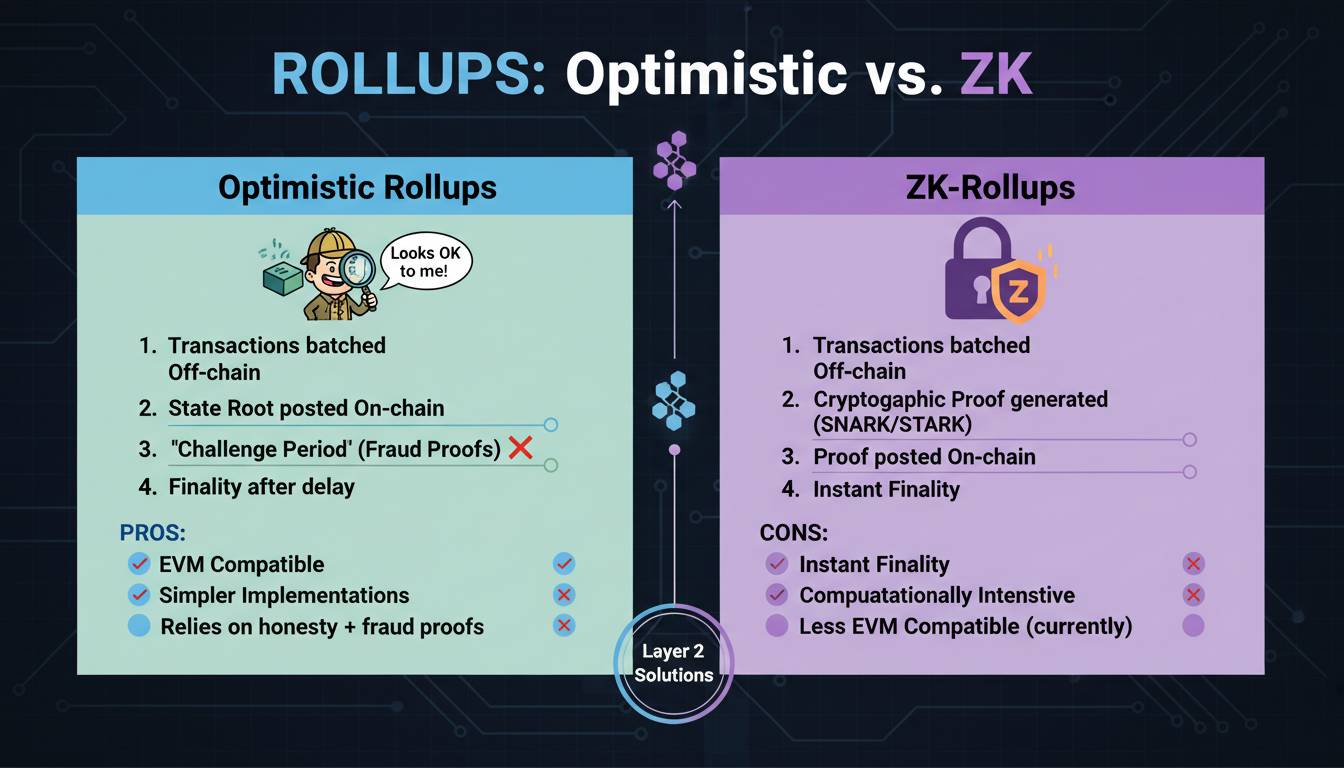
Optimistic Rollups batch hundreds of transactions into a single compressed proof submitted to Layer 1. The “optimistic” name comes from the assumption that transactions are valid by default—fraud proofs only activate if someone challenges a batch.
How they work:
- Transactions execute on a separate chain
- Batched data commits to Layer 1 as calldata
- A challenge period (typically 7 days) allows anyone to contest fraud
- Valid batches become final; invalid ones get reverted
Real-world performance: Arbitrum and Optimism, the two leading optimistic rollups, currently process approximately 10-15 TPS on Layer 1 but can handle thousands of TPS within their batch processing. Total Value Locked (TVL) in optimistic rollups exceeded $15 billion by late 2023, demonstrating substantial user adoption.
The trade-off: The 7-day withdrawal delay remains a UX challenge. Several projects are working on “fast bridges” to mitigate this, but users withdrawing large amounts should plan accordingly.
Zero-Knowledge Rollups (ZK-Rollups)
ZK-Rollups use cryptographic proofs (zero-knowledge proofs) to validate transactions instantly. Unlike optimistic rollups, there’s no challenge period—validity is proven mathematically at submission.
How they work:
- Transactions execute off-chain
- A succinct validity proof generates
- The proof submits to Layer 1 with minimal data
- Verification takes milliseconds
Current leaders: StarkNet, zkSync Era, and Polygon zkEVM have all launched mainnets. zkSync Era reported processing over 100 TPS in testing, with theoretical capacity reaching thousands.
The trade-off: ZK-Rollups are more technically complex to build and have historically faced longer development timelines. However, 2024 has seen significant maturation—with multiple production-ready ZK-Rollups now operational.
Layer 1 Innovations: Upgrading the Foundation
Layer 1 solutions modify the base blockchain itself. These approaches aim to increase throughput without sacrificing security.
Sharding
Sharding divides the blockchain into multiple parallel “shards,” each processing its own transactions. Rather than every node processing every transaction, nodes only maintain data for their specific shard.
Ethereum’s implementation: Ethereum 2.0 introduced “data sharding” rather than full execution sharding. This means shards primarily store data while execution remains on Layer 2. The approach reduces data availability costs while letting rollups handle computation.
Current status: Ethereum completed “The Merge” transition to proof of stake in September 2022. Danksharding, the full implementation, is rolling out in phases through 2024-2025, with proto-danksharding launching in March 2024, significantly reducing Layer 2 costs.
Consensus Mechanism Improvements
Moving from Proof of Work to Proof of Stake reduced Ethereum’s energy consumption by approximately 99.95% and enabled new scalability pathways. Beyond this transition, other consensus innovations are emerging:
Block production optimization: Solutions like slot and epoch sampling reduce communication overhead between validators. Ethereum’s current design achieves finality in approximately 15 minutes, compared to Bitcoin’s 60-minute confirmation for high-value transactions.
Parallel processing: Newer Layer 1 blockchains like Sei and Injective design for parallel transaction execution, allowing multiple independent transactions to process simultaneously.
Sidechains and Alternative Chains
Sidechains are independent blockchains connected to main networks via bridges. They operate under their own consensus mechanisms but can anchor to parent chains.
Polygon PoS: Originally a proof-of-stake sidechain, Polygon processed over 60 million transactions in a single 24-hour period during peak usage. Its MATIC token now serves the broader Polygon ecosystem, including zero-knowledge solutions.
Gnosis Chain: Originally an Ethereum sidechain, it now operates as an independent Layer 1 using proof-of-stake. It processes thousands of daily transactions with minimal fees while maintaining bridge connectivity to Ethereum.
The trade-off: Sidechains don’t inherit Layer 1 security directly—they require their own validator sets. This introduces additional security assumptions users should understand before moving significant value.
Comparative Analysis: Which Solution Fits Your Needs?
Different solutions excel for different use cases. Here’s how the major approaches compare:
| Solution | TPS Capacity | Security Model | Finality | Best For |
|---|---|---|---|---|
| Ethereum L1 | ~15-30 | Highest | 12-15 min | High-value settlement |
| Optimistic Rollups | 2,000-10,000 | L1 security + fraud proofs | 7 days (withdrawals) | DeFi, trading |
| ZK-Rollups | 2,000-10,000 | Mathematical proofs | Minutes | Privacy, exchanges |
| Sidechains | 500-5,000 | Independent | Seconds | Gaming, NFTs |
| App Chains | Variable | Customizable | Variable | Specialized dApps |
Cost comparison (average fees):
- Ethereum L1: $5-50+ during congestion
- Optimistic Rollups: $0.10-1.00
- ZK-Rollups: $0.05-0.50
- Sidechains: $0.001-0.05
Real-World Implementation: Case Studies
Case Study 1: Uniswap on Arbitrum
Uniswap, the largest decentralized exchange, deployed on Arbitrum in September 2021. Within six months, total value locked exceeded $3.5 billion on the Arbitrum deployment alone.
What worked: Users experienced fees 90-95% lower than Ethereum mainnet while maintaining full interaction with Ethereum addresses. The transition required minimal user education—wallets detected the network automatically.
Results: Transaction volume on Arbitrum consistently exceeded Ethereum mainnet for DEX activity, demonstrating users prioritize cost when security remains comparable.
Case Study 2: dYdX on StarkNet
dYdX, a decentralized perpetual futures exchange, migrated to StarkNet (a ZK-Rollup) in 2023. The move aimed to reduce costs while maintaining high throughput for trading applications.
What worked: StarkNet’s cryptographic proofs enabled faster finality than optimistic alternatives. Gas costs decreased by approximately 95% compared to Ethereum mainnet.
Challenges: ZK-Rollup technology required dYdX to rebuild significant infrastructure. The migration took multiple months of development effort.
Case Study 3: Immutable X
Immutable X, built as a ZK-Rollup specifically for gaming and NFTs, processed over 20 million transactions in its first year while maintaining zero gas fees for users.
Results: Games like Gods Unchained and Illuvium deployed on the platform, demonstrating viability for gaming use cases where user experience (no gas fees) is critical.
Expert Perspectives on Scalability Evolution
Vitalik Buterin, Ethereum co-founder, has repeatedly emphasized that “the future will be multi-rollup.” In various writings, he’s noted that Layer 2 ecosystems will eventually process 100x more transactions than Layer 1 while maintaining security properties.
Kyle Samani, Managing Partner at Multicoin Capital, argues: “The debate between optimistic and ZK rollups is largely settled—ZK will win in the long run due to immediate finality, but optimistic rollups have a 2-3 year structural advantage in developer tooling and ecosystem adoption.”
Ari Paul, Founder of The Blockchain Alliance, notes: “We’ve seen more real scalability progress in the last 18 months than the previous five years combined. The technology is finally catching up to user demand.”
Common Misconceptions About Blockchain Scalability
Myth 1: “Layer 1 can scale to Visa levels without trade-offs”
Achieving 65,000 TPS on a decentralized network requires significant compromises in either security (fewer validators) or decentralization (more powerful hardware requirements). Most successful approaches combine Layer 1 improvements with Layer 2 solutions.
Myth 2: “ZK-Rollups are always better than Optimistic Rollups”
While ZK-Rollups offer instant finality, optimistic rollups currently support more complex smart contract functionality and have more mature developer ecosystems. Many applications still choose optimistic rollups for these practical reasons.
Myth 3: “Scalability solves everything”
Scalability addresses throughput and cost, but user experience also depends on wallet abstraction, cross-chain compatibility, and onboarding simplicity. These factors often matter more for mainstream adoption than raw TPS numbers.
Future Outlook: What’s Coming Next
The scalability roadmap continues evolving:
2024-2025 developments:
- Ethereum’s full danksharding implementation will further reduce Layer 2 data costs
- More ZK-Rollups will achieve EVM compatibility, enabling easier porting of existing dApps
- Cross-rollup communication standards are emerging, reducing fragmentation
Emerging approaches:
- Data availability sampling improves security for larger blocks
- Account abstraction improves user experience without protocol changes
- Validiums combine ZK proofs with off-chain data storage for additional scaling
Frequently Asked Questions
What is the fastest blockchain scalability solution currently available?
ZK-Rollups currently offer the highest theoretical throughput with instant finality. In production, projects like StarkNet and zkSync Era have demonstrated 100+ TPS with potential for thousands. However, “fastest” depends on your definition—sidechains often achieve lower latency but with weaker security guarantees.
Are Layer 2 solutions as secure as Layer 1?
Optimistic rollups inherit Ethereum’s security through fraud proofs—if invalid transactions occur, the system can challenge and revert them during the 7-day window. ZK-Rollups use cryptographic proofs that provide mathematical certainty of validity. Both are considered highly secure, though they introduce additional trust assumptions compared to direct Layer 1 transactions.
How much can I save on transaction fees using Layer 2?
Layer 2 solutions typically reduce fees by 90-99% compared to Ethereum mainnet. During congestion, Layer 1 fees might be $20-100 per transaction, while Layer 2 fees often remain under $0.50. For high-frequency activities like DeFi trading or NFT minting, this difference is substantial.
Which Layer 2 should I use for DeFi applications?
For DeFi, Optimistic Rollups (Arbitrum, Optimism) currently have the most established ecosystems and tooling. If you prioritize maximum security and can wait for the technology to mature, ZK-Rollups offer advantages. The choice often comes down to specific dApp requirements and developer familiarity.
Do I need to move my tokens to a Layer 2?
Yes, Layer 2 solutions require bridging assets from Layer 1. This involves a deposit process that typically takes 10-30 minutes for optimistic rollups (the withdrawal delay applies when moving back to Layer 1). Most wallets like MetaMask now support switching networks with one click.
Will Layer 1 become obsolete?
No. Layer 1 serves as the settlement layer—the ultimate source of truth and security. Even with widespread Layer 2 adoption, Ethereum mainnet will remain critical for high-value transactions, governance, and securing the entire ecosystem. The future is layered, not replaced.
Conclusion: Navigating the Scalability Landscape
Blockchain scalability has evolved from theoretical challenge to practical reality. Users and developers now have multiple working solutions, each with distinct trade-offs.
For DeFi users: Optimistic rollups offer the best ecosystem support today. Arbitrum and Optimism both have mature tooling and established dApp ecosystems.
For cost-sensitive users: ZK-Rollups provide the lowest fees with strong security guarantees. As these technologies mature, expect continued migration.
For developers: The multi-chain future is here. Choose your execution environment based on your specific requirements—security preferences, smart contract complexity, and target user experience.
The key insight: you no longer need to choose between affordability and security. The Layer 2 ecosystem has matured sufficiently that most use cases can find appropriate solutions. The remaining challenge is user education and onboarding—making these options accessible to mainstream users who may not understand the technical distinctions.
Start by identifying your priorities (cost, speed, security, ecosystem), then evaluate which solution matches those requirements. The technology is ready. The question is which approach fits your specific needs.