Is Crypto Dead? The Truth Investors Need to Know

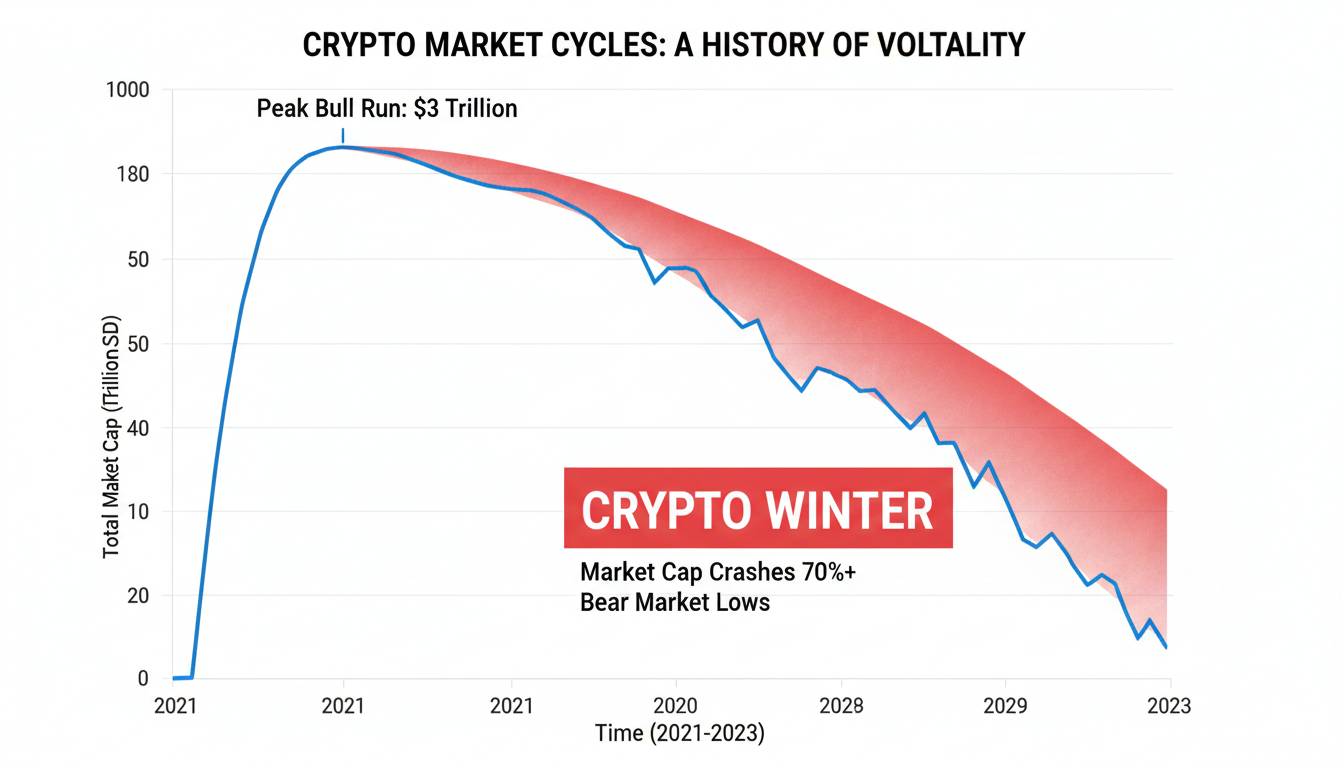
The cryptocurrency market has experienced dramatic volatility since Bitcoin’s creation in 2009, with multiple “death sentences” declared by critics during each market downturn. In 2022 alone, over $2 trillion in market value evaporated as major exchanges collapsed and prices plummeted. Yet by late 2024, Bitcoin had surged past previous all-time highs, and institutional investors had poured billions into crypto assets. This raises a critical question: is crypto dead, or is this simply another chapter in a market defined by cycles of boom and bust?
The answer requires examining the data, understanding market history, and separating emotional narratives from measurable reality.
The Current Market Reality
Quick Answer: Crypto is not dead, though it has transformed significantly from its speculative origins toward a more regulated, institutional asset class.
The cryptocurrency market capitalization peaked at approximately $3 trillion in November 2021 before crashing to around $800 billion in late 2022. By late 2024, the total market cap had recovered to approximately $2.3 trillion, with Bitcoin trading above $90,000 in some periods. This represents a substantial recovery, though the market remains far less speculative than its 2021 peak.
Several developments distinguish the current cycle from previous ones. The approval of spot Bitcoin ETFs by the U.S. Securities and Exchange Commission in January 2024 marked a watershed moment, providing traditional investors with regulated exposure to cryptocurrency without direct ownership. BlackRock, the world’s largest asset manager, launched a Bitcoin ETF that accumulated billions in assets within weeks of its debut. Fidelity, Franklin Templeton, and other established financial institutions followed with their own cryptocurrency products.
These developments represent a fundamental shift in how cryptocurrency is perceived by the financial establishment. Rather than a fringe asset primarily traded by retail enthusiasts, Bitcoin and other cryptocurrencies have become legitimate portfolio components for institutional investors managing trillions of dollars in assets.
Understanding Crypto Market Cycles
Cryptocurrency markets have historically followed predictable patterns of boom and bust, with each cycle typically lasting four to five years. Understanding these patterns provides essential context for evaluating whether crypto is “dead” during downturns.
The 2013-2014 Cycle: Bitcoin rose from approximately $100 in early 2013 to nearly $1,200 by December of that year, then crashed to around $200 by 2015. This cycle was characterized by early adoption, the collapse of major exchanges like Mt. Gox, and significant media skepticism about cryptocurrency’s viability.
The 2017-2018 Cycle: The market experienced exponential growth as Initial Coin Offerings (ICOs) proliferated, with Bitcoin reaching nearly $20,000 in December 2017 before collapsing to around $3,200 by December 2018. This cycle saw the first major wave of retail adoption and the collapse of numerous fraudulent projects.
The 2021-2022 Cycle: Bitcoin rose to nearly $69,000 in November 2021, driven by institutional adoption and unprecedented retail interest, before falling to approximately $16,000 by late 2022. This cycle witnessed the collapse of major platforms including Three Arrows Capital, FTX, and Celsius, resulting in billions in losses for investors.
Each cycle followed a similar pattern: rapid price appreciation, excessive speculation, followed by a crash that eliminated overleveraged participants and fraudulent projects. Yet each cycle also resulted in meaningful infrastructure development, increased institutional participation, and higher baseline prices than the previous cycle.
The 2022-2023 cycle followed this historical pattern precisely. The market bottomed in late 2022, with Bitcoin stabilizing around $16,000-$17,000 before beginning its recovery. By late 2024, Bitcoin had not only recovered but surpassed its previous all-time highs, reaching six-figure prices for the first time in its history.
Institutional Adoption: The Game Changer
Perhaps the most significant development distinguishing the current market from previous cycles is the degree of institutional adoption. This represents a fundamental transformation in cryptocurrency’s role within the broader financial system.
Major Financial Institutions Enter Crypto:
- BlackRock, managing over $10 trillion in assets, launched its Bitcoin ETF in 2024
- Fidelity Investments, with $4.5 trillion in assets under administration, offers cryptocurrency trading and custody services
- Citadel Securities, one of the largest market makers, began facilitating cryptocurrency trading in 2024
- PayPal, Venmo, and other payment platforms have integrated cryptocurrency functionality for millions of users
Corporate Treasury Adoption:
MicroStrategy, a business intelligence software company, has accumulated over $20 billion in Bitcoin holdings since 2020, representing the largest corporate treasury adoption of any publicly traded company. This move has inspired other companies to consider similar strategies, though most have remained cautious.
Banking Sector Involvement:
Major banks including JPMorgan Chase, Goldman Sachs, and Morgan Stanley have begun offering cryptocurrency services to wealthy clients and institutional investors. While initially hesitant due to regulatory uncertainty, banks have increasingly recognized cryptocurrency as an asset class that clients demand access to.
This institutional adoption provides several benefits that didn’t exist in previous cycles. It brings legitimate capital, regulatory compliance, and professional infrastructure to the market. It also creates natural buyers during downturns as institutional allocation models require maintaining target positions regardless of short-term price movements.
The Regulatory Landscape Evolution
Regulatory clarity has emerged as one of the most significant changes in the cryptocurrency landscape, addressing a major source of uncertainty that previously deterred institutional investors.
The approval of spot Bitcoin ETFs represented the culmination of years of regulatory engagement. The SEC had previously rejected multiple Bitcoin ETF applications, citing concerns about market manipulation and investor protection. However, the successful trading of these products has demonstrated that regulated exposure to cryptocurrency can operate within existing securities frameworks.
The European Union’s Markets in Crypto-Assets (MiCA) regulation, implemented in full in 2024, provides a comprehensive framework for cryptocurrency regulation across EU member states. This regulatory clarity has encouraged cryptocurrency companies to establish operations in Europe and has provided a model that other jurisdictions are examining.
In the United States, regulatory frameworks continue to evolve. The SEC has taken enforcement actions against numerous cryptocurrency exchanges and projects, arguing that many tokens constitute securities requiring registration. While this enforcement-heavy approach has created uncertainty, it has also established precedents that help clarify which cryptocurrencies may be considered securities.
The clarification around stablecoins—cryptocurrencies designed to maintain a fixed value—represents another regulatory development. Following the collapse of TerraUSD in 2022, regulators have focused on requiring stablecoin issuers to maintain reserves and comply with banking regulations. This has resulted in more trustworthy stablecoin options, with Tether (USDT) and USDC (issued by Circle) implementing more transparent reserve attestations.
What the “Crypto is Dead” Narrative Gets Wrong
The narrative that crypto is dead typically emerges during market downturns and reflects several cognitive biases that ignore fundamental developments in the market.
Recency Bias: The most common error is overweighting recent performance while ignoring longer-term trends. While 2022 was devastating for cryptocurrency prices, viewing the market solely through this lens ignores the substantial recovery that followed and the structural changes that occurred during the downturn.
Binary Thinking: The assumption that crypto must either be completely successful or completely dead ignores the reality that markets evolve and transform. Cryptocurrency has already become a permanent feature of the financial landscape, even if its precise form continues to evolve.
Confusing Projects with Technology: The collapse of FTX, Three Arrows Capital, and numerous other cryptocurrency companies does not mean the underlying technology or asset class has failed. The Dot-com bubble saw the failure of numerous companies, yet the internet transformed virtually every aspect of modern life. Similarly, the failure of speculative cryptocurrency projects does not invalidate the underlying blockchain technology or the legitimacy of cryptocurrencies as an asset class.
Ignoring Adoption Metrics: Despite bearish narratives, adoption has continued to grow. The number of unique blockchain wallet addresses has increased substantially, with Bitcoin alone exceeding 100 million addresses. Payment processors, remittance services, and financial institutions have integrated cryptocurrency functionality for mainstream use.
Overlooking Institutional Investment: The billions of dollars invested by BlackRock, Fidelity, and other institutions represent a fundamental validation of cryptocurrency as an asset class. These institutions conduct extensive due diligence before allocating client capital, and their involvement signals confidence in cryptocurrency’s long-term viability.
The Future Outlook: What Investors Should Watch
While predicting cryptocurrency prices remains impossible due to the asset class’s inherent volatility, several indicators suggest continued evolution rather than death.
On-Chain Metrics:
Bitcoin’s hashrate—the computational power securing the network—has reached all-time highs, indicating increased network security and miner investment. The number of addresses holding meaningful balances continues to grow, suggesting continued adoption rather than abandonment.
Technology Development:
Ethereum, the second-largest cryptocurrency, has successfully transitioned to a proof-of-stake consensus mechanism, reducing its energy consumption by over 99%. Layer 2 scaling solutions have significantly reduced transaction costs and increased throughput, addressing previous technical limitations. These developments have improved the practical utility of cryptocurrency networks.
Economic Context:
In an environment of rising government debts, currency debasement concerns, and geopolitical uncertainty, Bitcoin’s fixed supply schedule—capped at 21 million coins—continues to attract investors seeking alternatives to traditional stores of value. While this thesis remains controversial, it represents a meaningful demand driver that persists regardless of short-term price movements.
Global Adoption:
Nations including El Salvador and the Central African Republic have adopted Bitcoin as legal tender. While these examples represent small economies, they demonstrate growing acceptance of cryptocurrency as a legitimate monetary instrument. Major economies have not adopted such measures, but regulatory frameworks increasingly accommodate cryptocurrency activity.
Conclusion
The question “is crypto dead” fundamentally misunderstands the nature of technological and financial evolution. Cryptocurrency has survived multiple market cycles, regulatory crackdowns, and high-profile failures, emerging each time with greater institutional support and more sophisticated infrastructure.
The 2022 market collapse eliminated significant speculation and fraudulent activity, creating space for legitimate projects and institutional participation to flourish. The approval of spot Bitcoin ETFs, continued institutional adoption, and improving regulatory clarity suggest that cryptocurrency has evolved beyond its speculative origins toward becoming a recognized asset class.
This does not mean cryptocurrency is without risk. Volatility remains extreme, regulatory uncertainty persists in certain jurisdictions, and the failure of previous cycles demonstrates that future downturns are inevitable. Investors should approach cryptocurrency with appropriate risk tolerance and diversified portfolios.
What the data clearly shows is that cryptocurrency has not died. It has matured.
Frequently Asked Questions
Is it safe to invest in cryptocurrency now?
Cryptocurrency investment carries inherent risks including extreme volatility, potential loss of access to funds, and regulatory uncertainty. If you choose to invest, only allocate capital you can afford to lose entirely. Consider consulting with a financial advisor and thoroughly research any platform or token before investing.
What happened to crypto in 2022, and why did prices fall so dramatically?
The 2022 crypto collapse resulted from multiple factors: the Federal Reserve’s interest rate increases reduced appetite for speculative assets, the collapse of the TerraUSD stablecoin triggered broader panic, and major companies including Three Arrows Capital, FTX, and Celsius failed due to improper risk management and fraud. Over $2 trillion in market value was erased.
Are Bitcoin ETFs a good investment?
Bitcoin ETFs provide regulated exposure to Bitcoin’s price without requiring direct ownership or self-custody. They are suitable for investors who want cryptocurrency exposure within traditional brokerage accounts. However, like all cryptocurrency investments, they remain highly volatile and should comprise only a small portion of a diversified portfolio.
Will governments ban cryptocurrency?
Most major governments have chosen to regulate cryptocurrency rather than ban it entirely, recognizing the difficulty of completely restricting decentralized digital assets. The European Union’s MiCA framework and the U.S. approval of Bitcoin ETFs demonstrate regulatory acceptance. However, future regulatory changes remain possible and could significantly impact the market.
Is cryptocurrency still a good store of value?
Bitcoin’s fixed supply and decentralized nature make it attractive to investors seeking alternatives to fiat currency. However, its extreme volatility currently limits its effectiveness as a stable store of value. Whether cryptocurrency fulfills this potential remains uncertain and depends on future adoption and regulatory developments.
How do I know which cryptocurrency projects are legitimate?
Research thoroughly before investing. Legitimate projects typically have transparent teams, published code, active communities, and clear use cases. Be skeptical of projects promising guaranteed returns, lacking identifiable teams, or with unclear tokenomics. The collapse of numerous fraudulent projects in 2022 demonstrates the importance of due diligence.