URL: /proton-mail-vs-gmail Title: Proton Mail vs Gmail: The

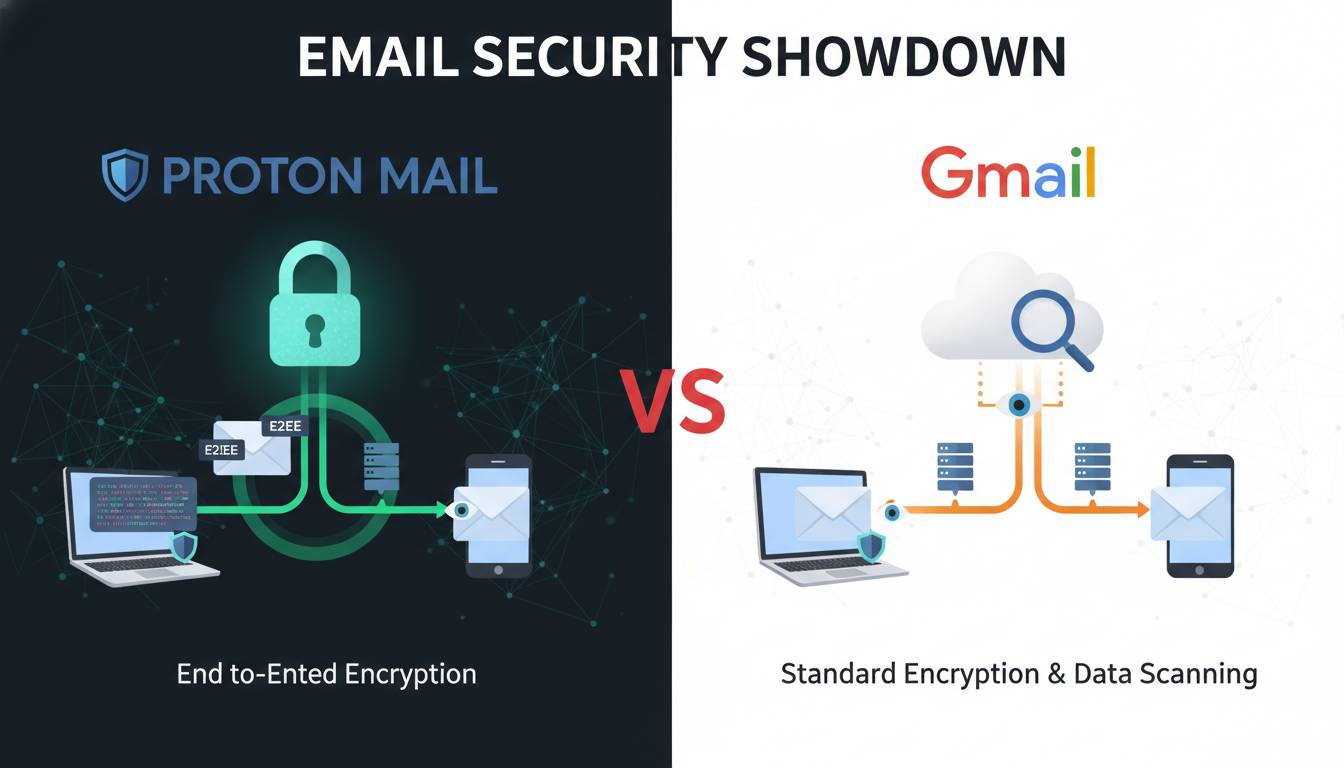
If you’re evaluating email services in 2024, you’re choosing between two fundamentally different philosophies: Google’s advertising-supported model that serves over 1.8 billion users, or Proton Mail’s encryption-first approach built by scientists who believe privacy is a human right. The difference isn’t just technical—it’s philosophical. While Gmail processes your emails to serve targeted ads, Proton Mail was designed from day one to never read your messages. This comprehensive comparison examines every critical factor: security architecture, pricing, storage, usability, integrations, and real-world performance—so you can make an informed decision based on facts, not marketing claims.
Understanding the Core Difference: Business Models at Odds
Before examining features, you must understand what fundamentally separates these two platforms. Gmail operates as part of Google’s advertising ecosystem. Google扫描 your emails for keywords to serve personalized ads—an approach that generated approximately $175 billion in advertising revenue in 2023 alone. This isn’t inherently malicious, but it means your email data directly fuels Google’s business model.
Proton Mail takes a fundamentally different approach. Founded in 2013 by scientists at CERN (the European Organization for Nuclear Research) in Switzerland, Proton Mail built its platform around end-to-end encryption where only you—not even Proton—can read your emails. The company operates on a subscription model with free tiers, meaning your privacy is the product, not your data.
📊 MARKET POSITION
| Platform | Users | Founded | Headquarters | Primary Revenue |
|———-|——-|———|————–|—————–|
| Gmail | 1.8+ billion | 2004 | Mountain View, CA | Advertising + Workspace |
| Proton Mail | 100+ million | 2013 | Geneva, Switzerland | Subscriptions |
This distinction shapes everything else in this comparison. Your choice reflects which trade-off you accept: Google’s free, ad-supported service with deep ecosystem integration, or Proton Mail’s privacy-focused model with some functional limitations.
Security and Privacy: The Encryption Gap
When security experts compare these platforms, the difference is stark. Gmail provides standard TLS encryption during transit and encrypts stored emails at rest using AES-256 encryption. However, Google retains the encryption keys, meaning the company can technically access your email content for scanning, legal requests, or algorithmic processing. Google also faces US jurisdiction, where agencies can request user data through various legal mechanisms.
Proton Mail implements end-to-end encryption (E2EE) as standard. When you send an email to another Proton user, it’s encrypted on your device and can only be decrypted by the recipient’s device. Even Proton’s servers cannot read the message content. For emails to non-Proton recipients, you can set password-protected external messages.
Key Security Features Comparison:
- Zero-Access Encryption: Proton ✓ | Gmail ✗
- Two-Factor Authentication: Both ✓ (TOTP, SMS, hardware keys)
- Open Source Encryption: Proton ✓ | Gmail ✗
- Third-Party Security Audits: Both ✓
- Metadata Protection: Proton ✓ (limited) | Gmail ✗
Switzerland’s privacy laws provide Proton with legal protections unavailable to US-based companies. The Swiss Federal Data Protection Act (FADP) and the European GDPR create barriers against mass surveillance requests that don’t exist for American companies.
👤 Expert Insight: “The fundamental difference is whether your email provider can read your emails. With Gmail, they can. With Proton Mail, they physically cannot. That’s not marketing—it’s mathematics. End-to-end encryption means the server only sees encrypted text.” — Dr. Andy Yen, CEO and Co-founder of Proton
Pricing and Plans: Free Tier Reality Check
Cost comparison reveals important trade-offs. Gmail’s free tier offers 15GB of shared storage across Gmail, Google Drive, and Google Photos—a massive value that Proton cannot match. Proton’s free tier provides 500MB storage, which fills quickly for active email users.
However, the paid plans tell a different story. ProtonMail’s Plus plan at $4.99/month (billed annually) includes 5GB storage, custom domains, priority support, and full feature access. Google’s Personal plan at $2.99/month (with annual billing) gets you 100GB, while Google One storage plans scale up from there.
Pricing Structure (Annual Billing):
| Feature | Gmail Free | Proton Free | Proton Plus | Google One (100GB) |
|---|---|---|---|---|
| Storage | 15GB | 500MB | 5GB | 100GB |
| Custom Domains | ✗ | ✓ | ✓ | ✗ |
| Email Support | Community | Priority | Priority | Priority |
| Encryption | Standard | E2EE | E2EE | Standard |
For users needing more storage, Google Workspace Business plans start at $6/user/month, while Proton Business plans begin at $5/user/month with 5GB storage included. Proton Business offers the same end-to-end encryption for team communications.
Storage Capacity: The Practical Reality
Storage directly impacts daily usability. Gmail’s 15GB free tier seems generous until you consider it also covers Google Drive and Google Photos. Heavy users of Google Photos can easily consume those 15GB, leaving minimal space for email. However, Gmail’s sophisticated spam filtering and email management help users stay organized and reduce storage pressure.
Proton Mail’s free tier at 500MB is notably limiting. Most users will exhaust this within months of regular use. The platform does compress attachments and offers efficient storage management, but 500MB fundamentally constrains heavy email users. Upgrading to Plus at 5GB ($4.99/month) provides breathing room for most users.
Real-World Storage Scenarios:
| Usage Pattern | Gmail Free | Proton Free | Proton Plus |
|—————|————|————-|————-|
| Light (50 emails/day) | ✓ 2+ years | ✓ 1+ year | ✓ 5+ years |
| Moderate (150 emails/day) | ✓ 1-2 years | ~6 months | ✓ 3+ years |
| Heavy (300+ emails/day) | ~6-12 months | ~2-3 months | ✓ 1-2 years |
Features and Functionality: What You Can Actually Do
Modern email requires more than sending and receiving. Feature comparison reveals where each platform excels and falls short.
Gmail Advantages:
– Smart Reply and Smart Compose: AI-powered suggestions improve with use
– Advanced Spam Filtering: Machine learning catches 99.9% of spam
– Native Integration: Seamless connection to Google Calendar, Drive, Keep, Tasks, and the broader Google Workspace
– Offline Mode: Full email access without internet connection
– Email Scheduling: Built-in send later functionality
– Large Attachment Support: Up to 25MB directly, 5GB via Google Drive
Proton Mail Advantages:
– True Privacy: No email scanning, no advertising, no data selling
– Anonymous Signup: Phone verification not required (unlike Gmail)
– Self-Destructing Messages: Timer-based message expiration
– Phishing Protection: Advanced detection for malicious links
– Open Source: Security can be independently verified
– Ad-Free Experience: No promotional content anywhere
Proton Mail Limitations:
– No native calendar (though Proton Calendar exists separately)
– No unified inbox for multiple accounts
– Limited third-party app integrations
– No offline mode for desktop (mobile has limited offline)
– Smaller ecosystem means fewer complementary products
📋 FEATURE COMPARISON
| Capability | Gmail | Proton Mail |
|————|——-|————-|
| End-to-End Encryption | Optional (S/MIME) | Standard |
| Ad-Free | ✗ | ✓ |
| Anonymous Account | ✗ | ✓ |
| Self-Destructing Messages | ✗ | ✓ |
| Email Recall | ✓ (within time limit) | ✗ |
| Rich Email Templates | ✓ | ✓ |
| Email Scheduling | ✓ | ✓ |
| Catch-All Email | ✓ (with custom domain) | ✓ |
Usability and User Experience
Daily usability determines which platform you’ll actually enjoy using. Gmail’s interface, refined over 20 years, offers intuitive navigation, powerful search, and a clean design that most users find comfortable. The tabs (Primary, Promotions, Social) help organize incoming mail automatically.
Proton Mail’s interface is clean and functional, though it lacks Gmail’s polish in some areas. The encrypted nature of Proton Mail creates some UX constraints: searching within encrypted emails requires indexing metadata only, as full-text search of encrypted content isn’t possible. This means finding old emails by content keyword takes longer on Proton.
Mobile Experience:
Both platforms offer excellent mobile apps. Gmail’s app integrates deeply with Android, while Proton’s app provides a comparable experience on both iOS and Android. Proton’s mobile apps have improved significantly, but Gmail’s search functionality remains superior on mobile.
Desktop Experience:
Gmail works as a full-featured web application and through third-party clients via IMAP/SMTP. Proton Mail offers a web client and desktop bridges for Outlook integration. Both support standard email protocols (IMAP, SMTP, POP3) with paid plans, enabling use in desktop email clients.
Privacy Policies and Data Handling
Understanding what each company actually does with your data is crucial for informed decision-making.
Gmail’s Data Practices:
– Scans email content for ad personalization (can be disabled)
– Analyzes email for spam and phishing detection
– Uses data to improve Google services and machine learning models
– Responds to legal requests for user data
– Shares data with third parties for advertising (anonymized)
– Stores metadata including sender, recipient, timestamps
Proton Mail’s Data Practices:
– Cannot read user emails due to zero-access encryption
– Does not scan email content for any purpose
– Does not serve advertisements
– Does not sell user data
– Minimizes metadata retention
– Stores only what’s necessary for account operation
⚖️ DATA POLICY COMPARISON
| Data Type | Gmail | Proton Mail |
|———–|——-|————-|
| Email Content | Scanned for ads | Encrypted (unreadable) |
| Location Data | Tracked | Minimized |
| Device Data | Collected | Minimal |
| Third-Party Sharing | Yes (anonymized) | No |
| Legal Request Response | Cooperates fully | Limited by Swiss law |
Proton’s transparency report shows government requests typically result in zero or minimal data disclosure because the company genuinely cannot provide email content—even if compelled by court order.
Who Should Choose Which Platform?
The right choice depends entirely on your priorities. Neither platform is universally superior.
Choose Gmail if:
– You need extensive free storage (15GB)
– Deep integration with Google Workspace matters
– AI-powered features like Smart Compose improve your workflow
– Offline access to email is essential
– You prefer feature-rich over privacy-focused
– Cost is a primary concern (free tier is generous)
Choose Proton Mail if:
– Privacy and security are your top priorities
– You object to email scanning for advertising
– You need end-to-end encryption for sensitive communications
– Swiss data protection laws matter to you
– You’re willing to pay for privacy features
– Anonymous account creation is important
– You’re less dependent on third-party integrations
Hybrid Approach:
Many privacy-conscious users employ both: Proton Mail for sensitive communications (financial, medical, legal) and Gmail for everyday correspondence where convenience outweighs privacy concerns. Proton can handle custom domains for professional use while Gmail serves personal accounts.
Performance and Reliability
Both platforms offer excellent reliability, though their architectures differ fundamentally.
Gmail Reliability:
– 99.9% uptime SLA for Google Workspace
– Google’s global infrastructure provides redundancy
– Massive scale means extensive testing and optimization
– Downtime is extremely rare and typically brief
Proton Mail Reliability:
– 99.9% uptime target for paid plans
– Swiss and European data centers
– Growing infrastructure with recent investments
– Occasional downtime during maintenance windows
Speed comparisons generally favor Gmail due to Google’s massive infrastructure investment. Proton Mail, while functional, may experience slightly slower load times, particularly for users geographically distant from European servers.
Making Your Final Decision
Your email choice reflects your values and priorities. Neither Gmail nor Proton Mail is objectively “better”—they serve different needs.
If you prioritize convenience, free storage, ecosystem integration, and don’t mind algorithmic email scanning for ad targeting, Gmail remains the practical choice for most users. Its free tier is exceptional, and the productivity features are unmatched.
If you prioritize privacy, security, and抵抗 surveillance over convenience, Proton Mail delivers on its core promise. The end-to-end encryption genuinely works, and Swiss jurisdiction provides real legal protections. The trade-off is less storage, fewer features, and higher cost.
The most honest assessment: Gmail is the better product for most people most of the time. Proton Mail is the right product for those who need—or want—true email privacy. Your decision should reflect how you balance convenience against privacy, not marketing claims from either company.
Frequently Asked Questions
Is Proton Mail actually more secure than Gmail?
Yes, Proton Mail is fundamentally more secure in terms of privacy. It uses end-to-end encryption that prevents anyone except the sender and recipient from reading email content—including Proton itself. Gmail uses standard encryption in transit and at rest but retains the keys, allowing Google to scan content. For most users, Gmail’s security is adequate; for those handling sensitive information, Proton’s architecture provides genuine protection.
Can I use Proton Mail with my existing Gmail address?
You can use Proton Mail with a custom domain, which allows you to use any email address including Gmail-style addresses. However, you cannot forward Gmail messages to Proton Mail while maintaining end-to-end encryption—the messages arrive in plain text. Some users create new Proton addresses for sensitive communications while keeping Gmail for general use.
Does Proton Mail have the same spam filtering as Gmail?
Proton Mail has solid spam filtering but generally considered less sophisticated than Google’s machine learning-powered system. Google’s spam detection benefits from analyzing billions of emails daily, providing massive training data. Proton’s spam filtering works adequately for most users but may catch slightly less spam than Gmail’s advanced system.
Will I lose my emails if I switch from Gmail to Proton?
If you properly migrate, you won’t lose emails. Both platforms support standard email protocols allowing migration via IMAP. Proton offers import tools, or you can use desktop email clients to transfer between services. The key is initiating proper migration before closing accounts—not after.
Is Proton Mail worth paying for compared to Gmail’s free tier?
For privacy-focused users, Proton Plus at $4.99/month offers genuine value. You get end-to-end encryption, 5GB storage, and no ads. However, if storage volume and ecosystem integration matter more than encryption, Gmail’s free tier remains hard to beat. The comparison isn’t simply price versus features—it’s what you prioritize.
Can businesses reasonably use Proton Mail?
Yes, Proton Business plans at $5/user/month offer end-to-end encrypted business email with 5GB storage, custom domains, and priority support. However, the smaller ecosystem means fewer third-party integrations compared to Google Workspace. Businesses heavily invested in Google tools may find switching costs prohibitive, while privacy-focused companies gain significant value from Proton’s security model.