Machine Learning for Beginners: Start Your AI Journey

Machine learning represents one of the most transformative technologies of our era, powering everything from the recommendations you see on streaming platforms to the voice assistants in your pocket. For beginners, understanding machine learning opens doors to exciting career opportunities and a deeper comprehension of how modern artificial intelligence works. This comprehensive guide will take you through the fundamentals of machine learning, helping you build a solid foundation for your journey into AI.
What Is Machine Learning?
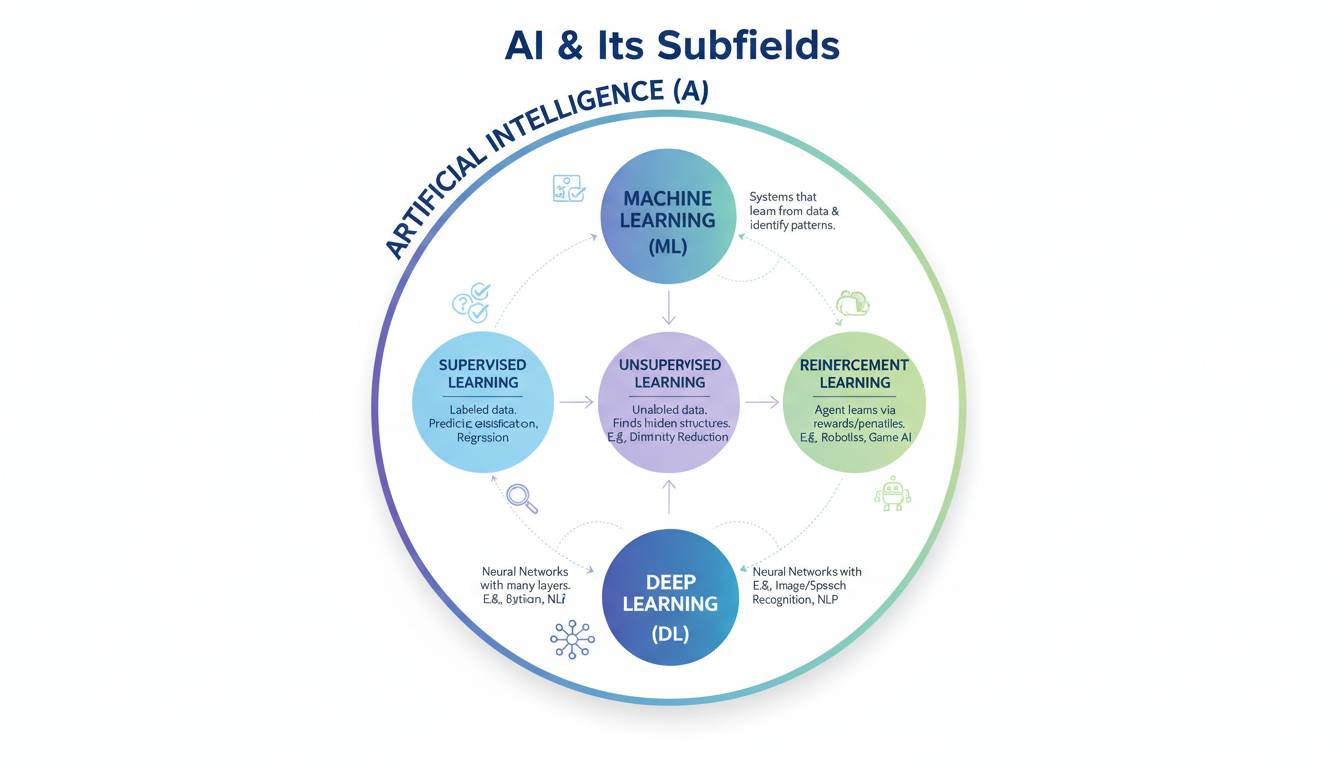
Machine learning is a subset of artificial intelligence that enables computers to learn from data and improve their performance on specific tasks without being explicitly programmed. Unlike traditional programming, where developers write explicit instructions for every possible scenario, machine learning systems identify patterns in data and use those patterns to make predictions or decisions.
The concept dates back to 1959 when Arthur Samuel, a pioneer in the field, defined machine learning as the “field of study that gives computers the ability to learn without being explicitly programmed.” Today, this technology processes billions of data points daily, from filtering spam emails to enabling autonomous vehicles to navigate roads safely.
Key Insight: Traditional software follows “if this, then that” rules written by humans. Machine learning discovers those rules automatically by analyzing examples. When you show a system thousands of photos of cats and dogs, it learns to distinguish between them—not through explicit instructions, but by identifying patterns in pixel arrangements.
Why Machine Learning Matters Now
The convergence of three factors has made machine learning extraordinarily powerful in recent years: massive amounts of available data, increased computational power, and advances in algorithms. According to industry analyses, global data creation exceeds 180 zettabytes annually, providing an unprecedented resource for training machine learning models. Simultaneously, graphics processing units (GPUs) originally designed for gaming now accelerate neural network training, making complex models practical for everyday applications.
Types of Machine Learning
Understanding the different approaches to machine learning helps you choose the right technique for your problem. The three primary categories differ in how they process training data and learn from it.
Supervised Learning
Supervised learning uses labeled datasets to train algorithms that classify data or predict outcomes accurately. You provide the system with input-output pairs—the “right answers”—and it learns the relationship between them. Email spam filters exemplify supervised learning: humans label thousands of emails as spam or not spam, and the algorithm learns to classify new messages based on patterns it discovers in those examples.
Common supervised learning tasks include classification (sorting items into categories), regression (predicting continuous values like prices or temperatures), and anomaly detection (identifying unusual patterns). Popular algorithms in this category include linear regression for simple predictions, decision trees for interpretable models, and support vector machines for complex classification boundaries.
Unsupervised Learning
Unsupervised learning works with unlabeled data, finding hidden patterns or structures without predefined categories. The system must discover these patterns independently, making this approach useful for exploratory data analysis and discovering natural groupings within data.
Customer segmentation exemplifies unsupervised learning: instead of telling the system what segments exist, you provide customer behavior data and let algorithms identify natural clusters of similar customers. This reveals patterns humans might not have anticipated. Principal component analysis reduces data complexity, while clustering algorithms like k-means group similar data points together.
Reinforcement Learning
Reinforcement learning involves an agent learning to make decisions by interacting with an environment, receiving rewards or penalties for its actions. The agent learns through trial and error, developing strategies that maximize cumulative rewards over time.
This approach powers game-playing AI systems, including the famous AlphaGo that defeated world champion Lee Sedol. In practical applications, reinforcement learning optimizes robotic control systems, manages resource allocation in data centers, and develops trading strategies in finance. The agent improves through repeated episodes, learning from both successes and failures.
Core Concepts Every Beginner Should Know
Building a foundation in machine learning requires understanding several fundamental concepts that appear throughout the field.
Features and Labels
Features are the individual measurable properties of your data—the inputs to your model. In a housing price prediction model, features might include square footage, number of bedrooms, location, and age of the home. Labels are the outputs you want to predict—in this case, the sale price. Supervised learning maps features to labels, learning the relationship between them.
Training and Testing Data
Machine learning models learn from training data and are evaluated on separate test data. This separation prevents overfitting—where a model memorizes training examples rather than learning generalizable patterns. A good model performs well on both training data (learning the patterns) and test data (applying them to new, unseen examples).
Overfitting and Underfitting
Overfitting occurs when a model learns training data too well, including its noise and peculiarities, resulting in poor generalization to new data. Imagine memorizing practice exam answers versus actually understanding the material—overfitting is like memorization. Underfitting happens when a model is too simple to capture the underlying patterns, like trying to fit a straight line through curved data. The goal is finding the right complexity level that captures meaningful patterns without memorizing noise.
Model Evaluation Metrics
Different metrics measure model performance depending on the task. Classification accuracy counts correct predictions, but precision and recall become important for imbalanced datasets. Regression models use mean absolute error or root mean squared error to quantify prediction distance from actual values. Understanding which metrics matter for your specific application prevents optimizing for the wrong objective.
How to Start Your Machine Learning Journey
Beginning your machine learning education requires a structured approach that builds knowledge progressively while maintaining practical engagement.
Prerequisites to Build First
Before diving into machine learning specifically, strengthen your foundation in mathematics, particularly linear algebra, calculus, and probability theory. These mathematical disciplines underpin the algorithms you will use and help you understand why they work. Programming skills in Python have become the standard for machine learning development, so familiarize yourself with Python syntax and basic data structures.
Online platforms offer structured learning paths from beginner to advanced levels. Many courses start with Python programming, then progress to data analysis with pandas and numpy, before introducing machine learning libraries. This progression ensures you have the necessary toolkit before tackling complex algorithms.
Recommended Learning Path
Start with understanding the fundamentals through introductory courses that explain machine learning concepts without heavy mathematical prerequisites. Stanford University’s machine learning course, available through various platforms, provides a comprehensive foundation. Simultaneously, begin experimenting with basic implementations using scikit-learn, a Python library that abstracts mathematical complexity while teaching core concepts.
After grasping fundamentals, explore specific areas that interest you—computer vision, natural language processing, or predictive analytics. Each specialization has its own techniques and best practices. Throughout your learning, work on projects that solve real problems, as hands-on experience accelerates understanding more effectively than theory alone.
Practical Applications of Machine Learning
Machine learning touches virtually every industry, creating opportunities for professionals across sectors. Understanding real-world applications helps contextualize your learning and inspires project ideas.
Healthcare and Medicine
Machine learning transforms healthcare through improved diagnostics, drug discovery, and treatment optimization. Algorithms analyze medical images to detect cancers, examine retinal scans for diabetic retinopathy, and identify heart conditions from electrocardiograms. Drug discovery, traditionally requiring years of laboratory work, now uses machine learning to predict molecular behavior and identify promising compounds faster.
Finance and Banking
Financial institutions employ machine learning for fraud detection, risk assessment, and algorithmic trading. Credit scoring models evaluate borrower risk more accurately than traditional methods, while fraud detection systems analyze transaction patterns to identify suspicious activity in real time. Robo-advisors use machine learning to manage investment portfolios based on individual risk tolerance and goals.
Entertainment and E-commerce
Recommendation systems power the content you encounter on streaming services and online retailers. These systems analyze your viewing history, purchase behavior, and similarity to other users to predict what you might enjoy. Netflix estimates that its recommendation system saves $1 billion annually by reducing customer churn and helping users discover content they watch.
Transportation and Logistics
Autonomous vehicles rely heavily on machine learning to interpret sensor data, identify objects, and make driving decisions. Ride-sharing services optimize driver-rider matching and estimated arrival times using machine learning. Supply chain management uses predictive algorithms to forecast demand, optimize inventory, and reduce delivery times.
Common Mistakes Beginners Make
Avoiding common pitfalls accelerates your learning and prevents frustration during the journey.
Skipping Fundamentals
Jumping directly into complex neural networks without understanding basic algorithms leads to fragile knowledge that breaks when problems arise. Understanding how linear regression works provides insight into why deep learning sometimes succeeds where simpler methods fail. Build your foundation methodically rather than racing toward advanced topics.
Ignoring Data Quality
Beginners often focus on algorithm selection while neglecting data preparation. The saying “garbage in, garbage out” applies perfectly to machine learning. Spending time cleaning data, handling missing values, and engineering meaningful features often matters more than trying different algorithms. Quality data beats sophisticated algorithms applied to poor data.
Overestimating Compute Requirements
While cutting-edge research requires expensive hardware, learning machine learning and even training production models works well on consumer hardware. Cloud platforms offer pay-as-you-go access to powerful servers for occasional needs. Many problems solve adequately with efficient algorithms running on standard computers, reserving expensive compute for when you genuinely need deep learning.
Neglecting Model Interpretation
Complex models sometimes become “black boxes” whose decisions are difficult to explain. For many applications, especially in regulated industries or where user trust matters, interpretability matters significantly. Start with interpretable models like decision trees or linear regression before moving to more complex alternatives, and always consider whether you can explain your model’s decisions.
Essential Tools and Resources
The machine learning ecosystem offers numerous tools that simplify development while teaching underlying concepts.
Programming Libraries
Python’s dominance in machine learning stems from its readability and the mature ecosystem of scientific libraries. NumPy provides efficient numerical computation, pandas handles data manipulation and analysis, and Matplotlib enables visualization. Scikit-learn implements dozens of standard machine learning algorithms with consistent interfaces, making experimentation straightforward. TensorFlow and PyTorch offer deep learning frameworks for more advanced applications.
Development Environments
Jupyter notebooks have become the standard environment for machine learning development, combining code execution, visualization, and documentation in interactive notebooks. Google Colab provides free access to GPUs and requires no setup, enabling immediate experimentation. Visual Studio Code with Python extensions offers a more traditional development experience with excellent debugging capabilities.
Learning Resources
Documentation for scikit-learn and deep learning frameworks includes tutorials that teach through implementation. GitHub hosts thousands of open-source machine learning projects where you can study how others solve problems. Kaggle, a platform for data science competitions, provides datasets and community discussions that accelerate learning through practical challenges.
Frequently Asked Questions
How long does it take to learn machine learning basics?
Most learners achieve basic proficiency in three to six months of dedicated study, assuming consistent engagement of ten to fifteen hours weekly. Becoming job-ready typically requires one to two years of focused practice. The timeline varies significantly based on your mathematical background, programming experience, and learning intensity.
Do I need advanced math skills to start machine learning?
A solid grasp of high school mathematics suffices for understanding basic algorithms. Calculus helps comprehension of optimization methods, linear algebra enables understanding of neural networks, and probability theory supports algorithm selection. Many successful practitioners started without advanced math, learning required concepts as needed.
Which programming language should I learn first?
Python has become the standard language for machine learning due to its readability and extensive library support. R remains popular in academic research and statistics-focused roles. Starting with Python provides the broadest set of resources, tutorials, and job opportunities.
Is machine learning suitable for my industry?
Machine learning applies to virtually every sector. Whether you work in healthcare, finance, marketing, manufacturing, or entertainment, machine learning can extract value from your data. Identify problems where historical data exists and predictions could improve decisions—these are prime candidates for machine learning applications.
Can I learn machine learning without a degree in computer science?
Absolutely. Many successful machine learning practitioners come from diverse backgrounds including physics, mathematics, economics, and even humanities. Online courses, bootcamps, and self-study resources make machine learning accessible to anyone with dedication and appropriate prerequisites.
Conclusion
Machine learning represents an accessible yet profound technology that continues reshaping how we interact with information and solve complex problems. Starting your journey requires building foundational knowledge progressively, understanding core concepts thoroughly, and maintaining practical engagement through projects. The field offers endless learning opportunities as algorithms evolve and new applications emerge.
Begin with the fundamentals outlined in this guide: understand what machine learning is, learn the different learning types, and master core concepts before tackling advanced topics. Leverage the abundant free resources available, connect with learning communities, and most importantly, build projects that solve problems you care about. Your journey into machine learning starts with a single step—so begin today and discover how this transformative technology can enhance your skills and career prospects.