Digital Transformation Strategy Guide: Complete Roadmap for Success


Digital transformation has evolved from a competitive advantage to a fundamental business imperative. Organizations that fail to adapt face obsolescence, while those that successfully navigate this shift capture market share, improve operational efficiency, and create sustainable growth engines. Yet despite widespread recognition of its importance, most digital transformation initiatives fail to deliver expected results. Understanding the strategic framework, common pitfalls, and proven implementation approaches separates successful transformations from costly failures.
This guide provides a comprehensive roadmap for leaders embarking on digital transformation, covering the essential components, implementation phases, and critical success factors that determine whether initiatives generate meaningful business value.
Understanding Digital Transformation in the Modern Enterprise
Digital transformation represents the integration of digital technology into all areas of a business, fundamentally changing how organizations operate and deliver value to customers. It extends far beyond simply adopting new tools—it requires a comprehensive rethinking of business models, processes, customer experiences, and organizational culture.
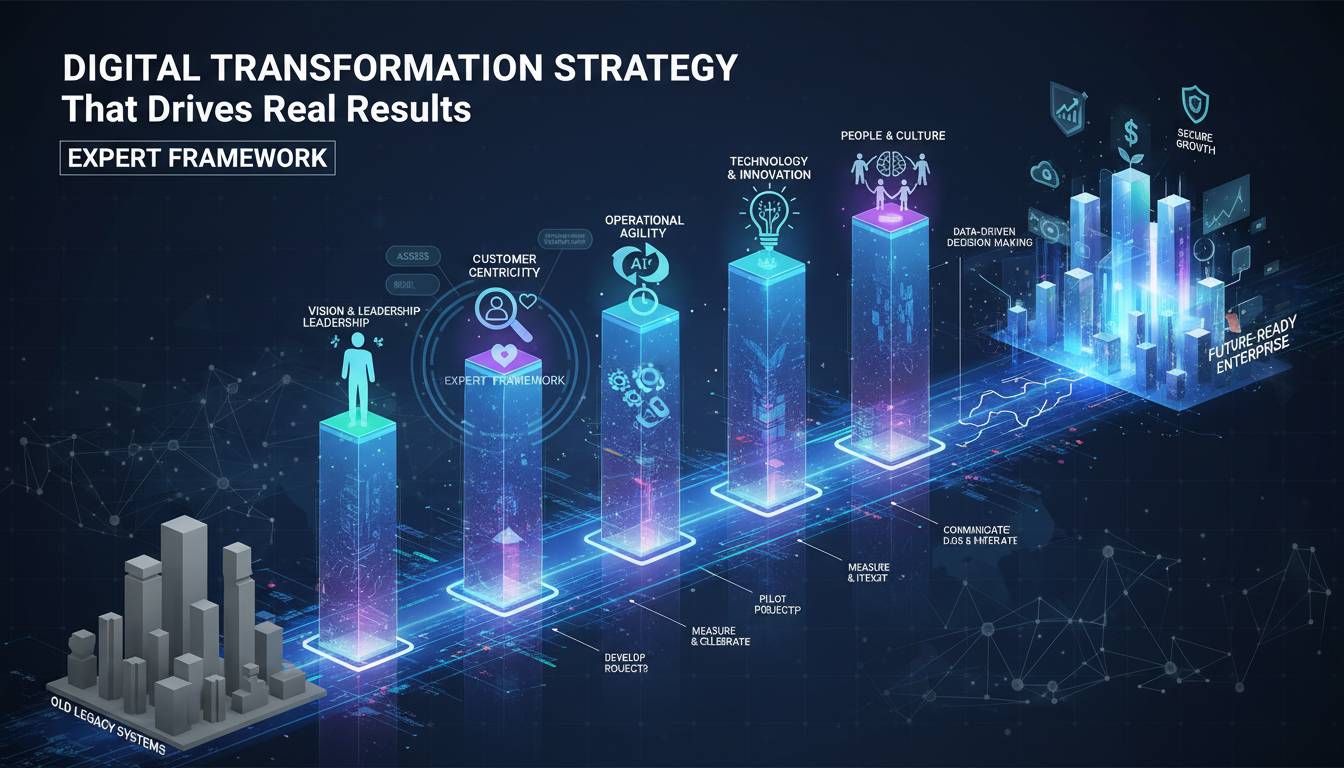
The scope of digital transformation varies significantly across industries and organizational sizes. For some enterprises, it means completely reimagining their business model to compete in digitally native markets. For others, it focuses on optimizing existing operations through automation and data analytics. Regardless of scale, successful transformation addresses four interconnected dimensions: customer experience, operational processes, business models, and organizational culture.
McKinsey research indicates that companies achieving their digital transformation goals share common characteristics: they align digital initiatives with core business strategy, invest in talent development, embrace agile methodologies, and maintain strong leadership commitment throughout the transformation journey. The distinction between successful and unsuccessful transformations often comes down to whether organizations treat digital transformation as a technology project or as a strategic transformation.
The Business Case: Why Digital Transformation Matters Now
The urgency for digital transformation has accelerated dramatically. Customer expectations have shifted toward digital-first interactions, supply chains have become more complex and volatile, and competitive barriers have lowered in many industries due to technological democratization.
Organizations that embrace digital transformation report measurable improvements across multiple performance indicators. According to Deloitte’s digital transformation surveys, digitally mature organizations are 1.5 times more likely to report revenue growth above industry peers and 1.6 times more likely to achieve above-average profitability. These performance differentials have widened as digital leaders continue to compound their advantages through data-driven decision-making and automated operations.
The COVID-19 pandemic served as an unexpected catalyst, demonstrating that organizations with mature digital capabilities adapted more quickly to disrupted markets. Companies with established remote work infrastructure, digital customer engagement channels, and automated supply chain systems maintained operational continuity while competitors struggled with manual processes and paper-based workflows. This real-world stress test convinced many business leaders that digital transformation is no longer optional but essential for organizational resilience.
Beyond competitive positioning, digital transformation enables new value creation opportunities that were previously impossible or impractical. Advanced analytics reveal customer insights that drive product development and marketing effectiveness. Automation reduces operational costs while improving quality and speed. Cloud infrastructure provides scalability that supports business growth without proportional capital investment. These capabilities compound over time, creating sustainable competitive advantages that are difficult for laggards to replicate.
Key Components of a Successful Digital Transformation Strategy
A comprehensive digital transformation strategy addresses multiple organizational dimensions simultaneously. Organizations that focus narrowly on technology adoption often achieve limited results because they fail to account for the human, process, and cultural changes required for sustainable transformation.
Vision and Strategy Alignment
Successful transformations begin with a clear vision that connects digital initiatives to core business objectives. This vision articulates how digital capabilities will create customer value, improve operational efficiency, and enable new revenue streams. The strategy must define specific outcomes, timelines, and success metrics that leadership can track and manage.
Strategy alignment requires honest assessment of current capabilities versus future requirements. Gap analysis identifies where organizational skills, processes, and technologies fall short of strategic objectives. This assessment informs investment priorities and helps leadership allocate resources to initiatives with the highest impact potential.
Customer Experience Transformation
Digital customer experience has become a primary battleground for competitive differentiation. Organizations must map customer journeys across all touchpoints, identifying friction points and opportunities for digital enhancement. This analysis reveals where self-service capabilities, personalization, and omnichannel integration create the most value.
Customer experience transformation requires collaboration between technology, marketing, and operations teams. Digital channels must integrate seamlessly with traditional channels to create consistent experiences regardless of how customers engage. Investment in customer data platforms enables the personalization that customers increasingly expect while respecting privacy preferences and regulatory requirements.
Operational Excellence Through Digital
Operational transformation focuses on automating manual processes, optimizing workflows, and enabling data-driven decision-making. Robotic process automation handles repetitive tasks, freeing employees for higher-value activities. Advanced analytics provide real-time visibility into operations, enabling proactive management and continuous improvement.
Supply chain digitization has become particularly critical given increasing complexity and disruption risk. Digital supply chain capabilities include predictive analytics for demand forecasting, IoT sensors for inventory and asset tracking, and blockchain for provenance verification. These technologies reduce costs, improve reliability, and enable more responsive decision-making.
Organizational Culture and Talent
Technology implementations fail without corresponding changes in organizational behavior and capabilities. Cultural transformation requires leadership to model desired behaviors, communicate compelling reasons for change, and recognize employees who embrace new ways of working. Resistance to change is natural, and successful transformations invest in change management rather than expecting automatic adoption.
Talent development addresses skill gaps that constrain digital initiative effectiveness. This includes both hiring external expertise and upskilling existing employees. Organizations with strong learning cultures adapt more quickly to new tools and methodologies. Investment in training demonstrates organizational commitment to employee growth, improving retention of talent that might otherwise seek opportunities elsewhere.
Common Digital Transformation Mistakes to Avoid
Understanding typical failure patterns helps organizations avoid costly missteps. Several recurring mistakes consistently undermine transformation initiatives across industries and organization sizes.
Treating transformation as a technology project: Organizations that focus exclusively on technology implementation without addressing process and cultural changes rarely achieve desired outcomes. Technology serves business strategy, not the reverse. Successful transformations begin with clear business objectives and work backward to identify required technology capabilities.
Insufficient leadership commitment: Transformations require sustained attention and resources from senior leadership. When executives delegate transformation oversight to IT departments or treat it as someone else’s responsibility, initiatives lose momentum and funding. Visible, engaged leadership signals organizational priority and enables cross-functional collaboration.
Attempting too much simultaneously: Ambitious transformations that spread resources across numerous initiatives often achieve nothing well. Prioritization focused on high-impact, achievable projects builds momentum and demonstrates value. Organizations can expand scope as early wins create organizational confidence and capability.
Neglecting change management: New technology implementation does not automatically change how people work. Training, communication, and support structures determine whether employees adopt new tools effectively. Organizations that invest in change management achieve higher adoption rates and realize transformation benefits faster.
Ignoring data quality: Analytics and automation depend on reliable data. Organizations that rush to implement advanced capabilities without addressing data silos, inconsistent definitions, and quality issues generate misleading insights and flawed automation. Data foundation work may be unglamorous but determines whether sophisticated applications succeed.
Implementation Roadmap: A Phased Approach
Effective digital transformation follows a structured approach that builds capability progressively while managing risk. A phased implementation allows organizations to learn from early initiatives and adjust strategies based on demonstrated results.
Phase One: Assessment and Planning
The initial phase establishes transformation direction through comprehensive assessment of current state and strategic objectives. This includes capability audits across technology, process, and talent dimensions. Leadership alignment sessions ensure shared understanding of priorities and success criteria. The phase concludes with a roadmap that sequences initiatives based on impact, feasibility, and dependencies.
Planning activities also establish governance structures that guide transformation execution. Clear decision rights, escalation processes, and accountability frameworks prevent the confusion that derails complex initiatives. Investment approval processes balance agility with appropriate oversight.
Phase Two: Quick Wins and Foundation Building
Early implementation should prioritize initiatives that demonstrate value while building organizational capability. Quick wins generate momentum and organizational confidence while revealing implementation challenges that require adjustment. These initiatives typically focus on improving customer experience or operational efficiency in targeted areas.
Simultaneously, organizations should invest in foundational capabilities that support broader transformation. This includes cloud infrastructure, data platforms, and integration architecture. Skipping foundational work to pursue visible initiatives often creates technical debt that constrains future progress.
Phase Three: Scaled Implementation
With demonstrated success and solid foundations, organizations can scale transformation across broader organizational scope. This phase extends successful pilot approaches to additional business units and geographies. Integration becomes more complex as initiatives interact and dependencies increase.
Scaled implementation requires robust program management that coordinates multiple workstreams, manages resource conflicts, and maintains strategic alignment. Regular health checks identify emerging issues before they derail progress. Adjustment mechanisms allow strategies to evolve based on learning from implementation experience.
Phase Four: Continuous Optimization
Digital transformation is never truly complete. Mature organizations establish continuous improvement practices that optimize existing capabilities while identifying next-generation enhancements. This includes retiring legacy systems that no longer serve strategic purposes, adopting emerging technologies that create new opportunities, and refreshing approaches based on evolving business requirements.
Continuous optimization requires investment in innovation scanning and experimentation capabilities. Organizations that only implement proven technologies eventually fall behind competitors embracing emerging capabilities. The right balance involves disciplined evaluation of new technologies against specific business needs rather than adoption for its own sake.
Measuring Digital Transformation Success
Effective measurement demonstrates transformation value, guides investment decisions, and enables continuous improvement. Success metrics should span multiple dimensions to capture comprehensive transformation impact.
| Metric Category | Key Indicators | Measurement Approach |
|---|---|---|
| Customer | Digital channel adoption, satisfaction scores, retention rates | Surveys, analytics platforms, CRM data |
| Operational | Process cycle times, automation rates, error reduction | Operational systems, workflow analytics |
| Financial | Revenue from digital channels, cost reduction, ROI | Financial systems, business case tracking |
| Organizational | Employee adoption, skill development, cultural indicators | Adoption metrics, assessments, surveys |
Leading indicators predict future results and enable proactive management. Lagging indicators confirm whether strategies produced intended outcomes. Both categories matter—organizations that track only lagging metrics miss opportunities to adjust course before results materialize.
Benchmarking against industry peers provides context for performance assessment. Organizations should identify appropriate comparison groups and track relative performance over time. Significant divergence from peers in either direction warrants investigation to understand underlying causes.
Technology Enablers for Digital Transformation
Modern digital transformation relies on several foundational technology categories that provide capabilities across multiple use cases. Understanding these categories helps leaders make informed investment decisions.
Cloud computing provides the scalability, flexibility, and cost efficiency that enable rapid experimentation and scaling. Cloud migration has become a prerequisite for many digital capabilities, though hybrid approaches remain appropriate for workloads with specific regulatory or performance requirements. Major cloud providers offer increasingly sophisticated services that accelerate development of advanced capabilities.
Data and analytics platforms transform raw information into actionable insights. Modern architectures support real-time processing alongside traditional batch analytics. Machine learning capabilities enable predictive models that drive automation and personalization. Data governance practices ensure quality and compliance while enabling appropriate access.
Automation technologies range from robotic process automation for routine tasks to intelligent automation that handles complex, variable processes. Workflow orchestration coordinates automated and human activities across organizational boundaries. Successful automation requires careful process analysis to identify appropriate targets and design effective solutions.
Integration capabilities connect disparate systems to create unified experiences and enable data flow across organizational boundaries. API-first architectures support both internal integration and external partnership ecosystems. Modern integration platforms reduce the technical complexity and maintenance burden that historically constrained integration initiatives.
Frequently Asked Questions
How long does digital transformation typically take?
Digital transformation timelines vary significantly based on organizational size, scope, and starting maturity. Most comprehensive transformations require three to five years to achieve full maturity, though organizations typically see meaningful results within six to twelve months from initiative launch. Attempting to compress timelines excessively often compromises quality and adoption. Phased approaches that deliver incremental value over time tend to outperform big-bang implementations.
What is the typical investment required for digital transformation?
Investment levels depend heavily on organizational scale, current state, and strategic ambition. Large enterprises often invest hundreds of millions of dollars over multi-year periods. Mid-market organizations typically invest tens of millions. Smaller businesses can achieve meaningful transformation with more modest investments by focusing on high-impact areas. Beyond technology investment, organizations must budget for talent development, change management, and ongoing operational costs.
How do we measure ROI from digital transformation initiatives?
ROI measurement requires establishing baseline metrics before transformation begins and tracking changes over time. For customer initiatives, measure adoption rates, satisfaction scores, and revenue attribution. For operational improvements, track efficiency gains, error reduction, and cost changes. Assigning precise financial impact can be challenging when transformations affect multiple interdependent areas. Conservative estimates, peer benchmarking, and before-after comparisons provide reasonable confidence in ROI assessment.
Should we build internal capabilities or partner with external experts?
Most organizations require both approaches. Internal teams maintain institutional knowledge and ongoing operational capabilities. External partners provide specialized expertise, accelerate capability building, and offer objective perspectives. The right balance depends on internal talent availability, transformation scope, and long-term strategic direction. Many organizations start with heavy partner involvement and progressively build internal capabilities through knowledge transfer.
How do we manage employee resistance to digital transformation?
Resistance typically stems from fear of job displacement, unfamiliarity with new tools, or skepticism about organizational commitment. Addressing these concerns requires transparent communication about transformation purpose and expected outcomes, investment in training and support, involvement of employees in design decisions, and visible leadership engagement. Organizations that treat affected employees as partners in transformation rather than obstacles achieve higher adoption and better outcomes.
What is the biggest mistake organizations make in digital transformation?
The most common fatal mistake is treating digital transformation as a technology project rather than a business transformation. Organizations that focus exclusively on implementing new systems without addressing process redesign, cultural change, and talent development rarely achieve expected benefits. Technology enables transformation but does not accomplish it alone. Successful transformations integrate technology investments with organizational development investments and maintain focus on business outcomes throughout implementation.
Conclusion
Digital transformation represents both an imperative and an opportunity for organizations seeking sustainable competitive advantage. The path to successful transformation requires clear strategic vision, comprehensive planning, disciplined execution, and continuous optimization. Organizations that approach transformation as a business transformation rather than a technology project position themselves to capture the substantial value that digital capabilities enable.
The journey is not without challenges. Resource constraints, organizational resistance, and technical complexity create ongoing management demands. However, organizations that commit to transformation with appropriate strategies and sustained leadership attention consistently achieve results that justify the investment. The competitive landscape will continue evolving toward digital-native competition—organizations that begin their transformation journeys thoughtfully and persistently will be best positioned to thrive in this new environment.
Success requires balancing ambition with pragmatism, pursuing quick wins that demonstrate value while building foundations for broader impact. Measurement and adjustment mechanisms ensure that strategies evolve based on learning and changing conditions. With appropriate approach and commitment, digital transformation becomes not just a competitive necessity but a sustainable source of ongoing business value.