URL: /dao-governance-tokens Title: DAO Governance Tokens:

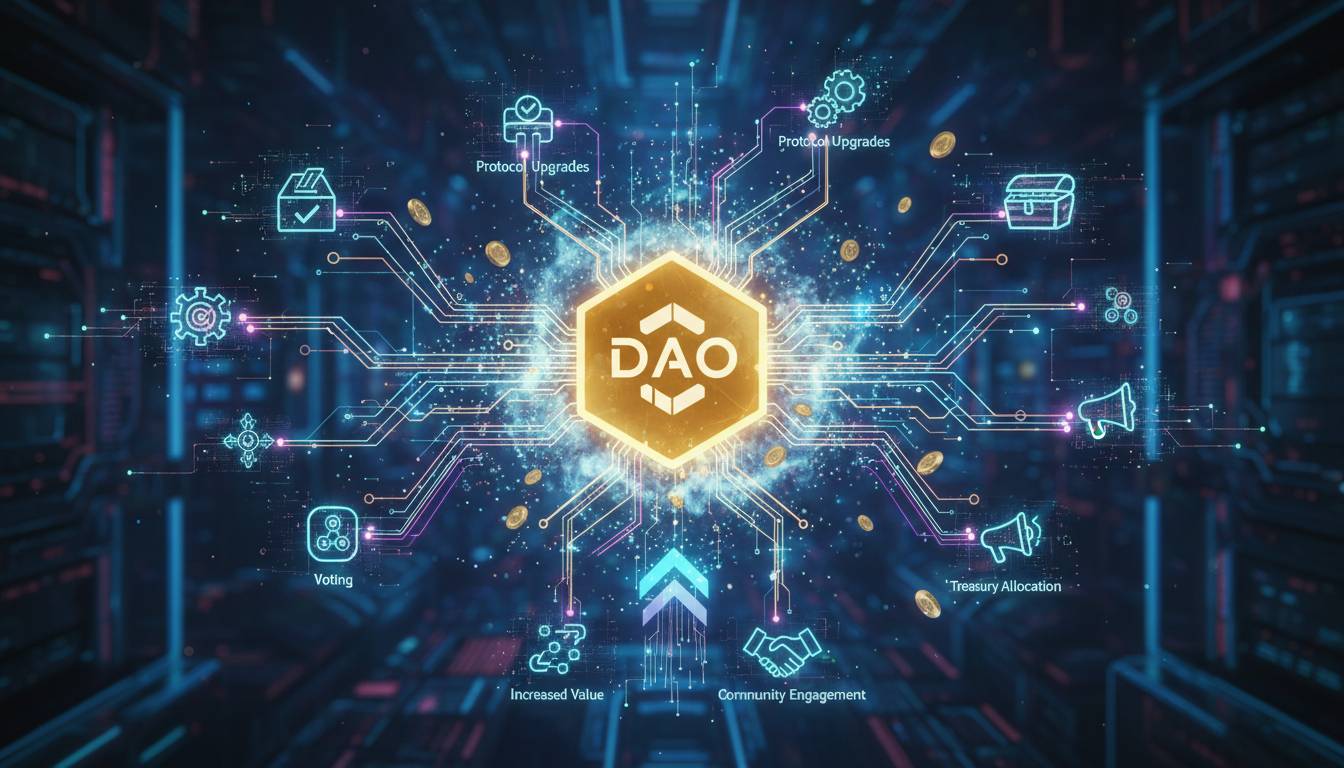
DAO governance tokens represent one of the most significant innovations in decentralized finance, enabling token holders to participate directly in the decision-making processes of decentralized autonomous organizations. These digital assets have transformed how communities organize, fund, and manage projects without relying on traditional hierarchical structures.
What Are DAO Governance Tokens?
DAO governance tokens are cryptographic tokens that grant holders voting rights and decision-making power within a decentralized autonomous organization. Unlike traditional corporate shares, these tokens operate on blockchain networks, ensuring transparency, immutability, and universal accessibility. When you hold a governance token, you acquire the right to propose changes, vote on protocol upgrades, and influence the strategic direction of the organization.
The fundamental premise behind governance tokens lies in aligning incentives between stakeholders and the organizations they govern. Token holders typically receive voting power proportional to their token holdings, though some DAOs implement quadratic voting or token-weighted systems to prevent whale dominance. This democratized approach to governance has attracted billions of dollars in total value locked across various DAO ecosystems.
Governance tokens differ from utility tokens in that their primary function is not to provide access to services or products but to enable participation in organizational governance. Some tokens serve dual purposes, offering both governance rights and utility functions like fee discounts or staking rewards.
How DAO Governance Tokens Work
The mechanics of DAO governance tokens revolve around on-chain and off-chain voting systems that translate token holdings into voting power. When a proposal is submitted to a DAO, token holders can cast their votes within a specified timeframe, and the outcome is determined by predefined rules encoded in smart contracts.
The proposal lifecycle typically follows these stages:
- Proposal Submission: Any token holder meeting the minimum threshold can submit a proposal, usually requiring a small deposit to prevent spam.
- Discussion Period: The community discusses the proposal through forums, Discord servers, or governance dashboards.
- Voting Phase: Token holders cast votes using their governance tokens. Many DAOs employ “snapshot” voting, where token balances are recorded at a specific block to prevent vote buying.
- Execution: If the proposal passes the quorum and approval threshold, it executes automatically through smart contracts.
Key mechanisms include:
| Mechanism | Description | Purpose |
|---|---|---|
| Token-Weighted Voting | One token equals one vote | Simple majority rule |
| Quadratic Voting | Votes increase quadratically with tokens | Reduces whale influence |
| Conviction Voting | Votes accumulate over time | Values long-term holders |
| Rage Quit | Exit with proportional tokens | Protection against decisions |
The technical infrastructure often relies on governance frameworks like Governor (by Compound), Tally, or Aragon, which provide standardized templates for creating and managing DAO voting processes.
Types of DAO Governance Token Models
DAO governance tokens operate under several models, each with distinct characteristics that shape community participation and organizational outcomes.
1. Single-Token Model
The most common approach where one token governs all aspects of the DAO. Examples include UNI (Uniswap), MKR (MakerDAO), and AAVE. This simplicity reduces complexity but may concentrate too much power in single decision-making forums.
2. Dual-Token Model
Separates governance rights from economic incentives. For instance, some protocols issue governance tokens separate from revenue-sharing or staking tokens, allowing distinct participation in different organizational functions.
3. Reputation-Based Systems
Instead of purchasing governance rights, users earn reputation through contributions to the DAO. Projects like Colony and 1Hive implement this model, where reputation cannot be bought—only earned through demonstrated commitment.
4. Liquid Democracy Delegation
Holders can delegate their voting power to trusted representatives who vote on their behalf. This system, employed by platforms like Compound and Uniswap, allows passive holders to maintain influence without actively participating in every decision.
Comparison of Governance Models:
| Model | Advantages | Disadvantages |
|---|---|---|
| Single-Token | Simple, liquid, clear value | Whale concentration risk |
| Dual-Token | Specialized governance | Complex tokenomics |
| Reputation-Based | Sybil-resistant, quality focus | Entry barriers, illiquid |
| Liquid Democracy | Scalable participation | Trust dependency |
Benefits of Governance Tokens
Governance tokens offer transformative advantages over traditional organizational structures, creating new paradigms for collective decision-making and value creation.
Decentralized Authority Distribution
Unlike traditional corporations where voting power concentrates among board members and major shareholders, DAO governance tokens distribute authority across global participant networks. Research from Messari indicates that DAOs with distributed token ownership demonstrate 47% higher community engagement rates compared to traditional organizations.
Transparent Decision-Making
Every vote, proposal, and transaction occurs on-chain, creating an immutable audit trail. This transparency reduces corruption risks and builds unprecedented trust between stakeholders. The Harvard Business Review noted that blockchain-based governance systems demonstrate “unprecedented accountability mechanisms” previously impossible in analog systems.
Global Accessibility
Anyone with an internet connection and a compatible wallet can participate in DAO governance, removing geographical barriers to organizational participation. This global accessibility has proven particularly valuable for diaspora communities and individuals in regions with restricted financial systems.
Aligning Incentives Through Token Economics
Token holders benefit from organizational success, creating powerful alignment between individual interests and collective outcomes. When governance tokens appreciate due to protocol improvements, all stakeholders share in the value creation—a departure from traditional structures where shareholders capture most upside.
Rapid Iteration and Innovation
DAOs can implement changes within days or weeks rather than the months typically required for corporate governance changes. This agility enables organizations to respond quickly to market conditions, competitive threats, or technological opportunities.
Real-World Examples of DAO Governance Tokens
Understanding how governance tokens function in practice reveals their transformative potential across different sectors.
Uniswap (UNI)
The Uniswap DAO governs the largest decentralized exchange protocol, with over $3.5 billion in total value locked. UNI token holders have approved numerous protocol upgrades, treasury grants, and fee structure modifications. The governance process has successfully managed a treasury exceeding $2 billion, demonstrating large-scale DAO operational capacity.
MakerDAO (MKR)
MakerDAO’s governance token MKR holders oversee the Dai stablecoin system, one of the most battle-tested DeFi protocols. MKR holders vote on risk parameters, collateral types, and protocol upgrades. The system has maintained Dai’s peg through extreme market conditions, validating governance token resilience.
Lido DAO (LDO)
Lido’s governance token manages liquid staking derivatives, controlling significant portions of Ethereum’s proof-of-stake infrastructure. LDO holders govern the protocol’s fees, node operator selection, and strategic partnerships, processing billions in user deposits.
ConstitutionDAO (PEOPLE)
In 2021, ConstitutionDAO demonstrated governance tokens’ potential for collective action, raising nearly $47 million in days to attempt purchasing a rare copy of the U.S. Constitution. While unsuccessful, the experiment showcased governance tokens’ capacity to mobilize rapid, coordinated financial resources around shared objectives.
Common Challenges and Risks
Despite their innovative potential, DAO governance tokens face significant challenges that participants must understand before engagement.
Low Voter Participation
Most DAO governance suffers from chronic low participation rates. Research indicates that average DAO voter turnout hovers between 4-8% of eligible token holders. This “rational apathy” creates scenarios where small, motivated groups can disproportionately influence outcomes.
Smart Contract Vulnerabilities
Governance tokens depend on smart contract code that may contain exploits. The DAO hack of 2016, resulting in $60 million in losses, demonstrated that governance systems can become attack vectors. Protocols must invest heavily in security audits and formal verification.
Regulatory Uncertainty
Securities regulators worldwide continue evaluating whether governance tokens constitute securities under existing frameworks. The SEC’s enhanced scrutiny of crypto assets creates potential compliance risks for DAO participants and developers.
Manipulation and Collusion
Whale addresses holding significant token supplies can potentially manipulate governance outcomes. Proposal bonding requirements and quorum thresholds provide partial mitigations but cannot eliminate sophisticated manipulation attempts.
Governance Capture
Long-term token holders may accumulate voting power and use governance processes to extract value from the protocol, prioritizing personal enrichment over collective benefit. This “governance capture” represents an ongoing challenge requiring continuous vigilance.
How to Evaluate a DAO Governance Token
Before acquiring governance tokens, prospective participants should conduct thorough due diligence across multiple dimensions.
Token Distribution Analysis
Examine how tokens are allocated among initial holders, team members, investors, and community reserves. Highly concentrated distributions signal potential governance centralization risks. Tools like Etherscan and governance dashboards reveal holder concentrations.
Governance Mechanism Assessment
Evaluate the specific voting mechanisms, quorum requirements, and proposal thresholds. Understanding these parameters helps predict governance responsiveness and minority protection levels.
Treasury and Incentive Structure
Review the DAO’s treasury holdings, spending mechanisms, and token emission schedules. Sustainable treasury management indicates long-term organizational viability.
Community Health Indicators
Active governance requires engaged communities. Assess discussion forums, Discord activity, and proposal participation rates to gauge organizational vitality.
Security and Development Track Record
Examine smart contract audit reports, bug bounty programs, and historical incident responses. Security investment indicates organizational maturity.
Decision Framework Table:
| Factor | Green Flag | Red Flag |
|---|---|---|
| Token Distribution | Broad, diverse holders | Single wallet controls >30% |
| Participation | >10% voter turnout | <3% turnout consistently |
| Treasury | Transparent, audited spending | Unexplained reserves |
| Security | Multiple audits, active bounties | No audits, few security measures |
| Community | Active discussions, diverse views | Muted forums, pump channels |
Frequently Asked Questions
What is the purpose of a DAO governance token?
DAO governance tokens provide holders with voting rights to influence decentralized organizations’ decisions. These tokens enable token holders to propose changes, vote on protocol upgrades, and direct treasury funds without traditional hierarchical leadership structures.
How do governance tokens differ from cryptocurrencies?
While governance tokens are cryptocurrencies, not all cryptocurrencies are governance tokens. Governance tokens specifically confer decision-making power within an organization, while other cryptocurrencies may function as currencies, utility tokens, or store-of-value assets without voting capabilities.
Can anyone participate in DAO governance?
Yes, most DAOs allow anyone holding their governance tokens to participate in voting. However, some proposals require minimum token thresholds for submission. Participation typically requires a compatible cryptocurrency wallet and holding the governance token in a non-custodial wallet.
Are DAO governance tokens a good investment?
Governance token investment carries substantial risk including regulatory uncertainty, low participation vulnerabilities, and protocol failure. Investors should thoroughly research token distribution, governance mechanisms, and protocol fundamentals before investing. Many governance tokens also provide utility functions like fee discounts or staking rewards that add investment considerations.
What happens if a DAO proposal fails?
Failed proposals do not execute, and proposal deposits may be burned or refunded depending on the DAO’s rules. Failed proposals can be revised and resubmitted with modifications to address community concerns.
How are DAO voting results verified?
DAO voting results are verified through blockchain transparency—the smart contract automatically tallies votes recorded on-chain. Snapshot voting systems record token balances at specific blocks to prevent vote manipulation while reducing gas costs.