New Cryptocurrencies 2024: Top Picks for Maximum Gains

The cryptocurrency market in 2024 represents a pivotal transformation year. With Bitcoin breaking past previous all-time highs following the January 2024 spot ETF approvals, institutional capital flowing into the space, and layer-2 technologies reaching meaningful scale, the market has evolved beyond speculation toward actual utility. New cryptocurrency projects launching in this environment face higher bars for credibility and real-world application.
This guide examines the emerging cryptocurrency landscape for 2024, analyzing which new projects demonstrate genuine innovation versus those riding market momentum. You’ll find category breakdowns, risk considerations, and a framework for evaluating nascent crypto projects—regardless of whether you’re a seasoned DeFi user or exploring your first altcoin investment.
The 2024 Crypto Landscape: Why New Projects Matter Now
The cryptocurrency market capitalization exceeded $2.3 trillion in early 2024, with Bitcoin dominance fluctuating between 50-58% as capital rotated into alternative chains and protocols. This dynamic creates opportunity: when Bitcoin rallies, altcoins typically experience amplified movements, and 2024 has delivered both volatility and substantial gains for strategically positioned portfolios.
Key Market Dynamics
Several structural shifts distinguish 2024 from previous cycles:
Institutional Infrastructure Maturation: BlackRock and Fidelity launching spot Bitcoin ETFs created unprecedented access for traditional investors. This infrastructure means new cryptocurrency projects now compete for attention among sophisticated capital allocators who demand legitimate use cases and transparent tokenomics.
Layer-2 Revolution: Ethereum scaling solutions have progressed from theoretical promises to functional realities. Arbitrum, Optimism, and newer entrants like zkSync and Starknet process transactions at a fraction of base-layer costs, enabling applications previously impossible on mainnet.
Real-World Asset Tokenization: Major financial institutions including BlackRock and Franklin Templeton have piloted blockchain-based securities. This trend validates cryptocurrency utility beyond pure digital-native applications.
Regulatory Clarity Emergence: The SEC’s 2024 actions, including approval of spot ETFs and resolution of certain enforcement matters, provided frameworks that clarity-seeking projects can now navigate.
These dynamics mean new cryptocurrencies in 2024 face different selection criteria than those from 2021’s DeFi summer or 2020’s yield farming boom.
Emerging Cryptocurrency Categories for 2024
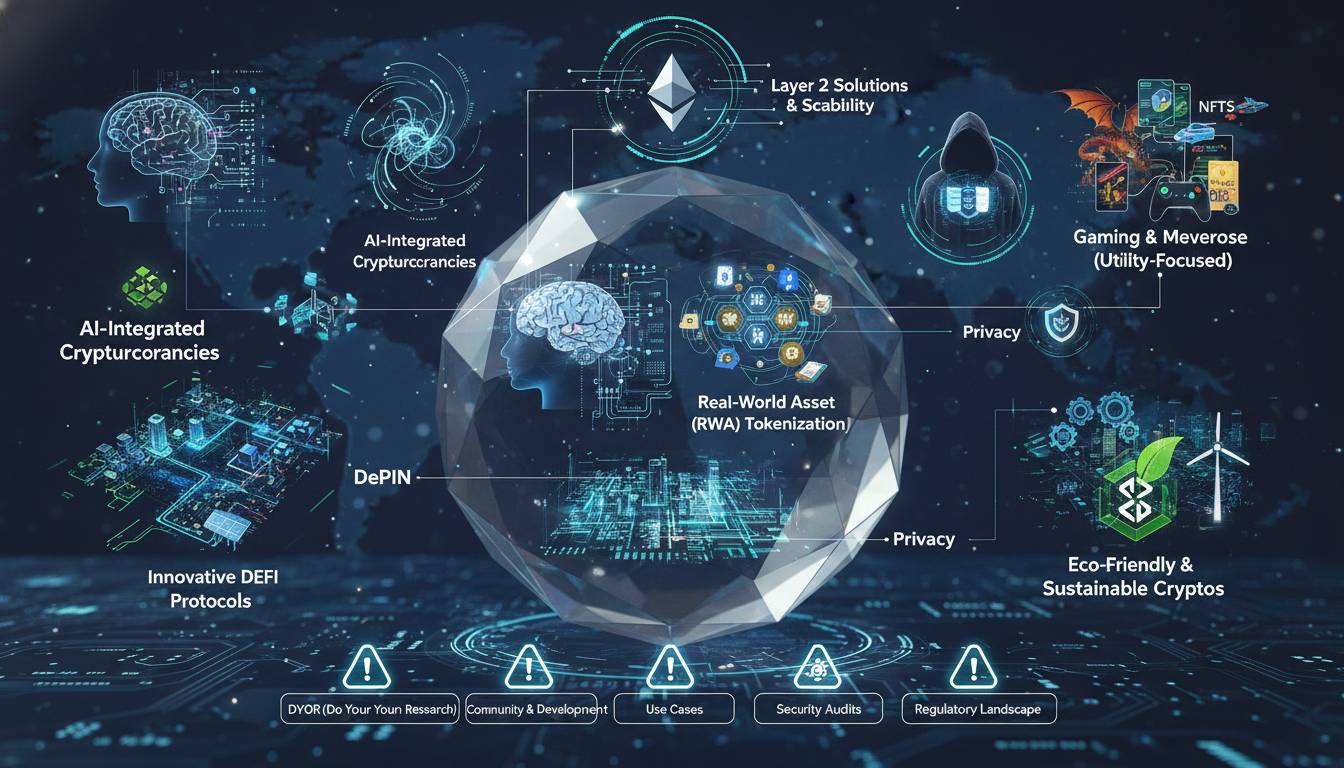
Rather than listing individual tokens, understanding which categories represent genuine innovation helps identify projects with sustainable value propositions. Here’s how emerging crypto segments compare:
| Category | Primary Use Case | Maturity Level | Risk Profile | 2024 Narrative Strength |
|---|---|---|---|---|
| Layer-2 Scaling | Faster/cheaper transactions | High | Low-Medium | Strong |
| ZK-Privacy | Confidential transactions | Medium | Medium-High | Moderate |
| DeFi Aggregators | Yield optimization | High | Medium | Strong |
| RWA Tokenization | Real asset ownership | Emerging | Medium | Very Strong |
| Gaming/NFT Infrastructure | Digital ownership | Medium | High | Moderate |
| AI-Blockchain Intersection | AI data/monetization | Emerging | High | Growing |
Layer-2 Solutions: The Scaling Foundation
Ethereum’s base layer processes approximately 12-15 transactions per second, creating bottlenecks during network activity. Layer-2 solutions process transactions on secondary networks while periodically settling to Ethereum’s mainnet, achieving thousands of transactions per second with dramatically reduced fees.
Why Layer-2s Matter for New Projects:
When evaluating new cryptocurrencies, layer-2 infrastructure enables projects that were previously impractical. High-frequency trading applications, gaming platforms requiring instant transactions, and micropayment systems all require the cost and speed improvements layer-2s provide.
Prominent Layer-2 Ecosystems:
- Arbitrum: Leading optimistic rollup with substantial TVL (Total Value Locked) and established DeFi ecosystem
- Optimism: EVM-equivalent rollup with strong developer tooling and retropublic goods funding
- zkSync Era: zk rollup offering Ethereum-level security with faster finality
- Starknet: Cairo-based zk rollup focusing on privacy and scalability
New projects building within these ecosystems inherit technical infrastructure while potentially capturing value through native tokens. However, the layer-2 token landscape has become increasingly competitive, with multiple viable options already established.
Real-World Asset Tokenization: The Institutional Bridge
Perhaps no category better represents 2024’s maturation than Real-World Asset (RWA) tokenization. This process represents traditional assets—treasuries, real estate, commodities, securities—as blockchain tokens, enabling fractional ownership, 24/7 trading, and programmable financial terms.
Market Development:
BlackRock’s tokenized fund pilot and Franklin Templeton’s OnChain U.S. Government Money Market Fund demonstrated that major financial institutions view blockchain as complementary infrastructure rather than competitive threat. The RWA sector attracted over $800 million in protocol-level investment during 2023-2024, with projections suggesting the addressable market could reach $16 trillion by 2030.
Emerging RWA Protocols:
New cryptocurrency projects in this space typically focus on:
- Tokenization Infrastructure: Protocols enabling asset originators to mint tokens representing real-world value
- Trading/Exchange: Platforms facilitating secondary market trading of tokenized assets
- Compliance Layer: Solutions handling KYC/AML requirements essential for regulated asset tokenization
Projects demonstrating traction include those securing partnerships with established asset managers or operating in jurisdictions with clear regulatory frameworks like Singapore, Switzerland, and the UAE.
DeFi Innovation: Beyond Basic Yield Farming
Decentralized Finance has evolved past simple yield farming激励机制. New cryptocurrency projects in DeFi now emphasize sustainable revenue models, real yield generation through actual protocol revenue, and risk management tools.
Sustainable DeFi Characteristics:
The 2022-2023 market failures—Celsius, Three Arrows Capital, FTX—exposed unsustainable leverage throughout the ecosystem. Current DeFi development prioritizes:
- Audited Code: Multiple security audits from recognized firms becoming baseline expectation
- Transparent Revenue: Protocols sharing real-time revenue data rather than projected yields
- Insurance/Risk Management: Tools helping users assess and mitigate smart contract and market risks
- Regulatory Consideration: Teams proactively addressing compliance rather than ignoring it
Innovation Areas:
New cryptocurrency projects finding traction address specific DeFi pain points: concentrated liquidity pools offering better capital efficiency, perpetual DEXes enabling leverage without centralized exchanges, cross-chain interoperability protocols, and real-time analytics platforms.
Evaluating New Cryptocurrency Projects: A Framework
With thousands of new tokens launching annually, a systematic evaluation framework prevents impulse decisions based solely on price momentum or social media hype.
Fundamental Analysis Checklist
Team Verification:
- Identifiable founders with relevant track records
- Public GitHub activity demonstrating ongoing development
- Transparent token allocation and vesting schedules
- Community accessibility through verified channels
Technical Differentiation:
- Clear value proposition versus existing solutions
- Realistic roadmap with measurable milestones
- Independent security audits from reputable firms
- Testnet/mainnet functionality, not just whitepaper promises
Economic Design:
- Token utility beyond speculation (governance, staking, fee payment)
- Sustainable emission schedule without excessive inflation
- Alignment between team incentives and long-term token value
- Clear narrative around value accrual mechanism
Red Flags to Avoid
- Anonymous teams with no verifiable background
- Presale tokens with immediate liquidity
- copied whitepapers with minimal modification
- Aggressive marketing exceeding technical development
- Tokenomics with multi-year cliffs and team-heavy allocation
Risk Considerations for New Cryptocurrency Investment
Cryptocurrency remains among the most volatile asset classes. New projects carry amplified risks compared to established cryptocurrencies:
Smart Contract Risk: Even audited contracts contain vulnerabilities. Newer codebases have less battle-testing than established protocols.
Liquidity Risk: New tokens may lack sufficient market depth, making entry and exit difficult without significant price impact.
Regulatory Risk: The regulatory landscape remains uncertain. Projects targeting U.S. users face particular scrutiny from SEC and CFTC.
Market Manipulation: Lower-cap new cryptocurrencies are susceptible to pump-and-dump schemes and wash trading.
Tech Obsolescence: Rapid technological change means today’s innovative solution may become outdated within years or even months.
Capital Preservation Principle: Never invest more than you can afford to lose entirely. New cryptocurrency positions should represent capital you’re comfortable losing entirely. Diversification across categories, not concentration in single tokens, reduces idiosyncratic risk.
Strategic Approach: Building Your 2024 Crypto Framework
Rather than chasing the latest trending token, successful cryptocurrency positioning in 2024 requires category-level understanding and disciplined portfolio construction.
Position Sizing:
- Established cryptocurrencies (Bitcoin, Ethereum): 60-70% of crypto allocation
- Proven layer-1/2 ecosystems: 20-30%
- Emerging category bets (RWA, new DeFi primitives): 5-15%
Research Allocation:
Successful crypto investing requires ongoing education. Follow protocol documentation, engage with developer communities, track on-chain metrics, and maintain awareness of macro factors influencing digital asset markets.
Rebalancing Discipline:
The cryptocurrency market evolves rapidly. Quarterly portfolio reviews allow you to take profits from winners, rotate into emerging categories, and prune failed experiments.
Frequently Asked Questions
What are the most promising new cryptocurrencies in 2024?
Rather than recommending specific tokens, the most promising categories for 2024 include layer-2 scaling solutions, real-world asset tokenization protocols, and DeFi primitives addressing specific pain points. Projects with identifiable teams, audited code, and demonstrable use cases outperform those relying primarily on marketing. Always conduct your own research before any investment.
Is it safe to invest in new cryptocurrencies?
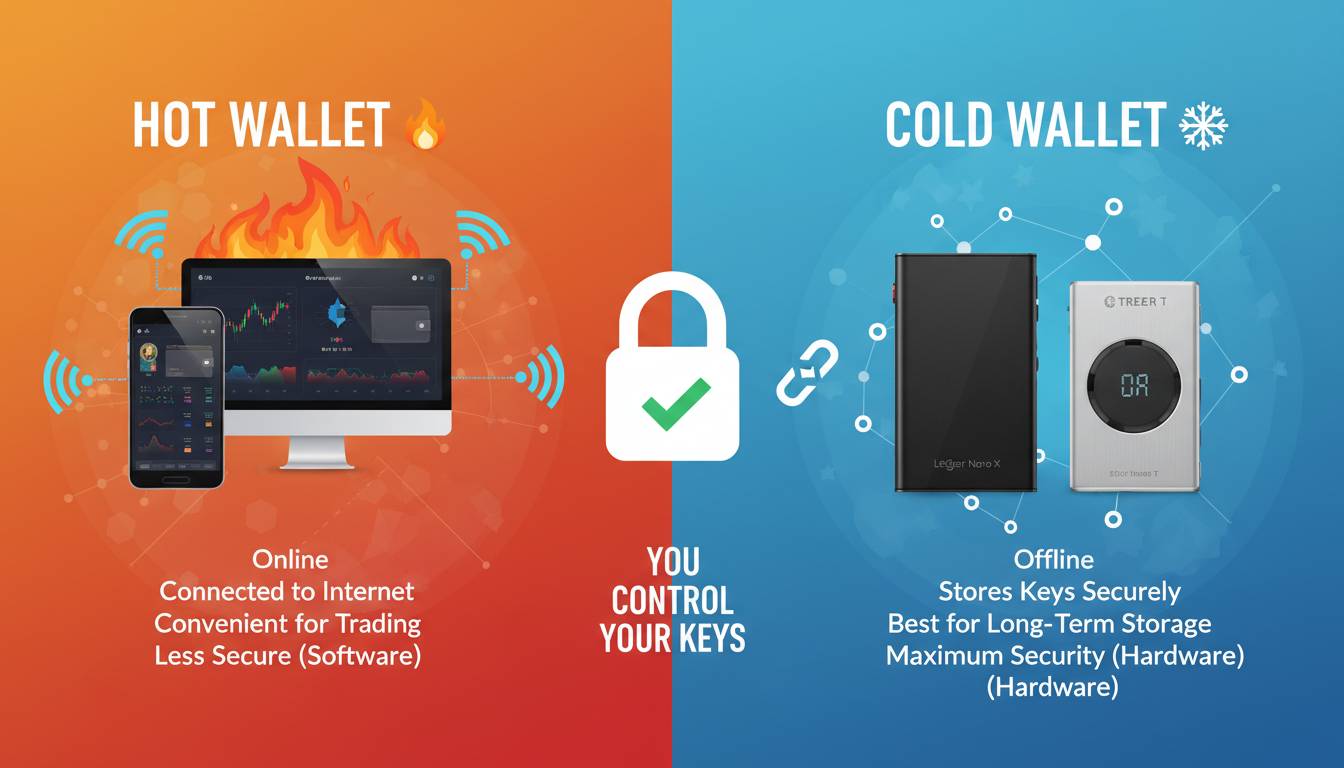
New cryptocurrencies carry higher risk than established assets due to lower liquidity, less battle-tested code, and higher failure rates. Only invest capital you can afford to lose entirely, use hardware wallets for storage, verify team identities, review security audits, and start with small position sizes that you can scale after demonstrating sustained value.
How do I evaluate a new cryptocurrency before investing?
Apply the fundamental analysis framework: verify identifiable teams with relevant experience, examine GitHub for development activity, review security audit reports, analyze tokenomics for fair distribution, assess real utility beyond speculation, and check community engagement quality. Projects meeting all criteria still fail—diversification remains essential.
When is the best time to buy new cryptocurrencies?
Dollar-cost averaging into positions over time reduces timing risk. New cryptocurrency launches often experience initial price discovery volatility, so waiting for stability before establishing positions often proves prudent. Avoid FOMO-driven decisions during social media-driven price spikes.
What percentage of my portfolio should be in new cryptocurrencies?
Conservative guidance suggests new cryptocurrency allocations (beyond Bitcoin and Ethereum) should not exceed 10-15% of total crypto holdings, with individual position sizes limited to 1-3% each. This ensures successful bets can meaningfully impact returns while failed investments don’t cause permanent capital impairment.
Are new cryptocurrencies better than established ones?
Not inherently. Newer cryptocurrencies offer higher growth potential but correspondingly higher risk. Established cryptocurrencies like Bitcoin and Ethereum have demonstrated network effects, security through network usage, and institutional adoption that newer projects must earn. Most portfolio frameworks emphasize established assets as core holdings with newer tokens as satellite positions.
Conclusion: Navigating the 2024 Cryptocurrency Opportunity
The cryptocurrency market in 2024 offers genuine innovation beyond previous cycles’ speculation. Layer-2 solutions have achieved functional scaling, institutional infrastructure has matured through ETF approvals, and real-world asset tokenization bridges traditional finance with blockchain technology.
For investors exploring new cryptocurrency opportunities, the path forward requires shifting focus from hype-driven narratives to fundamental analysis. Projects with identifiable teams, audited code, sustainable tokenomics, and demonstrable utility position themselves for long-term success amid market volatility.
Remember: cryptocurrency investment carries substantial risk, and the market remains highly speculative. This guide provides educational context for understanding the 2024 landscape—never investment advice. Conduct thorough research, maintain diversification, and only invest capital you can afford to lose entirely.
The most successful participants in this space treat cryptocurrency as a learning journey rather than a get-rich-quick scheme. Stay curious, remain skeptical of guarantees, and build your understanding incrementally.