How to Start Investing for Beginners: A Step-by-Step Guide

Investing remains one of the most effective ways to build long-term wealth, yet nearly 60% of Americans report feeling uncertain about how to begin. If you’ve ever felt overwhelmed by financial jargon, intimidated by the stock market, or unsure where your first dollar should go, you’re not alone—and this guide is designed specifically for you. By the end of this article, you’ll understand exactly how to start investing with confidence, regardless of your current income level or financial background.
Key Insights
– The S&P 500 has delivered an average annual return of approximately 10% since its inception in 1926
– Financial experts recommend starting to invest as early as possible to leverage compound interest
– You can begin investing with as little as $1 through modern fractional share platforms
– Employer-sponsored retirement accounts often include matching contributions—free money you’re leaving on the table if you don’t participate
Why Investing Matters More Than You Think
The difference between saving and investing becomes staggering over time. While traditional savings accounts currently offer interest rates around 0.5% to 4% annually, the stock market has historically averaged 7% to 10% per year after adjusting for inflation. This difference isn’t minor—it compounds dramatically over decades.
Consider this scenario: two individuals begin investing at age 25. Person A invests $200 monthly until age 65, earning an average 8% annual return. Person B waits until age 35 and invests the same $200 monthly at the same rate. By age 65, Person A will have approximately $520,000, while Person B will have only about $225,000—despite investing for ten fewer years. That decade-long delay cost Person B nearly $300,000 in potential growth.
This power of compound interest—earning returns on your returns—makes investing essential for anyone building long-term wealth. According to research from J.P. Morgan Asset Management, a $10,000 investment in the S&P 500 in 1980 would have grown to over $1.1 million by 2023, demonstrating the exponential potential of patient, consistent investing.
Beyond growth potential, investing provides protection against inflation. When you keep money entirely in cash, inflation gradually erodes your purchasing power. In contrast, investments historically outpace inflation, preserving and increasing your money’s real value over time.
Core Investment Concepts Every Beginner Must Understand
Before committing your first dollar, grasp these fundamental concepts that govern investment success.
Stocks vs. Bonds: The Fundamental Distinction
Stocks represent ownership shares in a company. When you buy stock, you become a partial owner and benefit from the company’s growth—and conversely, you lose value if the company performs poorly. Stocks generally offer higher potential returns but come with greater volatility.
Bonds function as loans to companies or governments. When you purchase a bond, you’re lending money in exchange for regular interest payments and the return of your principal at maturity. Bonds typically provide lower returns than stocks but offer greater stability and predictable income.
Most financial experts recommend holding a mix of stocks and bonds, with the ratio shifting toward more conservative investments as you approach retirement.
Understanding Risk and Your Personal Risk Tolerance
All investments carry some degree of risk. Risk tolerance refers to your ability and willingness to lose some or all of your initial investment in exchange for potentially greater returns. This depends on factors including your age, income stability, financial goals, and emotional comfort with market fluctuations.
Younger investors typically have higher risk tolerance because they have more time to recover from market downturns. Older investors near retirement often prefer stability over growth potential. Understanding your risk tolerance helps you build a portfolio that lets you sleep at night while still working toward your goals.
The Power of Diversification
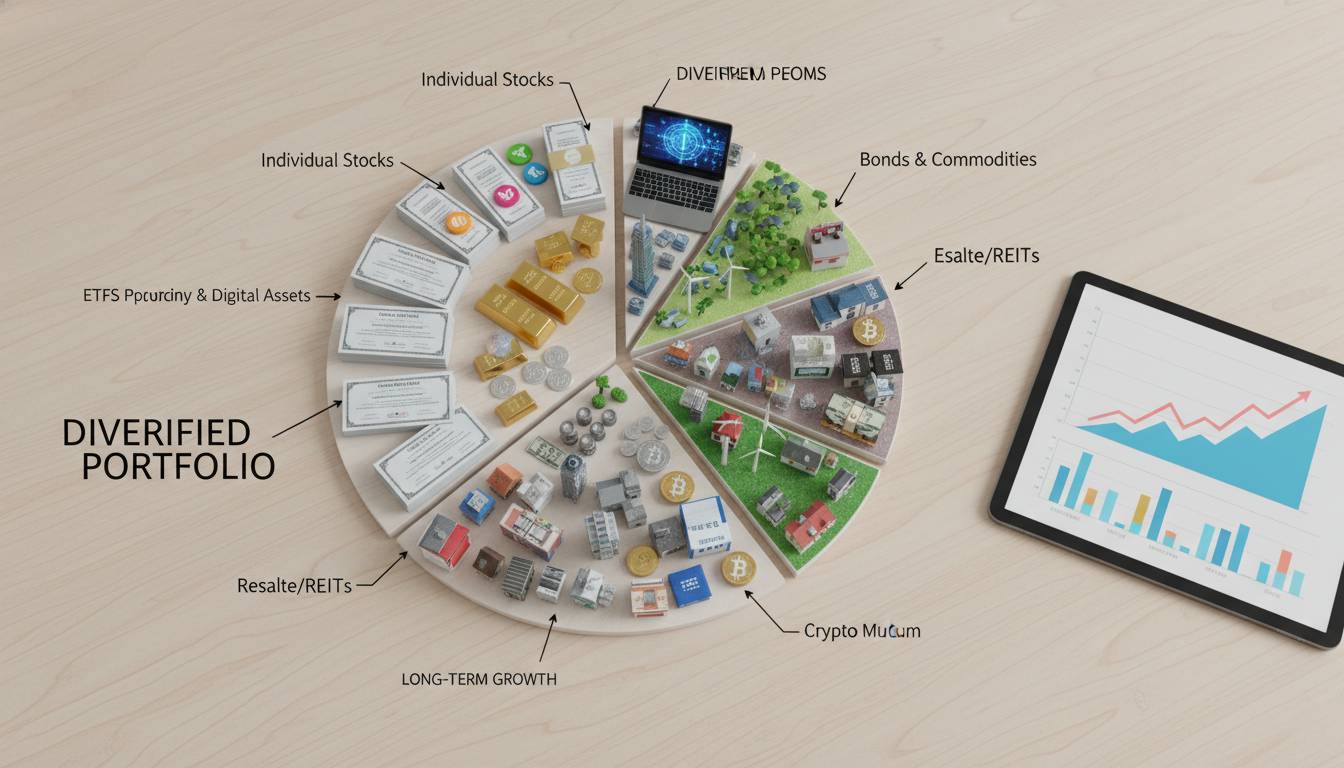
“Don’t put all your eggs in one basket” applies directly to investing. Diversification means spreading your investments across different asset classes, industries, and geographic regions. When one investment performs poorly, others may perform well, balancing your overall returns and reducing risk.
Modern portfolio theory, developed by Nobel Prize-winning economist Harry Markowitz, demonstrates that you can reduce portfolio risk without sacrificing expected returns through strategic diversification. Index funds and exchange-traded funds (ETFs) provide easy, low-cost diversification for beginners.
How to Start Investing: A Step-by-Step Process
Starting your investment journey involves these concrete steps, designed to build your portfolio systematically while minimizing costly mistakes.
Step 1: Establish Your Financial Foundation
Before investing, ensure you’ve addressed these financial priorities:
- Emergency fund: Build 3-6 months of living expenses in a high-yield savings account before investing. This prevents you from needing to sell investments during market downturns to cover unexpected expenses.
- High-interest debt payoff: Pay off credit card balances and other high-interest debt. Earning 15-20% on investments while paying 20%+ on credit cards creates a negative return scenario.
- Employer 401(k) match: Contribute enough to your employer’s retirement plan to receive the full matching contribution. This instant 50-100% return on your money exceeds anything the market guarantees.
Step 2: Choose Your Investment Account
For most beginners, these account types serve specific purposes:
| Account Type | Best For | Tax Benefits | Key Features |
|---|---|---|---|
| 401(k) | Employees with employer match | Pre-tax contributions | Employer matching, contribution limits |
| IRA | Individuals without 401(k) access | Tax-deferred growth | Annual contribution limits ($7,000 for 2024) |
| Roth IRA | Lower tax bracket earners | Tax-free growth | After-tax contributions, tax-free withdrawals |
| Brokerage | Goals before retirement | Capital gains treatment | Flexible withdrawals, no contribution limits |
If your employer offers a 401(k) with matching funds, prioritize contributing enough to receive the full match before opening a separate brokerage account. For self-employed individuals, consider a SEP-IRA or Solo 401(k).
Step 3: Select Your Investment Strategy
Your investment strategy should align with your goals, timeline, and risk tolerance.
Target-date funds automatically adjust their asset allocation as you approach a specific retirement date. If you plan to retire around 2060, selecting a “2060 Target Date Fund” provides a diversified portfolio that starts aggressive and gradually becomes more conservative. This “set it and forget it” approach suits many beginners.
Index funds track specific market benchmarks like the S&P 500, offering broad market exposure with minimal fees. These funds consistently outperform actively managed funds over time, largely because active managers’ fees drag down returns.
Robo-advisors provide automated, algorithm-driven portfolio management based on your goals and risk tolerance. Services like Betterment, Wealthfront, and Fidelity Go construct diversified portfolios, rebalance automatically, and charge low advisory fees—typically 0.25% to 0.35% annually.
Step 4: Make Your First Investment
Once your account is funded, purchasing your first investment requires these steps:
- Research your selected fund or stock: Review the expense ratio (aim for below 0.20% for index funds), historical performance, minimum investment, and underlying holdings.
- Place your order: Through your brokerage’s platform, select “Buy” and enter the dollar amount or number of shares. For beginners, dollar-cost averaging—investing a fixed amount regularly—reduces timing risk.
- Confirm and monitor: Review your confirmation, then check your portfolio periodically without reacting to daily market movements.
Modern brokerages like Fidelity, Charles Schwab, Vanguard, and Robinhood offer user-friendly mobile apps that make investing as simple as ordering products online.
Investment Options Explained: Finding What Works for You
Understanding different investment types helps you construct a portfolio matching your goals.
Index Funds and ETFs
Index funds and ETFs provide instant diversification by holding hundreds or thousands of stocks or bonds in a single investment. Popular options include:
| Fund Type | Example | What It Holds | Expense Ratio |
|---|---|---|---|
| Total Stock Market | VTSAX | 4,000+ US stocks | 0.04% |
| S&P 500 Index | VOO | 500 large US companies | 0.03% |
| Total Bond Market | BND | 10,000+ bonds | 0.03% |
| International Stock | VXUS | Non-US companies | 0.07% |
These funds typically outperform most actively managed alternatives after fees, making them ideal for beginner investors.
Individual Stocks
Purchasing individual company stocks offers potentially higher rewards but requires more research and carries greater risk. Successful stock investing demands understanding financial statements, competitive positioning, and industry trends.
For most beginners, building a diversified portfolio through funds provides better risk-adjusted returns than picking individual stocks. If you want to include individual stocks, limit them to 5-10% of your portfolio to maintain diversification.
Mutual Funds
Mutually funds pool money from multiple investors to purchase diversified portfolios managed by professional fund managers. While active management theoretically provides alpha (returns above the market), most mutual funds underperform index funds after fees. Additionally, mutual funds often require minimum investments of $1,000 to $3,000, creating higher barriers than ETFs.
Common Investment Mistakes to Avoid
Learning from others’ mistakes proves far less expensive than making them yourself.
Mistake #1: Trying to Time the Market
Attempting to buy at market bottoms and sell at peaks rarely works. Research from Dalbar Associates shows the average investor earns significantly less than market indices—primarily due to emotional decisions to buy during peaks and sell during downturns. Consistent, regular investing through dollar-cost averaging consistently outperforms market timing strategies.
Mistake #2: Ignoring Fees
Fees compound dramatically over time. A 1% annual fee on a $500,000 portfolio costs approximately $150,000 in lost growth over 30 years compared to a 0.04% index fund fee. Always review expense ratios before investing, and understand any transaction fees your brokerage charges.
Mistake #3: Reacting to Market Volatility
Market downturns create panic, but they’re normal. The S&P 500 has experienced numerous 20%+ declines, including during the 2008 financial crisis and the 2020 pandemic—yet it has always recovered and reached new highs. Selling during downturns “locks in” losses and prevents participation in recoveries.
Mistake #4: Failing to Rebalance
Over time, some investments grow faster than others, shifting your portfolio away from your intended allocation. Annual rebalancing—selling winning investments and buying underperforming ones—maintains your target risk level and forces the disciplined practice of “buying low, selling high.”
Building Your Long-Term Investment Strategy
Successful investing requires more than opening an account and buying funds. A thoughtful strategy addresses your complete financial picture.
Define Clear Goals
Specific goals with timelines guide your investment decisions. Are you saving for retirement at 65? A house down payment in five years? Your child’s education in 18 years? Each goal suggests different investment approaches and risk tolerances.
Automate Your Contributions
Setting up automatic monthly transfers removes emotional decision-making and ensures consistent investing. Research from Vanguard finds investors who automate contributions significantly outperform those who invest sporadically, regardless of market conditions.
Continue Learning
The investment landscape evolves constantly. Stay informed through reputable sources like the Journal of Financial Planning, Investment News, and your brokerage’s educational resources. However, avoid information overload—simple, consistent strategies typically outperform complex approaches.
Frequently Asked Questions
How much money do I need to start investing?
You can begin investing with as little as $1 through brokerages offering fractional shares. Many index funds and ETFs have no minimum investment requirements beyond the share price. Some retirement accounts require $1,000 to $3,000 minimums, though options exist with lower or no minimums.
Is investing in stocks safe for beginners?
All investing carries risk, but stocks remain one of the most proven long-term wealth-building tools. Beginners can manage risk through diversification (index funds), investing for long horizons, and avoiding emotional reactions to market volatility. Historical evidence shows patient, diversified investors have historically been rewarded.
What’s the difference between a 401(k) and an IRA?
A 401(k) is an employer-sponsored retirement account with higher contribution limits ($23,000 for 2024) and potential employer matching. An IRA is an individual account with lower limits ($7,000 for 2024) but more investment options. Both offer tax advantages; 401(k)s typically offer traditional (pre-tax) contributions while IRAs often allow Roth (after-tax) options.
When should I start investing?
Financial experts universally recommend starting as early as possible to maximize compound growth. Even starting with small amounts creates valuable habits and gives your money more time to grow. The second-best time to start is today—waiting costs you potential growth you’ll never recover.
Conclusion
Starting your investment journey doesn’t require expertise, large sums of money, or complicated strategies. By establishing your financial foundation, choosing appropriate accounts, investing in diversified low-cost index funds, and maintaining consistent contributions regardless of market conditions, you position yourself for long-term wealth building.
Remember that every expert investor began exactly where you are now. The most important step is starting—however small—rather than waiting for the “perfect” moment that never arrives. Your future self will thank you for beginning today.