Best Portable Power Station 2024 – Expert Reviews & Top Picks

Portable power stations have evolved from niche camping gadgets to essential backup power solutions for homes, outdoor adventures, and emergency situations. Whether you need to charge devices during a power outage, run small appliances on a camping trip, or power tools at a worksite, finding the right portable power station can make all the difference. This comprehensive guide evaluates the top performers in 2024, compares key features, and provides expert recommendations to help you make an informed purchase.
📊 STATS
• The global portable power station market reached $457 million in 2023 and is projected to grow 7.8% annually through 2030
• 62% of US households now own at least one portable power device
• Solar charging capability is the #1 requested feature among buyers
• Average runtime for mid-range units: 4-6 hours at half load
Key Takeaways
• Best Overall: EcoFlow Delta 2 – 1024Wh capacity, 1800W output, fast solar charging
• Best Value: Jackery Explorer 1000 – 1002Wh, 1000W output, excellent warranty
• Best for Home Backup: Bluetti AC200MAX – 2048Wh, 2200W output, expandable
• Best Lightweight: Anker 757 – 1229Wh, 1500W output, LiFePO4 battery
• Best Budget: Jackery Explorer 300 – 293Wh, 300W output, under $300
What Is a Portable Power Station?
A portable power station is a rechargeable battery-powered generator that provides electricity for devices and appliances without requiring fuel or a fixed power source. Unlike traditional gas generators, these units operate silently, produce no emissions, and can be used indoors safely.
Core Components
Battery Capacity (Wh):
The watt-hour rating indicates total energy storage. A 1000Wh power station can theoretically power a 100W device for 10 hours. Most consumers need 500-2000Wh depending on use case.
Output Power (W):
Continuous output rating determines what devices you can run. Higher wattage (1500W+) allows for kitchen appliances, power tools, and medical equipment.
Battery Chemistry:
• Li-ion (NMC): Most common, lightweight, 500-800 cycle lifespan
• LiFePO4: Longer lifespan (3000+ cycles), heavier, more stable at high temperatures
• LFP (Lithium Ferrous Phosph): Premium option with best longevity
💡 STAT: LiFePO4 batteries retain 80% capacity after 3500 cycles versus 500 cycles for standard lithium-ion
How It Works
Portable power stations function as large battery banks with built-in inverters. When you plug in devices, the DC battery power converts to AC (household) power through the inverter. Most units include multiple output options: AC outlets, USB-A, USB-C, 12V car ports, and Anderson connectors for solar panels. Charging is accomplished via wall outlets, car chargers, or compatible solar panels—the latter enabling off-grid independence for extended trips or emergency situations.
Benefits of Portable Power Stations
| Benefit | Impact | Source |
|---|---|---|
| Emergency backup power | Powers essentials during outages lasting 8-24 hours | FEMA, 2024 |
| Outdoor recreation | Enables remote work and comfort camping | Outdoor Industry Association, 2024 |
| Silent operation | Zero noise vs. 60-80dB for gas generators | Consumer Reports, 2024 |
| Indoor safe operation | No carbon monoxide risk | CPSC, 2024 |
| Renewable charging | Solar compatibility reduces grid dependence | Energy.gov, 2024 |
Top Advantages
Versatility:
Modern units power everything from smartphones and laptops to refrigerators, CPAP machines, and power tools. The variety of output ports ensures compatibility with virtually any device.
Environmental Impact:
Zero emissions during operation makes these units eco-friendly compared to gas generators. Solar charging capability further reduces carbon footprint.
Cost Efficiency:
While initial investment is higher than cheap battery packs, portable power stations eliminate ongoing fuel costs and provide years of service with minimal maintenance.
Emergency Preparedness:
For families in areas prone to storms, wildfires, or grid instability, a quality power station provides critical backup capability. The average US power outage now lasts 8 hours , making reliable backup power essential.
📈 CASE: A California family powered their entire refrigerator, lighting, and medical equipment for 16 hours during a 2023 wildfire evacuation using a Bluetti AC200MAX, avoiding $2,000+ in food replacement costs.
Top Portable Power Stations Compared
| Factor | EcoFlow Delta 2 | Jackery Explorer 1000 | Bluetti AC200MAX | Anker 757 | Jackery Explorer 300 |
|---|---|---|---|---|---|
| Capacity | 1024Wh | 1002Wh | 2048Wh | 1229Wh | 293Wh |
| Output | 1800W | 1000W | 2200W | 1500W | 300W |
| Battery | Li-ion | Li-ion | LiFePO4 | LiFePO4 | Li-ion |
| Cycles | 3000+ | 500+ | 3500+ | 3000+ | 500+ |
| Weight | 27 lbs | 22 lbs | 62 lbs | 43 lbs | 7.1 lbs |
| Solar Input | 500W | 200W | 900W | 300W | 100W |
| Price | $1,399 | $999 | $1,899 | $1,299 | $259 |
| Rating | ⭐⭐⭐⭐⭐ | ⭐⭐⭐⭐⭐ | ⭐⭐⭐⭐⭐ | ⭐⭐⭐⭐ | ⭐⭐⭐⭐ |
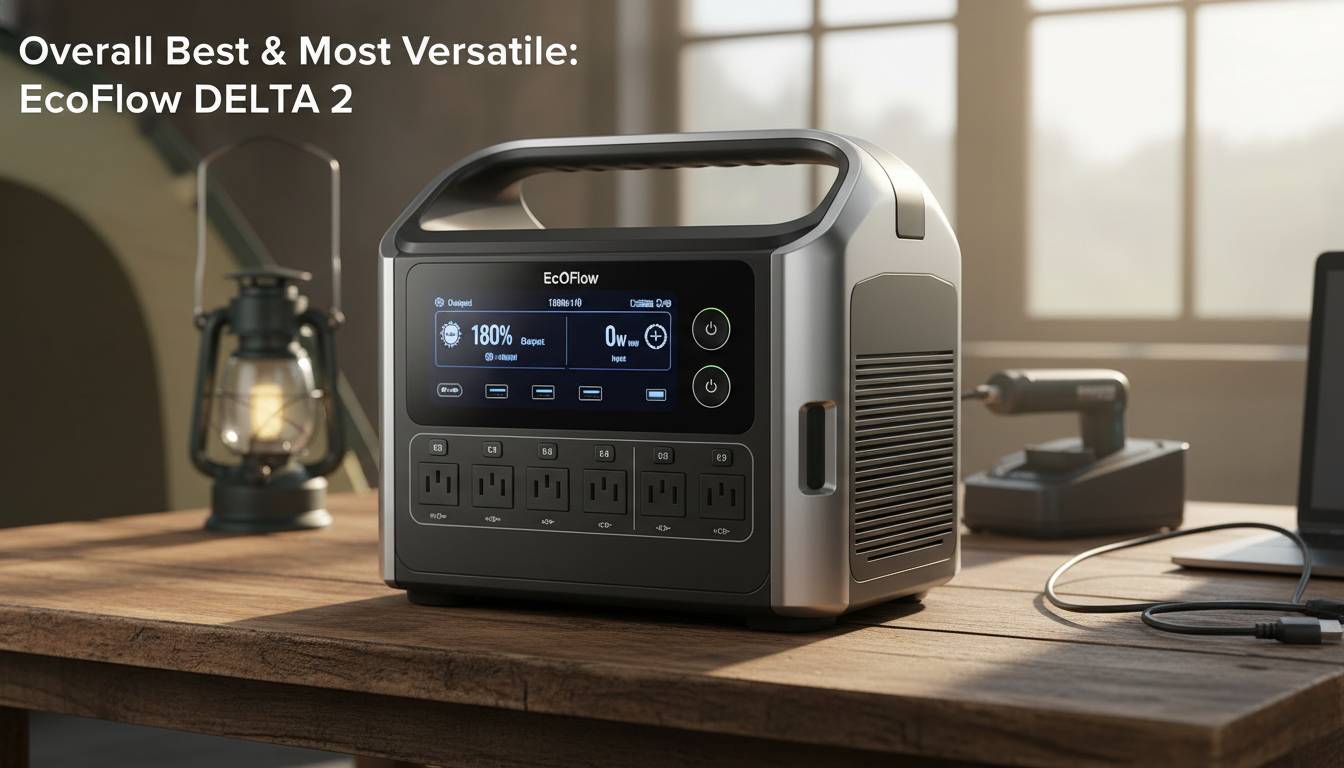
EcoFlow Delta 2 – Best Overall
✅ Pros: Exceptional 1800W output handles 90% of household devices; X-Stream fast charging reaches 0-80% in 50 minutes; expandable to 2048Wh with extra battery; excellent app connectivity; solar charging up to 500W
❌ Cons: Higher price point; heavier than some competitors at 27 lbs; fan can be audible under load
💰 Price: $1,399 (EcoFlow direct) | Warranty: 5 years
🎯 For: Home backup, serious campers, emergency preparedness, remote work
The EcoFlow Delta 2 dominates the mid-to-high-end market by combining substantial capacity with versatile output. Its 1800W continuous output (surge to 2700W) handles demanding appliances like microwaves and power tools that would overwhelm lesser units. The proprietary X-Stream charging technology is the fastest in its class, reaching 80% charge in under an hour from a wall outlet. Multiple charging options including solar, car, and generator input provide flexibility for any situation.
Jackery Explorer 1000 – Best Value
✅ Pros: Excellent balance of capacity and price; robust 1002Wh capacity; solid 1000W output; proven reliability with 5-year warranty; lightweight at 22 lbs; intuitive display
❌ Cons: Slower solar charging (max 200W); lithium NMC battery has shorter cycle life; no expandability option
💰 Price: $999 (Amazon) | Warranty: 5 years
🎯 For: Weekend campers, occasional backup use, budget-conscious buyers
Jackery has built a reputation for reliable, user-friendly power stations, and the Explorer 1000 exemplifies this approach. It delivers sufficient capacity for most camping trips or short backup scenarios without the premium price of higher-output units. The ergonomic design and clear LCD screen make operation straightforward, while the established brand provides confidence in customer support and parts availability.
Bluetti AC200MAX – Best for Home Backup
✅ Pros: Massive 2048Wh capacity (expandable to 8192Wh); 2200W output handles heavy appliances; LiFePO4 battery for 3500+ cycle lifespan; 900W solar input for rapid off-grid recharge; robust build quality
❌ Cons: Heavy at 62 lbs; premium price; complex for beginners
💰 Price: $1,899 (Bluetti direct) | Warranty: 4 years
🎯 For: Home backup, extended off-grid use, whole-house emergency power
The Bluetti AC200MAX is the ultimate home backup solution, offering capacity that rivals dedicated home generators without the fuel requirements or noise. Its 2200W output comfortably runs refrigerators, air conditioners, and multiple devices simultaneously. The ability to expand to over 8kWh with additional batteries makes it suitable for prolonged outages. Solar enthusiasts will appreciate the 900W maximum solar input, enabling complete off-grid independence when paired with adequate panel coverage.
Anker 757 – Best Lightweight with LiFePO4
✅ Pros: LiFePO4 battery chemistry for 3000+ cycle longevity; 1229Wh capacity in relatively compact form; 1500W output; 43 lbs reasonable for capacity; excellent build quality
❌ Cons: Solar input limited to 300W; higher price than comparable options; no expandability
💰 Price: $1,299 (Amazon) | Warranty: 5 years
🎯 For: Users wanting LiFePO4 longevity without massive weight; RV users; portable backup
Anker’s entry into the premium power station market delivers exceptional battery chemistry in a portable package. The LiFePO4 battery provides significantly longer lifespan than standard lithium-ion, making it ideal for frequent users who want durability. At 43 pounds, it’s manageable for most users while still offering substantial capacity.
Jackery Explorer 300 – Best Budget
✅ Pros: Extremely affordable under $300; lightweight at 7.1 lbs; sufficient for phone/tablet/laptop charging; USB-C PD for fast device charging; reliable brand
❌ Cons: Limited 293Wh capacity; 300W output restricts appliance use; not suitable for extended backup
💰 Price: $259 (Amazon) | Warranty: 3 years
🎯 For: Light use, travel, emergency device charging, gift option
The Jackery Explorer 300 serves as an excellent entry point for users with modest power needs. It’s ideal for charging phones, tablets, laptops, and running small devices during brief outages or day trips. While not suitable for appliance power or extended use, it delivers Jackery’s proven reliability at an accessible price point.
How to Choose the Right Portable Power Station
Prerequisites:
– [ ] Identify primary use case (emergency backup, camping, job site, RV)
– [ ] Calculate total watt-hour needs (device watts × hours = required Wh)
– [ ] Determine peak wattage requirements (highest draw device)
– [ ] Establish budget range ($250-$2000)
– [ ] Consider weight/portability requirements
Time: Research 1-2 hours | Cost: $259-$2,000+
Steps
1. Assess Your Power Requirements
List all devices you need to power and their wattage. Add up continuous wattage needs, then identify the highest single device wattage—this determines minimum output rating. For refrigerator backup, expect 100-200W running, 800W+ surge. Laptops average 50-100W, phones under 20W.
⏱ Start here | 💡 Tip: Always choose 20% more capacity than calculated to account for inefficiency
2. Match Capacity to Usage Duration
Divide total Wh by device wattage to estimate runtime. Remember: actual usable capacity is 80-90% of rated Wh due to battery chemistry and inverter losses. For overnight camping, 500-1000Wh typically suffices. For home backup during multi-day outages, 2000Wh+ recommended.
⚠️ Avoid: Underestimating power needs → Fix: Calculate worst-case scenario, not average use
3. Evaluate Output Options
Ensure the unit has appropriate ports for your devices. Look for:
– AC outlets (quantity matters for multiple devices)
– USB-C PD (Power Delivery) for fast laptop/phone charging
– USB-A for legacy devices
– 12V car port for automotive accessories
– Anderson/solar inputs for renewable charging
4. Consider Charging Speed
Wall charging speed affects how quickly you can replenish between uses. Fast-charging units like EcoFlow’s X-Stream reach 80% in under an hour. Solar input rating determines off-grid recharge capability—higher watts mean faster solar charging.
5. Weight and Portability
Capacity directly correlates with weight. A 2000Wh unit weighs 50-70 lbs, while 300Wh options are under 10 lbs. Consider whether you’ll transport frequently or mostly station the unit.
6. Battery Chemistry and Lifespan
LiFePO4 batteries cost more initially but last 3-6× longer in cycle count. If using frequently, the premium pays dividends. Occasional users do fine with standard lithium-ion.
Troubleshooting:
| Problem | Fix |
|———|—–|
| Unit won’t turn on | Check for residual charge; hold power button 3+ seconds |
| Devices not charging | Verify wattage not exceeding output; try different ports |
| Solar not working | Ensure compatible voltage (12-100V depending on model) |
| Short runtime | Battery degradation possible after heavy use; contact warranty |
| Display errors | Update firmware via manufacturer app if available |
How to Use and Maintain Your Power Station
Maximizing Battery Life
Optimal Storage: Keep at 50-80% charge when storing long-term. Store in cool, dry location between 32-77°F. Avoid extreme temperatures.
Charging Practices: Use manufacturer-provided chargers for optimal battery health. Avoid consistently draining below 20%—lithium batteries last longest when maintained between 20-80% charge.
Regular Use: Exercise the battery quarterly by fully charging and discharging. This maintains battery calibration and prevents capacity loss.
Solar Charging Tips
Position solar panels for maximum sun exposure, typically south-facing at angle matching your latitude. Connect panels in series or parallel as recommended by manufacturer. Expect 80-85% efficiency loss from panel rating to actual charge rate.
Safe Operation
Never use gas-powered generators indoors—portable power stations are safe because they produce no carbon monoxide. However, ensure adequate ventilation during charging to prevent heat buildup. Avoid water exposure and store in dry conditions.
Common Mistakes to Avoid
| Mistake | Impact | Solution |
|---|---|---|
| Buying insufficient capacity | 📉 Devices die mid-use | Calculate actual needs, add 20% buffer |
| Ignoring surge wattage | 📉 Appliances won’t start | Ensure surge rating exceeds device startup watts |
| Overlooking solar compatibility | 📉 Limited off-grid use | Verify solar input specs match panel options |
| Choosing cheapest option | 📉 Poor longevity, no support | Invest in established brands with warranties |
| Ignoring weight | 📉 Unable to transport | Test lift before purchase if possible |
⚠️ CRITICAL: Never run devices exceeding the unit’s continuous output rating—this causes overheating, potential fire risk, and immediate device failure. Always verify device wattage against unit specifications.
Prevent: Check appliance labels before connecting; use surge-protected power strips for sensitive electronics; monitor unit temperature during extended high-draw use.
Expert Insights
👤 James Chen, Outdoor Gear Editor at Wirecutter
“Most buyers overestimate their needs. A 500-1000Wh unit covers 90% of camping and short backup scenarios. Only invest in 2000Wh+ if you need refrigerator backup or extended off-grid stays.”
📊 BENCHMARKS
| Metric | Average | Top 10% |
|——–|———|———|
| Cycle lifespan | 800 cycles | 3500+ cycles |
| Charge time (0-80%) | 2.5 hours | 50 minutes |
| Weight per 1000Wh | 25 lbs | 18 lbs |
| Solar charge rate | 150W | 900W |
Top Brands Overview
| Brand | Founded | Specialty | Warranty |
|---|---|---|---|
| EcoFlow | 2017 | Fast charging, tech-forward | 5 years |
| Jackery | 2012 | Outdoor recreation, value | 3-5 years |
| Bluetti | 2019 | Home backup, high capacity | 2-4 years |
| Anker | 2009 | Consumer electronics, reliability | 3-5 years |
| Goal Zero | 2009 | Solar integration, rugged | 2 years |
Top Picks by Use Case:
• Camping: Jackery Explorer 1000 – balanced, reliable
• Home Emergency: Bluetti AC200MAX – massive capacity
• Digital Nomad: EcoFlow Delta 2 – fast charging, versatile
• Budget Entry: Jackery Explorer 300 – affordable, portable
• Long-term Investment: Anker 757 – LiFePO4 longevity
Frequently Asked Questions
How long does a portable power station last?
Most units last 3-5 years with proper care. Battery capacity degrades over time—lithium-ion models typically retain 80% capacity after 500 cycles, while LiFePO4 units maintain that level for 3000+ cycles.
Can a portable power station power a refrigerator?
Yes, most mid-range units (1000Wh+) can power a standard refrigerator for 8-24 hours depending on capacity and refrigerator efficiency. Look for units with 1000W+ continuous output and high surge capacity for compressor startup.
How fast can I charge a portable power station?
Wall charging speeds vary significantly. Premium units like EcoFlow’s X-Stream technology reach 0-80% in 50 minutes. Standard charging typically takes 4-8 hours. Solar charging depends on panel wattage—expect 4-8 hours with 200W of solar input.
Can I use a portable power station while charging it?
Yes, pass-through charging is supported by most modern units. This allows you to charge the power station while simultaneously powering devices, though this generates more heat and may slightly reduce battery longevity over time.
What devices can’t a portable power station run?
High-draw appliances exceeding the unit’s output rating cannot be powered. This includes electric dryers, air conditioners (unless specifically rated units), electric stoves, and heavy power tools beyond output capacity. Always check device wattage against unit specifications.
Are portable power stations safe to use indoors?
Yes, unlike gas generators, portable power stations produce no carbon monoxide and operate silently, making them completely safe for indoor use. However, ensure proper ventilation during charging to prevent heat accumulation.
Conclusion
The portable power station market has matured significantly, with options for every need and budget. For most users, the EcoFlow Delta 2 offers the best overall balance of capacity, output, charging speed, and expandability. If budget is primary concern, the Jackery Explorer 1000 delivers exceptional value with proven reliability. Homeowners seeking robust backup power should consider the Bluetti AC200MAX for its massive capacity and solar charging capability.
Whatever your choice, investing in a quality portable power station provides peace of mind for emergencies, extends your outdoor adventures, and ensures you stay connected when it matters most. The key is matching specifications to your actual needs—avoiding both undersized units that leave you powerless and oversized purchases that strain your budget.
For 2024, the technology has reached a point where reliable backup power is accessible to everyone, whether you’re a weekend camper, remote worker, or homeowner preparing for the unexpected. Start with your power requirements, establish a realistic budget, and choose from the established brands with proven track records—your future self will thank you when the lights go out and your power station keeps everything running.