5G Network Coverage Map – Find Fastest Signal in Your Area ✓

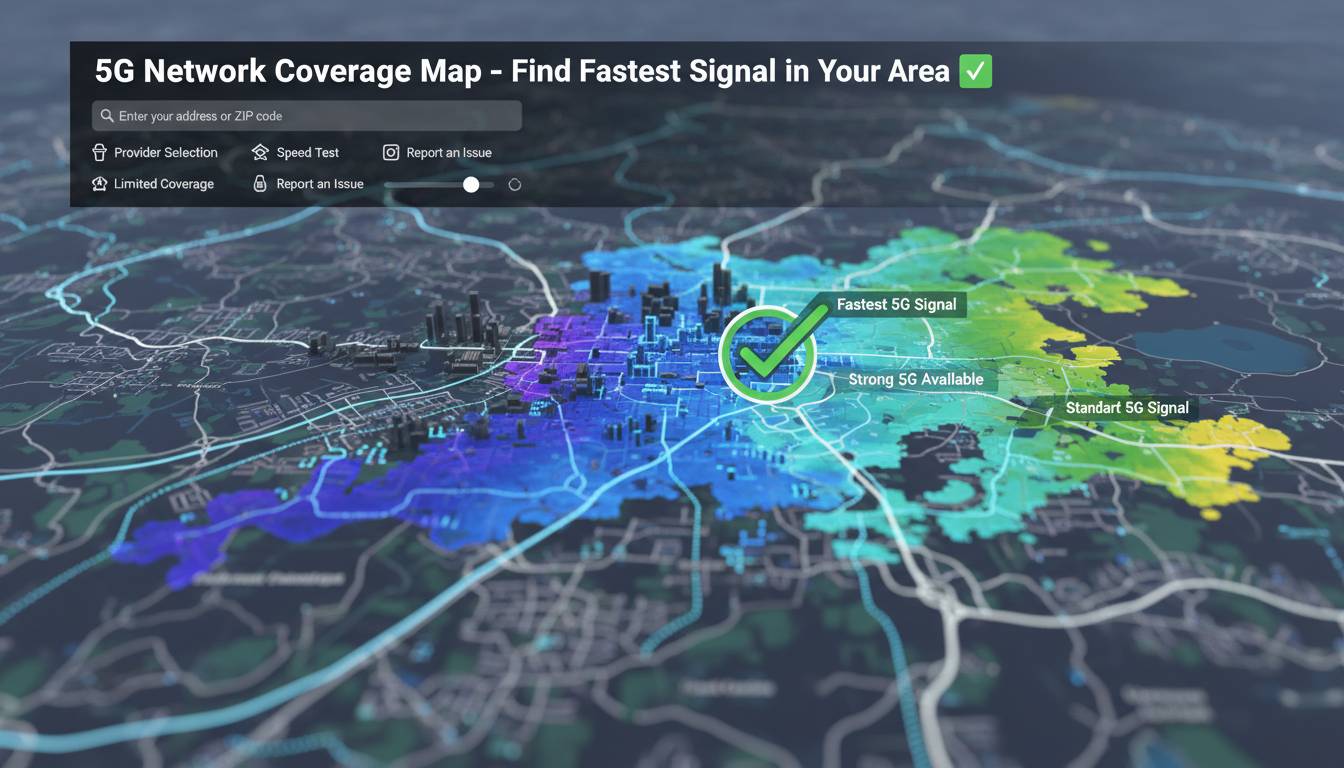
5G network coverage in the United States has expanded dramatically since 2019, with the three major carriers—Verizon, AT&T, and T-Mobile—now collectively covering over 300 million people with some form of 5G service. However, not all 5G is created equal, and understanding the differences between coverage types, carrier networks, and how to measure actual signal quality in your specific location is essential for making informed decisions about your wireless service.
This guide walks you through everything you need to know about 5G coverage in the US: how it works, which carriers offer the best service in your area, the technical distinctions between 5G types, and practical tools for finding the fastest signal available where you live and work.
How 5G Network Coverage Works in the United States
5G represents the fifth generation of wireless cellular technology, succeeding 4G LTE. Unlike its predecessor, 5G operates across three distinct frequency bands, each with different characteristics that directly impact coverage area and speed.
The low-band spectrum (below 1 GHz) provides the widest coverage but the slowest 5G speeds—typically 20-50% faster than 4G LTE. This spectrum penetrates buildings effectively and travels long distances, making it ideal for rural and suburban coverage. The mid-band spectrum (1-6 GHz) offers a balance between coverage and speed, delivering 2-4 times faster than 4G while still reaching reasonable distances from cell towers. The high-band millimeter wave (mmWave) spectrum (24+ GHz) delivers the fastest possible speeds—potentially 10 times faster than 4G—but has extremely limited coverage, typically reaching only a few hundred meters from towers and struggling to penetrate walls or vegetation.
The FCC has conducted multiple spectrum auctions since 2019, with the C-band auction in 2021 proving particularly significant. AT&T and Verizon spent over $68 billion combined acquiring mid-band spectrum, which now forms the backbone of their faster 5G networks. T-Mobile’s acquisition of Sprint’s 2.5 GHz mid-band holdings gave the carrier an early advantage in mid-band 5G deployment.
Understanding these distinctions matters because carriers frequently market “5G” coverage without specifying which type of spectrum powers the connection in your area. A phone showing a 5G icon in rural America may connect to low-band 5G that barely outperforms 4G, while the same phone in a urban core might access mmWave delivering blistering speeds.
Major Carrier 5G Coverage Comparison
The three largest US carriers have taken markedly different approaches to 5G deployment, resulting in varying coverage maps, speed profiles, and service availability across different regions.
| Carrier | 5G Coverage (Population) | Primary Spectrum Type | Peak Speeds |
|---|---|---|---|
| T-Mobile | 325+ million | Low-band + 2.5 GHz mid-band | 300-400 Mbps |
| Verizon | 300+ million | Low-band + mmWave + C-band | 200-500 Mbps |
| AT&T | 295+ million | Low-band + C-band | 150-300 Mbps |
T-Mobile operates the nation’s largest 5G network by population coverage, leveraging its Sprint acquisition to deploy 2.5 GHz mid-band spectrum at scale. The carrier’s “Ultra Capacity” 5G label designates areas with mid-band or mmWave coverage, while “Extended Range” covers the broader low-band footprint. T-Mobile’s mid-band deployment gives it a meaningful speed advantage in metropolitan and suburban areas where competitors rely heavily on low-band spectrum.
Verizon invested heavily in mmWave deployment in dense urban areas before pivoting to C-band spectrum following the 2021 auction. The carrier’s 5G Ultra Wideband service utilizes mmWave in select locations and C-band elsewhere, delivering the fastest speeds in its coverage areas. However, Verizon’s low-band 5G coverage—which provides the broadest footprint—often performs similarly to 4G LTE due to spectrum constraints.
AT&T has expanded its C-band deployment following spectrum acquisitions, but the carrier’s 5G network still heavily relies on low-band spectrum for broad coverage. AT&T’s “5G+” branding indicates mmWave or C-band access, while standard 5G indicates low-band connectivity.
For most users, checking specific coverage at their address rather than relying on carrier coverage maps alone provides the most accurate picture, as propagation varies significantly based on local terrain, buildings, and network congestion.
How to Check 5G Coverage in Your Area
Finding accurate 5G coverage information requires using multiple tools, as carrier coverage maps tend to be optimistic and don’t account for local obstacles or network congestion.
The most reliable starting point is each carrier’s own coverage map:
- T-Mobile Coverage Map: coverage.t-mobile.com
- Verizon Coverage Map: verizon.com/5g-coverage-map
- AT&T Coverage Map: att.com/5g-coverage-map
These maps allow you to enter a specific address and see projected 5G coverage types. However, they frequently indicate coverage in areas where actual 5G performance is marginal or unavailable due to factors not reflected in the maps.
The FCC’s 5G Data Map (fcc.gov/5g) provides a neutral third-party view of 5G deployment, showing licensed spectrum holdings and deployment status across all carriers. This tool is particularly useful for comparing coverage claims and understanding which spectrum bands are deployed in your county.
For real-world speed information, Ookla’s Speedtest Global Index and OpenSignal provide user-reported data showing actual 5G speeds experienced by consumers. OpenSignal’s 5G User Experience Reports break down performance by carrier and location, revealing that average 5G speeds often fall well below theoretical peak speeds due to network congestion and coverage limitations.
Testing 5G performance at your location requires actually connecting to the network. Walking or driving with your phone while monitoring signal strength and speed tests provides the most accurate picture of what to expect. Most smartphones display the 5G type in the status bar—look for indicators like “5G UW” (Verizon mmWave), “5G+” (AT&T mmWave/C-band), or “5G UC” (T-Mobile mid-band)—which tells you which spectrum type you’re connected to rather than simply showing a 5G icon.
Understanding 5G Types and What They Mean for Speed
The label “5G” encompasses multiple technology generations and frequency bands, creating confusion for consumers who assume all 5G connections deliver similar performance. Understanding these distinctions helps set realistic expectations.
5G Non-Standalone (NSA) operates using existing 4G LTE infrastructure for certain functions, with 5G spectrum adding capacity. This is the most common 5G deployment in the US currently and is what most carriers mean when they advertise 5G coverage. 5G NSA delivers meaningful speed improvements over 4G only when mid-band or mmWave spectrum is deployed in your area.
5G Standalone (SA) represents true 5G architecture without 4G dependency. T-Mobile launched the nation’s first nationwide 5G SA network in 2022, with Verizon and AT&T following in 2023. Standalone 5G enables lower latency and better network efficiency, though consumer-perceptible differences remain modest.
The practical speed differences between 5G types are substantial:
- Low-band 5G: 25-100 Mbps typical speeds, comparable to strong 4G LTE
- Mid-band 5G: 150-400 Mbps typical speeds, 3-5x faster than 4G
- mmWave 5G: 500 Mbps-2+ Gbps peak speeds, but extremely limited range
Your phone’s display provides clues about which type you’re using. Verizon uses “5G UW” for Ultra Wideband (mmWave or C-band) and “5G” for low-band. AT&T shows “5G+” for mmWave/C-band. T-Mobile displays “5G UC” for Ultra Capacity (mid-band or mmWave) and “5G” for Extended Range (low-band).
If you consistently see only the basic “5G” indicator without carrier-specific branding, you’re likely on low-band 5G that may not deliver meaningfully better performance than 4G. This is particularly common in rural areas where mid-band and mmWave deployment remains limited.
Common 5G Coverage Issues and Solutions
Despite rapid expansion, 5G coverage issues persist across the US due to spectrum limitations, infrastructure delays, and device compatibility challenges.
Indoor coverage limitations affect all 5G types but are particularly severe for mmWave, which cannot penetrate most walls or even glass. If you have strong 5G signal outdoors but poor connectivity inside, low-e windows, building materials, and distance from windows all contribute. Solutions include moving near windows, using Wi-Fi calling when available, or installing a cell signal booster approved for 5G use.
Network congestion frequently degrades 5G speeds in densely populated areas. Stadiums, concert venues, and downtown cores during business hours often see 5G speeds drop to 4G levels or worse despite strong signal indicators. Carriers are addressing this through small cell deployment and additional spectrum, but congestion remains a practical limitation during peak usage times.
Coverage gaps in rural areas persist because mid-band 5G deployment has focused on population centers. Many rural areas have only low-band 5G or no 5G coverage at all. The FCC’s Rural 5G Fund aims to address this, but mid-band 5G in rural America remains years away in many regions.
Device compatibility issues also impact 5G experience. Older 5G phones may not support all 5G bands, particularly C-band spectrum that launched after many devices shipped. Ensuring your device supports the specific bands used by your carrier in your area prevents purchasing a 5G phone that performs no better than 4G.
False 5G indicators occur when phones display 5G connectivity despite actual performance being indistinguishable from 4G. This happens because phones prioritize showing any available 5G connection over reporting accurate data speeds. Using speed tests to verify actual performance rather than relying on status bar indicators provides more reliable information.
The Future of 5G Coverage in America
5G network development continues evolving, with carriers and the FCC pursuing infrastructure improvements that will enhance coverage and speeds through 2025 and beyond.
Mid-band 5G expansion represents the most significant near-term improvement. Carriers are deploying additional C-band and 2.5 GHz spectrum acquired in recent auctions, extending mid-band coverage beyond major metros into suburban and smaller urban areas. This transition will bring the most noticeable speed improvements for the largest number of users.
The 5G Open Radio Access Network (ORAN) movement promises more flexible network deployment, potentially enabling smaller carriers and new players to offer 5G service. While major carriers have been slow to adopt O-RAN fully, industry developments suggest increased competition could emerge in coming years.
Fixed wireless access (FWA) for home internet represents an expanding use case for 5G. Verizon and T-Mobile both offer 5G-based home internet services in areas with strong mid-band or mmWave coverage, providing alternatives to traditional wired broadband for millions of households.
The next generation of wireless—6G—remains in early research phases with commercial deployment not expected before 2030. However, early tests suggest future 6G networks could deliver terabit-per-second speeds with dramatically improved latency, building on 5G infrastructure investments.
For current 5G users and those considering 5G service, the practical recommendation is straightforward: verify actual coverage and speeds in your specific locations using multiple tools, understand which 5G type your carrier provides in your area, and maintain realistic expectations about performance differences between low-band and mid-band/mmWave 5G.
Frequently Asked Questions
How can I tell if I have true 5G or just a 5G indicator?
Look at your phone’s status bar for carrier-specific labels. Verizon shows “5G UW” for Ultra Wideband, AT&T displays “5G+”, and T-Mobile uses “5G UC” for Ultra Capacity—all indicating faster mid-band or mmWave connections. A plain “5G” icon without these indicators typically means low-band 5G, which often performs similarly to 4G LTE.
Which carrier has the best 5G coverage in rural areas?
T-Mobile currently offers the broadest 5G coverage footprint in rural America, followed by Verizon and AT&T. However, most rural 5G coverage is low-band, delivering speeds that may not significantly exceed 4G LTE. If 5G performance matters in rural areas, testing actual speeds at your location before committing to any carrier is essential.
Does 5G consume more battery than 4G?
5G can consume more battery, particularly when connecting to mmWave networks that require more power-intensive radio components. However, modern 5G smartphones have improved power efficiency, and the difference is often negligible in everyday use. Battery impact varies significantly by device, 5G type, and signal strength.
Can I get 5G home internet service?
Yes, Verizon and T-Mobile both offer 5G-based home internet services in areas with suitable coverage. Verizon’s 5G Home Internet and T-Mobile Home Internet are available in many metropolitan and suburban areas. Performance depends heavily on local 5G deployment quality, and service availability requires checking specific addresses on carrier websites.
Will 5G work indoors as well as 4G?
This depends entirely on which 5G type is available. mmWave 5G performs poorly indoors, often failing completely without windows or external antennas. Mid-band 5G provides reasonable indoor coverage in most situations. Low-band 5G offers indoor performance comparable to 4G LTE. Building materials, window type, and distance from cell towers all influence actual indoor performance.
How do I switch carriers for better 5G coverage?
To switch carriers while keeping your current phone number, check coverage in your area using each carrier’s map and third-party tools like the FCC’s 5G map and OpenSignal data. If you’re bringing your own device, verify it supports the bands used by your new carrier. Most carriers offer free trial periods or return policies allowing you to test service before committing.
Finding the fastest 5G signal in your area requires moving beyond carrier marketing claims to understand the technical realities of spectrum deployment. The tools and information in this guide provide everything you need to make informed decisions about 5G service, whether you’re choosing between carriers, evaluating home internet options, or simply trying to understand why your 5G connection performs differently than expected. With mid-band 5G deployment accelerating across the country, now is an especially good time to reassess your coverage options as network quality continues improving in more locations.