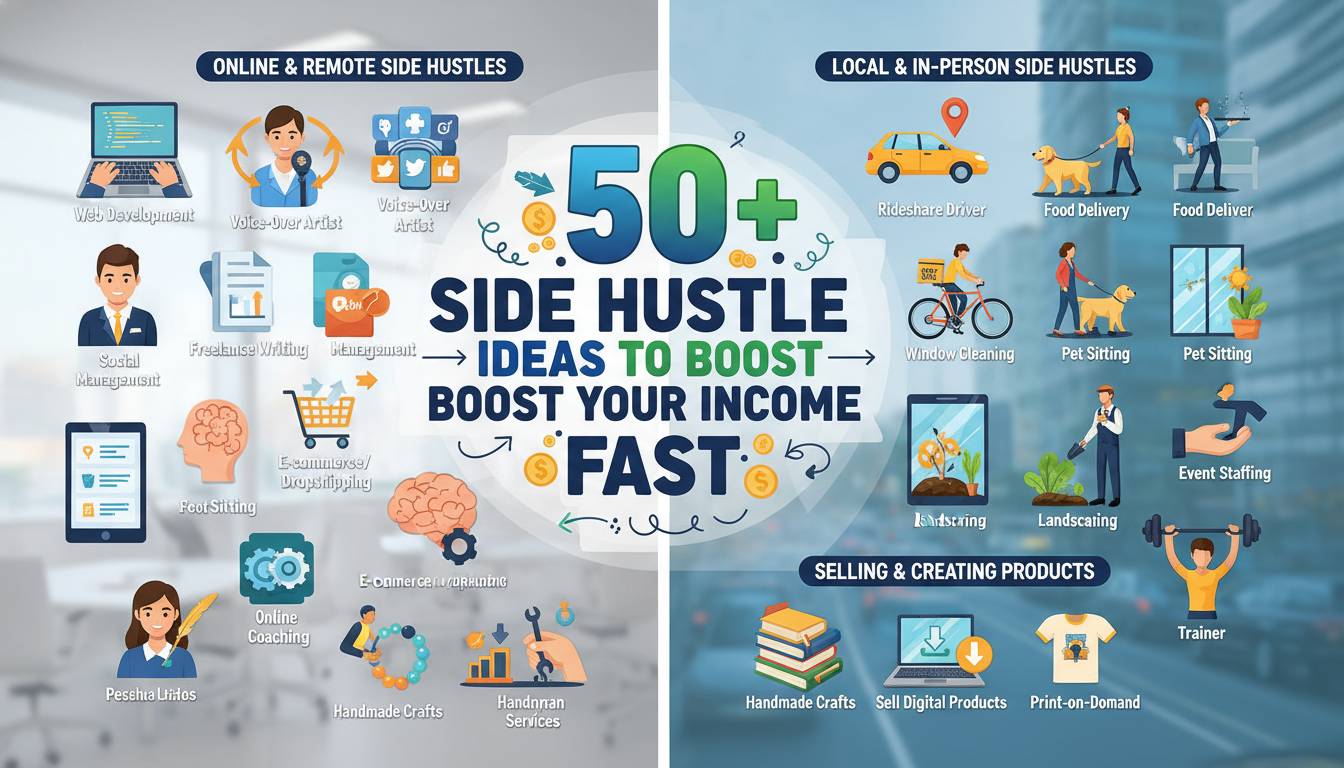
50+ Side Hustle Ideas to Boost Your Income Fast

More than 40% of American workers now have a side hustle, and the average earner brings in an extra $810 per month. Whether you’re saving for a major purchase, paying off debt, or building financial security, a well-chosen side hustle can accelerate your goals without sacrificing your primary income. The key is finding an opportunity that matches your skills, available time, and financial goals.
This guide covers 50+ proven side hustle ideas organized by startup cost, time commitment, and income potential—so you can identify what works best for your situation.
Why Side Hustles Have Become Essential
The economic landscape has shifted dramatically. Housing costs have risen 40% since 2019, student loan payments have resumed, and 58% of Americans report living paycheck to paycheck. A full-time job alone increasingly cannot provide the financial cushion most people need.
Beyond necessity, side hustles offer strategic advantages: skill diversification protects against job loss, additional income accelerates wealth building, and entrepreneurship experience creates long-term career opportunities. Research from Upwork indicates that 73% of freelancers say their side work provides more financial stability than traditional employment.
Side Hustles Under $100 to Start
Digital Services
Freelance Writing
Starting costs: $0 (portfolio website: $12-60/year)
Businesses consistently need blog posts, website copy, email sequences, and white papers. Entry-level writers earn $25-50 per article; experienced copywriters command $500+ for landing pages. Platforms like Contena, ProBlogger, and nDash connect writers with paying clients.
Virtual Assistant Services
Starting costs: $0
Administrative support remains one of the most accessible side hustles. Tasks include email management, calendar scheduling, data entry, and customer service. Rates range from $15-35 per hour, with specialized VAs (social media, bookkeeping) earning $50-100+ hourly. The Virtual Assistant industry is projected to reach $25 billion by 2025.
Online Tutoring
Starting costs: $0-50
If you excel in a subject, tutoring pays $30-80 per hour. Platform tutoring (VIPKid, Wyzant, Tutor.com) handles client acquisition but takes a 15-30% cut. Building your own clientele through local advertising or Craigslist yields higher hourly rates but requires marketing effort.
Transcription
Starting costs: $0
Transcription services pay $15-30 per audio hour for general work, $45-75+ for specialized medical or legal transcription. Rev, TranscribeMe, and GoTranscript offer entry points. Accuracy and speed improve earnings significantly—experienced transcriptionists complete 2-3 hours of audio per hour worked.
Selling Your Stuff
Reselling Thrift Store Finds
Starting costs: $20-50
Flip clothing, furniture, or collectibles from thrift stores to eBay, Poshmark, or Facebook Marketplace. Successful resellers report 200-500% margins on vintage clothing and electronics. The key is understanding what sells: brand names, vintage-condition items, and currently trending aesthetics.
Print on Demand
Starting costs: $25-100
Use platforms like Printful or Redbubble to sell designs on t-shirts, mugs, phone cases, and posters. No inventory required—you only pay when a customer orders. Most sellers earn $20-100/month initially; top performers generate $5,000-10,000 monthly with viral designs.
Dropshipping
Starting costs: $50-200
Run an e-commerce store without holding inventory. When a customer orders, your supplier ships directly. Shopify stores with winning products generate $1,000-10,000 monthly, though 90% fail due to poor product selection and marketing. Success requires understanding Facebook Ads and niche research.
Moderate-Investment Side Hustles ($100-$1,000)
Skill-Based Services
Photography
Starting costs: $300-1,000 (used camera equipment)
Event photography pays $200-500 per gig; portrait sessions run $150-400. Stock photography through Shutterstock and Adobe Stock generates passive income—successful contributors earn $500-5,000 monthly. Wedding photography commands $1,500-5,000 per event but requires significant skill and equipment.
Video Editing
Starting costs: $100-500 (software)
YouTubers, podcasters, and businesses need video editors. Entry-level rates: $25-50/hour. Specialists in YouTube editing or corporate content charge $75-150/hour. Software costs $20-30/month (Adobe Premiere, DaVinci Resolve) with a learning curve of 2-4 months.
Consulting in Your Field
Starting costs: $0-200 (website, business cards)
If you have 5+ years of professional experience, consulting pays $100-500+ per hour. Common niches: marketing, HR, finance, IT, and operations. Building credibility through LinkedIn content and networking accelerates client acquisition.
Teaching and Courses
Online Courses
Starting costs: $0-500
Create once, earn repeatedly. Course creators on Udemy earn an average of $7,000/year; top performers make $100,000+. Topics with high demand: coding, business skills, personal finance, fitness, and exam preparation. Platforms handle hosting and payments; you provide the content.
Coaching
Starting costs: $100-500 (certification, website)
Life coaches charge $50-200/session; business coaches command $150-500/hour. Certification improves credibility (International Coach Federation, Institute of Integrative Nutrition) but isn’t legally required. Building a practice requires marketing and client retention strategies.
Higher-Investment Side Hustles ($1,000+)
Real Estate
Rental Property
Starting costs: $20,000-50,000 (down payment + renovations)
Real estate remains one of the highest-return side hustles. The average rental yields 5-10% annual cash flow plus appreciation. House hacking—renting out rooms or units while living in one—reduces entry costs. Services like Arrived allow fractional investing with as little as $100.
Vacation Rental Management
Starting costs: $5,000-15,000
Manage properties on Airbnb or VRBO for owners who can’t or won’t do it themselves. Typical fees: 10-25% of booking revenue. A well-managed property generates $500-2,000/month per unit. This hustle requires hospitality skills and local market knowledge.
Business Ventures
Local Service Business
Starting costs: $2,000-10,000
Pressure washing, lawn care, house cleaning, or handyman services generate $1,000-5,000 monthly with consistent effort. Equipment costs vary: pressure washer ($500-2,000), lawn care equipment ($1,000-5,000), cleaning supplies ($200-500). Building recurring clients through neighborhood marketing creates stable income.
Food Business
Starting costs: $3,000-15,000
Cottage food laws allow selling baked goods, jams, and prepared foods from home in most states. Food trucks require $30,000-100,000. Farmers markets provide testing grounds with vendor fees of $25-100/day. Successful food entrepreneurs scale to wholesale accounts and retail partnerships.
Low-Time, High-Return Side Hustles
Dividend Investing
Starting costs: $500+
While not technically a hustle, dividend investing provides income with minimal ongoing effort. The average dividend portfolio yields 3-5%. Reinvesting dividends compounds returns—$10,000 invested at 4% yields $400/year, growing to $1,600+ after 15 years with reinvestment.
Renting Assets
Starting costs: $500-5,000
Rent out unused space (storage), vehicles (Turo), equipment (Fat Llama), or parking spots. Turo hosts earn $500-1,000/month per vehicle. Storage units rent for $100-300/month. This approach leverages existing assets rather than trading time for money.
Royalties from Intellectual Property
Starting costs: $0-500
Write a book, record music, or develop an app. Kindle self-publishing requires minimal investment—authors earn 35-70% royalties. Music distributors like DistroKid collect streaming royalties for $12/year. App development requires coding skills but can generate passive income indefinitely.
Side Hustles by Time Commitment
| Time Available | Best Options | Typical Monthly Income |
|---|---|---|
| 5-10 hours/week | Freelance writing, tutoring, transcription, print-on-demand | $200-800 |
| 10-20 hours/week | Virtual assisting, reselling, online courses, photography | $500-2,000 |
| 20-30 hours/week | Consulting, coaching, local services, Airbnb management | $1,500-4,000 |
| Full-time equivalent | Rental properties, food business, agency services | $3,000-10,000+ |
Real Results: Side Hustle Success Stories
Sarah, Marketing Professional → Freelance Copywriter
Started: evenings and weekends
Time to first paying client: 6 weeks
Current monthly income: $3,200 (after 18 months)
Investment: $0
Sarah built her portfolio by offering free work to three local businesses, then raised rates as testimonials accumulated. She now works 15 hours/week evenings while keeping her full-time job.
Marcus, Teacher → Online Course Creator
Started: summer break
Time to first sale: 3 months
Current monthly income: $1,800 passive
Investment: $200
Marcus created a test prep course for his subject area. Initial content creation took 80 hours; updates require 5 hours monthly. Course ratings and word-of-mouth drive organic sales.
Jennifer, Office Worker → Reseller
Started: weekends
Time to consistent sales: 2 months
Current monthly income: $1,100
Investment: $150 initial
Jennifer focuses on vintage designer clothing from Goodwill. She researches brands and sold prices on eBay before purchasing. Her best flip: a $12 thrifted jacket sold for $180.
Getting Started: Your First 30 Days
Week 1: Audit and Plan
List your skills, available time, and resources. Research 3-4 potential side hustles that match your situation. Join relevant Facebook groups or subreddits to understand real earnings and challenges.
Week 2: Setup Essentials
Create necessary accounts (Upwork, Shopify, PayPal). If selling products, source initial inventory. Build a simple website or social media presence. Set realistic income targets.
Week 3-4: Launch and Iterate
Start pitching clients, listing products, or posting content. Track what works and adjust. Expect slow results initially—consistency matters more than intensity.
After 90 Days: Evaluate
Calculate hourly earnings after accounting for all time spent. Compare to alternative opportunities. Either scale what works or pivot to a better-fit option.
Frequently Asked Questions
How much money can I realistically make from a side hustle?
Income varies dramatically by hustle type, effort, and skill level. Most beginners earn $200-800/month working 10-15 hours weekly. With consistent effort over 1-2 years, $1,500-4,000/month is achievable. Top performers in profitable niches (consulting, real estate, e-commerce) generate $5,000-10,000+ monthly.
What’s the easiest side hustle to start quickly?
Virtual assisting, freelance writing, and tutoring have the lowest barriers to entry. These require no investment beyond a computer and internet connection. You can secure first clients within 1-4 weeks using platforms like Upwork, Fiverr, or Wyzant.
Do I need to pay taxes on side hustle income?
Yes. The IRS requires reporting all income over $600 annually on Schedule C if you’re self-employed. You’ll owe self-employment tax (15.3%) plus income tax. Track expenses meticulously—equipment, software, home office portion, and marketing costs reduce taxable income.
Should I tell my employer about my side hustle?
Generally not required unless your employment contract has exclusivity clauses. However, consider: does your side hustle compete with your employer? Could it create a conflict of interest? Many employers allow side businesses as long as they don’t affect primary job performance.
How do I choose between multiple side hustle options?
Match the hustle to your situation: available capital, time commitment, skill level, and income timeline. High-investment options (real estate) yield long-term returns but require capital. Skills-based services (writing, consulting) start quickly with low cost but trade time for money. Choose based on your financial runway and goals.
Final Thoughts
The best side hustle is one you’ll actually do consistently. Start with low-barrier options to test your commitment, then reinvest early earnings into higher-return opportunities as you learn what works. Remember: $500/month extra income covers car payments, student loans, or significant savings acceleration. The path to financial flexibility often begins with a single evening commitment.